🇨🇦 Original
Merci, Larry.1
C’est un plaisir – et un devoir – d’être parmi vous ce soir, en ce moment charnière que le Canada et le monde traversent.
Ce soir, je vous parlerai d’une rupture de l’ordre mondial, de la fin d’une fiction agréable et du début d’une réalité brutale où la géopolitique – et les grandes puissances – ne sont soumises à aucune limite, aucune contrainte.
Par ailleurs, j’aimerais vous dire que les autres pays, en particulier les puissances intermédiaires comme le Canada, ne sont pas impuissants. Ils ont la capacité de construire un nouvel ordre qui intègre nos valeurs, comme le respect des droits de la personne, le développement durable, la solidarité, la souveraineté et l’intégrité territoriale de tous les États.
La puissance des moins puissants commence par l’honnêteté.
🏛️ Translation
§1 Tibi, mi Laurenti, gratias ago maximas. Mihi autem, principes Davi congregati, cum voluptati tum officio est hac nocte vobiscum adesse, eo praesertim tempore cum et Canadae et universi orbis terrarum salus in summo discrimine versetur.
To you, my dear Larry, I give the warmest thanks. And for me, leaders gathered at Davos, it is at once a pleasure and a duty to be here with you this night — and this above all at a time when the welfare both of Canada and of the whole world stands at its utmost crisis.
§2 Dicam autem hodie, principes Davi congregati, ordinem illum orbis terrarum convelli: iucundae scilicet fabulae finem iam adesse, asperae veritatis initium ingruere, cum potentissimi quique nullum sibi finem statuant, nullas leges vereantur, nullum denique vinculum impositum esse arbitrentur.
I shall speak today, leaders gathered at Davos, of how that order of the world is being torn apart: how the end of the pleasant fiction is now at hand, the beginning of the harsh truth bearing down upon us — since the most powerful, one and all, set themselves no limit, revere no laws, and judge, in the end, that no bond whatever has been laid upon them.
§3 Ac tamen, principes Davi congregati, hoc vobis confirmare velim: ceteras civitates, eas praesertim quae mediae sunt potentiae, qualis est Canada, non esse virium expertes. Possunt enim novum condere ordinem, in quo ea contineantur quae nos colimus — iura dico generis humani, perpetuam rerum salutem, concordiam, suam cuiusque civitatis libertatem, finiumque integritatem.
And yet, leaders gathered at Davos, this I should wish to affirm to you: that the other states — and those above all of middling power, such as Canada is — are not devoid of strength. For they can found a new order, one in which are gathered the things we cherish — the rights, I mean, of the human race, the lasting welfare of affairs, concord, the freedom of each several state, and the integrity of borders.
§4 Infirmiorum autem potentia a fide proficiscitur.
But the power of the weaker proceeds from good faith.
💬 Commentary
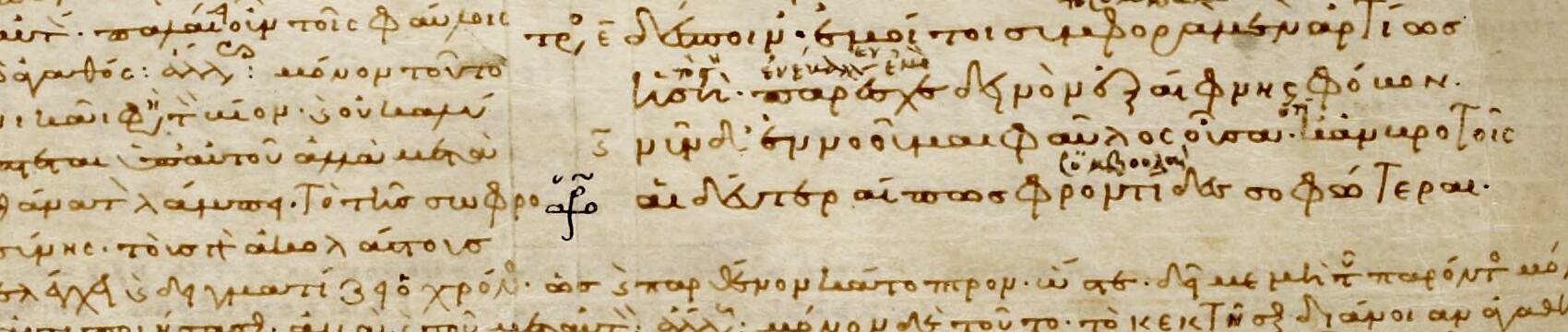
The first-pass commentary on §1 – §4 was written for the Greek rendering of the exordium, not the Latin; in the second pass that Greek rendering was set aside under D1. The Greek text and its first-pass commentary are preserved as a companion piece — see Post I bis2, below.
🤖🧐 Second pass
D1 — The diglossic frame. The structural conceit. Carney’s address is bilingual by delivery: he opens in French, then announces the switch and proceeds in English. Throughout, this translation renders the whole into Demosthenic Greek; here alone, the French exordium is given in Ciceronian Latin, and the change of language at §5 marks the point at which Carney himself changed his. The mapping is Latin : Greek :: French : English. It is defensible on three grounds:
- Pair-of-summits tradition. Cicero is the recognized Latin counterpart to Demosthenes — the two have been treated as the twin summits of ancient oratory since Plutarch paired their Lives, and the reader steeped in that tradition will hear the seam as a passage from the Roman, adapted, courtly school to the Greek, original, austere one.
- Historically-real dependence. Roman eloquence is a conscious adaptation of Greek models — Cicero studied under Greek masters — much as English prose is entangled with French; the diglossia therefore has a genuine shape rather than a merely ornamental one.
- Register-match in the exordial position. Cicero’s exordial manner — the periodic captatio3, the discrimen of the public moment — is itself the natural Latin setting for a gracious, faintly formal opening, exactly the register Carney’s French occupies before he turns plain.
The surface effect is undeniably theatrical; the underlying logic is not.
§1. The double dative and the audience. Cum voluptati tum officio est renders “both a pleasure and a duty” with the double dative (dative of effect and of person) under the cum… tum correlative — an idiom thoroughly Ciceronian and one English cannot reproduce without two abstract nouns. In summo discrimine versetur carries “pivotal moment”: discrimen is Cicero’s standing word for the political turning-point, and versari in the standing idiom for being caught up in a condition. Mi Laurenti matches the warmth of the corresponding Greek vocative and is in the register of Cicero’s letters (mi Attice). The first-pass Latin reading viri principes (“leading men”) was a deliberate, slightly loaded choice in place of an institutional address — Cicero’s patres conscripti, Quirites, iudices would all misfit a forum of this kind. Under D8 it was replaced by principes Davi congregati; see the D8 note below.
§2. The tricolon4 of lawlessness. Latin matches the Greek tricolon — they set no limit, revere no law, see no bond upon themselves — almost one to one under a cum-clause with anaphora5: nullum… nullas… nullum, capped by denique, the particle that signals the closing and heaviest member of a Ciceronian series. Convelli (“is being torn apart”) is Cicero’s verb for the violent dissolution of political order (fundamenta rei publicae convellere); ingruere (“bears down upon”) is the verb of war and calamity assailing — vivid where the English “beginning of a harsh reality” is flat. The governing antithesis iucundae fabulae finem … asperae veritatis initium sets finis against initium, iucundus against asper, fabula against veritas: three oppositions in a single balanced limb, which is concinnity of the kind Cicero builds his periods from.
§3. Litotes and the foundational verb. “Are not powerless” becomes non esse virium expertes — “not devoid of strength” — a litotes6 that mirrors the Greek litotes οὐκ ἄμοιρα δυνάμεως and is squarely in Cicero’s manner. “Build a new order” is novum condere ordinem: condere is the Roman foundational verb (condere urbem, condere rem publicam), and it dignifies the act in a way “build” does not. The list of values is rendered to recur with the body of the speech: quae nos colimus (“the things we cherish”) is the standing Latin equivalent of the Greek τὰ τιμώμενα; concordia is the exact Latin of ὁμόνοια and Cicero’s central political ideal (concordia ordinum); suam cuiusque civitatis libertatem carries αὐτονομία; and finium integritas is very nearly a calque of ἡ τῶν ὅρων ἀκεραιότης. “Sustainable development,” resistant in Greek, is resistant here too and is again handled by paraphrase: perpetuam rerum salutem, “the lasting welfare of affairs.”
D2 — §4, fides not veritas. The aphorism closing the exordium renders Carney’s “honesty” not with veritas but with fides. The choice is interpretive and deliberate. In the speech’s governing logic — Havel’s: that a system endures by everyone’s performing what they privately disbelieve, and cracks when one person stops — “honesty” does not mean accuracy of statement but refusal of pretense: being what one appears to be, keeping faith with the truth of one’s situation. That is the semantic field of fides (good faith, trustworthiness, the bond of one’s word), not of veritas (truth as correspondence).
The rendering also carries a Ciceronian resonance comparable to the Demosthenic windfalls7 noted later in the speech: De Officiis 1.23 founds justice itself upon fides — fundamentum autem est iustitiae fides — so to make the power of the weak proceed a fide sets the line, for any reader who knows the De Officiis, in Cicero’s own register of deriving the binding political thing from its root virtue, reinforced by the proficisci a construction by which Cicero habitually traces an obligation to its source.
Veritas was retained only as a possible fallback; simplicitas (frankness, absence of duplicity) was a lighter alternative if the commercial overtone of fides (which also denotes financial credit) had been judged a distraction rather than, given the speech’s later themes of economic coercion, a faint felicity.
The structural consequence is the substantive point: fides in §4 leaves the truth-keyword unspent, so that ἀλήθεια makes its weight-bearing entrance where it should — within the Greek, at §13 – §14, in the Havel movement — and not in a prefatory Latin sentence that the speech, on its author’s own showing, treats as standing before the argument rather than within it.
D8 (Latin row) — the inclusive vocative. Viri principes is replaced by principes Davi congregati — Davi as locative singular of 2nd-decl. Davus, parallel to Romae, Athenis; congregati the Latin equivalent of συνελθόντες. The Greek anchor’s ἄνδρες τε καὶ γυναῖκες is not reproduced compactly in Latin without bulk, but principes alone covers leaders of either sex by the same classical convention that the Greek explicitly dispatches with the doubled vocative. The two languages arrive at compatible inclusivity by different routes.
Footnotes
Larry is Larry Fink, founder, chairman, and chief executive of BlackRock — the world’s largest asset-management firm — and a long-standing fixture on the Davos circuit. At the WEF plenary at which this speech was delivered, Fink was the moderator who introduced Carney; Carney’s opening Merci, Larry is the direct address back to him before turning to the wider room. Mi Laurenti, the Latin equivalent used in the rendered exordium under D1, preserves the warmth of personal address in the register of Cicero’s letters (mi Attice, etc.) — see the first-pass note at §1 below.↩︎
bis, ter, quater — Latin enumerative adverbs (“a second time”, “a third time”, “a fourth time”), the classicising convention for marking numbered subsidiary items: a section 1 plus later additions becomes 1, 1 bis, 1 ter, 1 quater — equivalent to the modern 1A / 1B / 1C scheme. Standing in classical philology, mediaeval scholastic editions, and modern Continental scholarly apparatus.↩︎
Captatio is short for captatio benevolentiae, “the catching of goodwill” — the rhetorical move at the start of an ancient speech in which the orator explicitly bids for the audience’s favourable disposition before launching into the argument. Cicero and Quintilian both treat it as a standard opening move in forensic and political oratory: praise the audience, name the importance of the occasion, profess one’s own inadequacy or earnestness. The flatter modern equivalent is “thank you for having me, this is an important moment, I’ll try to do justice to it” — which is exactly what Carney’s French exordium does.↩︎
Tricolon is the rhetorical figure of three matched limbs in succession — three parallel parts of a single sentence given equal grammatical weight. Classical orators reach for it constantly because three is the smallest number that establishes a pattern (one is incidental, two is a pair, three is a rhythm), and because Greek and Latin grammar make it easy to balance the three members exactly. Cicero’s veni, vidi, vici is the textbook example; Lincoln’s of the people, by the people, for the people is the same figure in English. The §2 tricolon they set no limit, revere no law, see no bond upon themselves matches the Greek οὔτε ὅρον τιθέασιν, οὔτε νόμον αἰδοῦνται, οὔθ’ ἑαυτοῖς δεσμὸν… οὐδένα ὁρῶσιν limb for limb.↩︎
Anaphora is the rhetorical figure of repeating an opening word (or short phrase) at the head of successive clauses, so the repetition itself becomes the rhythmic frame of the period. Nullum… nullas… nullum in the Latin §2 — no limit… no laws… no bond — is anaphora reinforcing the tricolon, the same word at the head of each member doing the work of binding the three together. Churchill’s we shall fight on the beaches, we shall fight on the landing grounds is the same figure in English.↩︎
Litotes is the figure of understatement by double negation, where not weak serves for strong with a faint extra emphasis that the plain positive lacks. The figure is heavily used in classical Greek and Latin oratory because the double negative invites the listener to draw the positive conclusion themselves, which lands harder than the orator delivering it. Greek οὐκ ἄμοιρα δυνάμεως (“not devoid of strength”) and Latin non esse virium expertes (“not devoid of strength”) are mirror-image litotes carrying the same rhetorical lift; English not bad and no small task preserve the figure colloquially.↩︎
Demosthenic windfall [editorial coinage of this commentary] — the term-of-art this commentary uses for places where the Greek vocabulary loaded an editorial meaning that the modern author could not have known he was buying. Not an established philological term; coined for this rendering to name the phenomenon. Standing examples:
- προμηθεῖσθαι for risk management in §30 — Demosthenes’ own scolding-word to Athens, so the line lands as the Demosthenic refrain itself rather than as bland translation.
- ὑποτέλεια for subordination in §55 — the technical Delian-League term for tribute-paying subjection, so the line activates the Athenian-empire history Carney could not have intended.
- ἡγεμονία for hegemony in §17 — already carries its Delian-League ambiguity, so “American hegemony” reads as half a critique in the Greek.
The windfalls are the moments where translating into a load-bearing classical vocabulary adds an editorial layer Carney could not have known he was buying. They are not deliberate authorial choices; they are gifts of the target language.↩︎