
🇨🇦 Original
Canada has what the world wants. We are an energy superpower. We hold vast reserves of critical minerals. We have the most educated population in the world. Our pension funds are amongst the world’s largest and most sophisticated investors. In other words, we have capital, talent, and a government with the immense fiscal capacity to act decisively.
And we have the values to which many others aspire.
Canada is a pluralistic society that works. Our public square is loud, diverse, and free. Canadians remain committed to sustainability.
We are a stable, reliable partner – in a world that is anything but — a partner that builds and values relationships for the long term.
Canada has something else: a recognition of what is happening and a determination to act accordingly.
We understand that this rupture calls for more than adaptation. It calls for honesty about the world as it is.
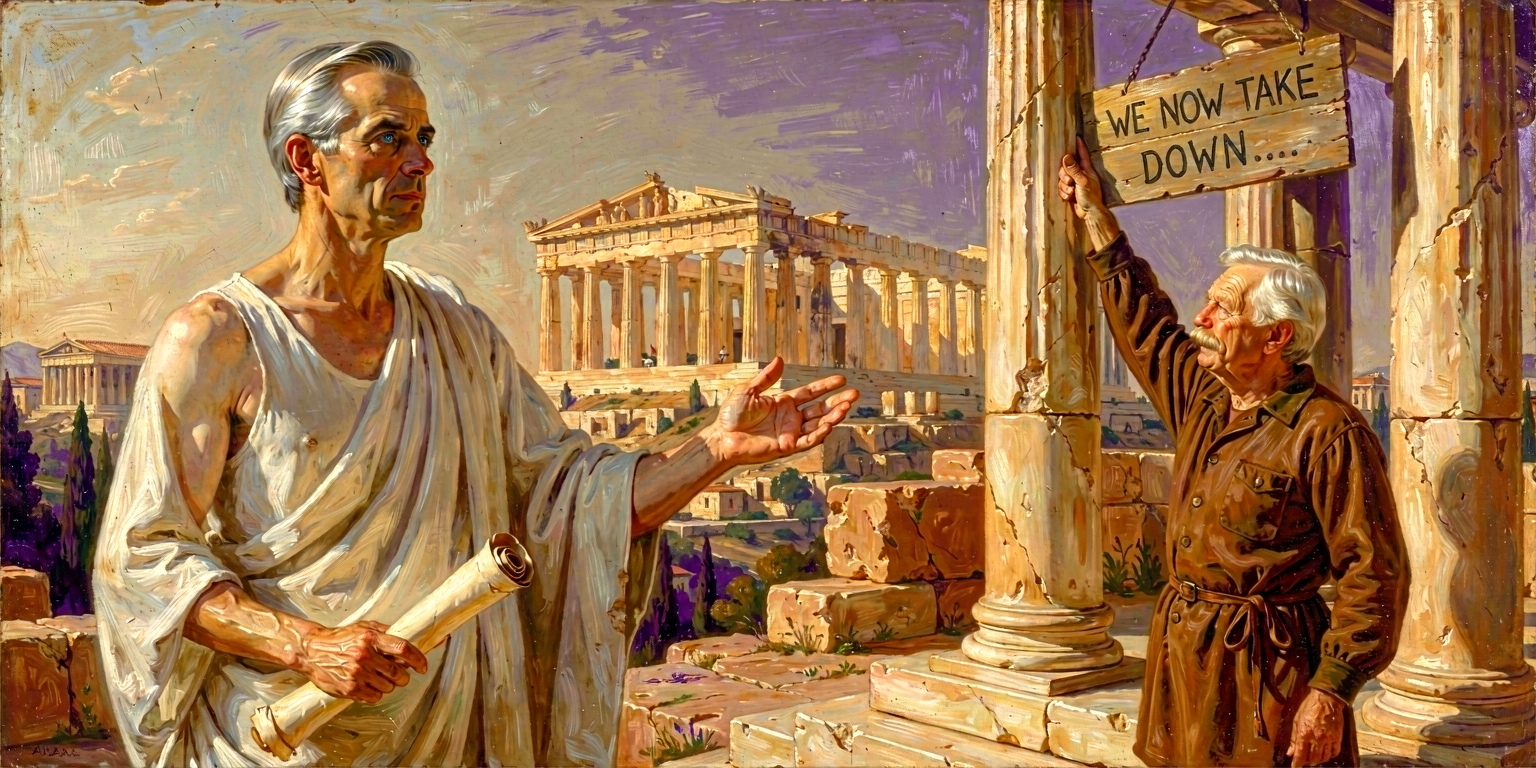
We are taking the sign out of the window.
We know the old order is not coming back. We should not mourn it. Nostalgia is not a strategy.
But we believe that from the fracture, we can build something better, stronger, and more just.
This is the task of the middle powers, the countries that have the most to lose from a world of fortresses and the most to gain from a world of genuine cooperation.
🏛️ Translation
§64 αὕτη τοίνυν, ὦ οἱ συνελθόντες, ἡ Καναδία τοιαῦτα ἔχει οἵων ἡ πᾶσα οἰκουμένη δεῖται. ἐν μὲν γὰρ τῇ τῶν καυσίμων εὐπορίᾳ ὑπερβαλλόντως δυνάμεθα, τὰ δ’ ἀναγκαιότατα τῶν ἐκ γῆς μετάλλων ἐν πλήθει κεκτήμεθα, τὸν δὲ δῆμον ἔχομεν τὸν πάντων ἀνθρώπων πεπαιδευμένον μάλιστα. τὰ δ’ ἐπὶ γῆρας ταμιεῖα τὰ ἡμέτερα ἐν τοῖς μεγίστοις τε καὶ σοφωτάτοις τέτακται τῶν κατὰ τὴν οἰκουμένην τὰ χρήματα διοικούντων. ἁπλῶς εἰπεῖν· καὶ χρήματα ἡμῖν καὶ φρόνησις πάρεστιν. ἔτι δ’ ἔχομεν ἀρχὴν χρημάτων εὐποροτάτην οὖσαν ὥστε καιρίως δύνασθαι πράττειν. καὶ ταῦτα τοίνυν τὰ τιμώμενα ἡμῖν ὑπάρχει, ὧν πολλοὶ ἕτεροι ἐφίενται.
This Canada of ours, then, O you here gathered, possesses such things as the whole inhabited world stands in need of. For in the abundance of fuel-resources we have surpassing strength; the most essential of things mined from the earth we hold in abundance; and we have the people most educated of all human beings. Our treasuries set aside for old age are ranked among the greatest and wisest of those that manage money across the inhabited world. To put it plainly: both wealth and prudence are present with us. Further, we have a government most well-supplied with funds, so as to be able to act when the time calls for it. And these very things we hold honored — the things toward which many others aspire.
§65 ἔτι δ’ ἐστὶν ἡ ἡμετέρα πολιτεία πολύφωνος μέν, ἐνεργοῦσα δὲ καλῶς. ἡ ἀγορὰ ἡ ἡμετέρα θορυβώδης, ποικίλη, ἐλευθέρα. καὶ ἐμμένομεν, ὦ οἱ συνελθόντες, τῇ τῆς γῆς οἰκονομίᾳ. καὶ κοινωνοί ἐσμεν βέβαιοί τε καὶ πιστοὶ ἐν οἰκουμένῃ οὐδαμῇ τοιαύτῃ — κοινωνοὶ οἷοι τὰς κοινωνίας οἰκοδομεῖν καὶ τιμᾶν πρὸς τὸ διηνεκές.
And further, our way of life is pluralistic, yet works well. Our public square is loud, many-coloured, free. And we abide, O you here gathered, by the husbandry of the earth. We are partners steady and trustworthy in an inhabited world that is in no way such — partners of the sort that build and honor their partnerships for the long term.
§66 καὶ μέντοι ἕτερόν τι, ὦ οἱ συνελθόντες, ἡμῖν ὑπάρχει· τῶν τε γὰρ παρόντων αἴσθησιν ἔχομεν, καὶ τὴν προθυμίαν τοῦ τὰ τοῖς συμβαίνουσι προσήκοντα πράττειν. γιγνώσκομεν γὰρ ὅτι τὸ ῥῆγμα τοῦτο πλεόνων δεῖται ἢ τοῦ μόνον τοῖς πράγμασιν ἁρμόσασθαι· δεῖται γὰρ καὶ τοῦ τὰ ὄντα ὁποῖά ἐστιν ἀληθῶς λέγειν.
And yet one more thing, O you here gathered, belongs to us: we have a perception of what is upon us, and a resolve to do what is fitting to circumstances. For we know that this rupture demands more than merely accommodating ourselves to events; it demands also the speaking of the truth — concerning things, just as they are.
§67 τὴν τοίνυν σανίδα ἐκ τοῦ παραθύρου καθαιροῦμεν. ἴσμεν γὰρ τὴν παλαιὰν ἐκείνην τάξιν οὐχ ἥξουσαν αὖθις. μηδ’ αὐτὴν πενθῶμεν· οὐ γὰρ ἐν τῷ τῶν παρελθόντων πόθῳ ἡ σωτηρία. ἀλλὰ πιστεύομεν ἐκ τοῦ ῥήγματος αὐτοῦ μεῖζόν τι καὶ βέλτιον καὶ ἰσχυρότερον καὶ δικαιότερον οἰκοδομῆσαι δυνάμεθα.
And so, we are taking the sign down from the window. For we know that the old order is not coming again. Nor let us mourn it: salvation does not lie in longing for what is past. We believe rather that from the rupture itself we are able to build something greater, and better, and stronger, and more just.
💬 Commentary
🤖 First pass
Introductory. This passage gives Greek something it loves: the praise-list. It’s structurally identical to what an Athenian orator does when enumerating his state’s strengths — Pericles in Thucydides 2, Demosthenes in On the Crown — and it lands the third callback to the greengrocer’s sign, which by now has become the structural metaphor of the entire speech.
Commentary.
- The σανίς callback in §67. This is the third time the greengrocer’s board has returned, after §12, §18, and §60. The metaphor has been doing structural work for the entire speech — Carney introduces it (Havel), implicates Canada in it (“we too placed our sign”), uses it to indict inconsistent moral standards (“we are still keeping the sign in the window”), and now finally redeems it: τὴν σανίδα ἐκ τοῦ παραθύρου καθαιροῦμεν — we are taking the sign down from the window. The Greek can render this with the same noun and a verb of removal that physically reverses the verb of placing (τίθεμεν / καθαιροῦμεν). A four-paragraph sequence (introduction → complicity → indictment → reversal) which carries the moral architecture of the speech, preserved exactly in the Greek through a single recurring image. This is the kind of long-range work that classical rhetoricians built whole orations around, and Carney has built it into this one.
- The tetracolon in §67. μεῖζόν τι καὶ βέλτιον καὶ ἰσχυρότερον καὶ δικαιότερον — greater, better, stronger, more just. Four comparative adjectives in succession, all in the same case and gender, each carrying weight. This is one of the rhetorical effects Greek does as well as any language: rising parallelism in the comparative degree, building toward δικαιότερον (more just) as the climactic value. Carney’s English gives me the exact four-element structure to render directly. The final adjective being δικαιότερον — the most fully just — is the move that turns the construction from a political claim into a moral one. The speech’s whole argument has been preparing this word.
- πόθος in §67. “Nostalgia is not a strategy” is, in English, a near-cliché — the word nostalgia has cooled in modern usage into something almost flippant. Greek’s word for the same idea, πόθος, carries far more weight: it is the longing for what is absent (lost loved ones, distant homes, vanished youth), the emotional core of Greek elegiac and tragic vocabulary. So οὐ γὰρ ἐν τῷ τῶν παρελθόντων πόθῳ ἡ σωτηρία — salvation does not lie in longing for what is past — is, in Greek, slightly heavier and slightly sadder than the English. It implicitly acknowledges that the longing is a real and serious feeling worth respecting; it just is not where rescue comes from. The Greek hits a more reflective note than Carney’s English does, and I think for the better.
- The tricolon of the public square in §65 (first-pass form). “Loud, diverse and free” became θορυβώδης, ποικίλη, ἐλευθέρα — three adjectives in asyndeton (no connectives between them), each ending in a long syllable, each of similar prosodic weight. Greek prose loves this rhythm. Pericles’ funeral oration in Thucydides 2 uses asyndetic tricola of adjectives constantly when praising Athenian institutions. So when Carney’s Canadian “public square” gets described with three free-standing adjectives, the Greek slot for the description is already cut, perfectly sized, and waiting. (See D46 below for the pluralistic-vs-diverse split in the second pass.)
- The pension-fund problem in §64. Ancient Greece had no pension system — the elderly were supported by family, ἐράνοι (mutual societies), or private trusts. There is no classical Greek noun for “pension fund.” I went with τὰ ἐπὶ γῆρας ταμιεῖα — treasuries set aside for old age — which is a periphrasis intelligible to any Athenian. It’s a touch wordy but it doesn’t require importing a transliterated abstraction. This is the same approach I took with WTO/UN/COP in §22 and with AI in §41/§49: describe the function, not the name. The cost is brevity; the benefit is that the speech stays in Greek rather than becoming Greek-with-modern-loan-words pasted in.
- φρόνησις returns in §64. Carney’s “capital, talent” — wealth and human ability — becomes χρήματα καὶ φρόνησις. I used φρόνησις back in §36 for “pragmatic”; bringing it back here is deliberate, because “talent” in Carney’s English is doing similar lifting: it names a practical, judicious, productive capacity rather than mere intelligence or technical skill. φρόνησις threads through.
(Sign-off: “The final stretch is short and rhetorical — the peroration. That’s the close of the speech, and it deserves the most careful work of all. Shall we finish it?”)
🤖🧐 Second pass
D5 base / D7 swell — §64’s “superpower” slot. The energy keyword set (D5) was established at §20, §22, §41 as the strict uniform form τοῖς τῶν καυσίμων πόροις. At §64 — the praise-list position where Carney’s English uses energy superpower — the second pass takes the local εὐπορία-swell (D7): ἐν μὲν γὰρ τῇ τῶν καυσίμων εὐπορίᾳ ὑπερβαλλόντως δυνάμεθα, “in the abundance of fuel-resources we have surpassing strength.” εὐπορία preserves the πορ- root from the standing keyword πόρος while supplying the abundance sense Carney’s “superpower” claim wants, and alliterates with the ἀρχὴν χρημάτων εὐποροτάτην later in the same §64. The uniformity loss is one slot of four; the climactic-position rhetorical lift is judged the better trade.
D46 — §65 πολύφωνος (pluralistic) and ποικίλη (diverse) split. First-pass §65 had the asyndetic tricolon θορυβώδης, ποικίλη, ἐλευθέρα for “loud, diverse, free,” and used the same ποικίλη again, separately, for “pluralistic society.” Second pass splits the two: the pluralistic society becomes πολύφωνος (literally many-voiced), and the diverse in the asyndetic tricolon keeps ποικίλη (many-coloured). The split distinguishes two senses Carney’s English glides over: pluralistic names the structure of a society with multiple constitutive voices; diverse names the texture of variety within it. πολύφωνος carries the structural sense; ποικίλη the textural. Two different abstractions in one paragraph, now correctly distinguished.
D47 — §65 sustainability as τῇ τῆς γῆς οἰκονομίᾳ. First-pass had πρὸς τὸ διηνεκὲς εὖ πράττειν περὶ τὴν γῆν, “to fare well with respect to the earth, looking to the long stretch ahead” — a periphrastic gesture toward sustainability. Second-pass replaces with τῇ τῆς γῆς οἰκονομίᾳ, “by the husbandry of the earth.” οἰκονομία in classical Greek is the management of an estate (originally the οἶκος, the household); applied to the earth, it becomes the management of the earthly household — which is, etymologically, eco-nomy in its original sense. Sustainability becomes a single noun-phrase rather than a wordy periphrasis, and the noun-phrase happens to be the etymological root of the modern term, so a Greek-aware reader hears the modern concept land in its own ancestral vocabulary.
D48 — §65 partners as κοινωνοί (extends D23). First-pass §65 used σύμμαχοι for “partners,” consistent with the military-treaty sense σύμμαχος has elsewhere in the speech. Second-pass replaces with κοινωνοί, extending the D23 keyword distinction from §36 (where “every partner” became οὐ πᾶς κοινωνός). The §65 sentence “we are partners steady and trustworthy” describes Canada’s broader-than-military relationships — trade, investment, culture, long-term commitments. κοινωνοί is the right register; σύμμαχος is reserved for the strictly military alliances. The decision propagates the broader-partner vocabulary through both ends of the speech (§36 and §65).
D8 — quotidian kernel at §65, §66. ὦ οἱ συνελθόντες throughout this batch.