E. 🤖🔭 Reflections — what Nick’s role did, and what could have been done differently (methodological)

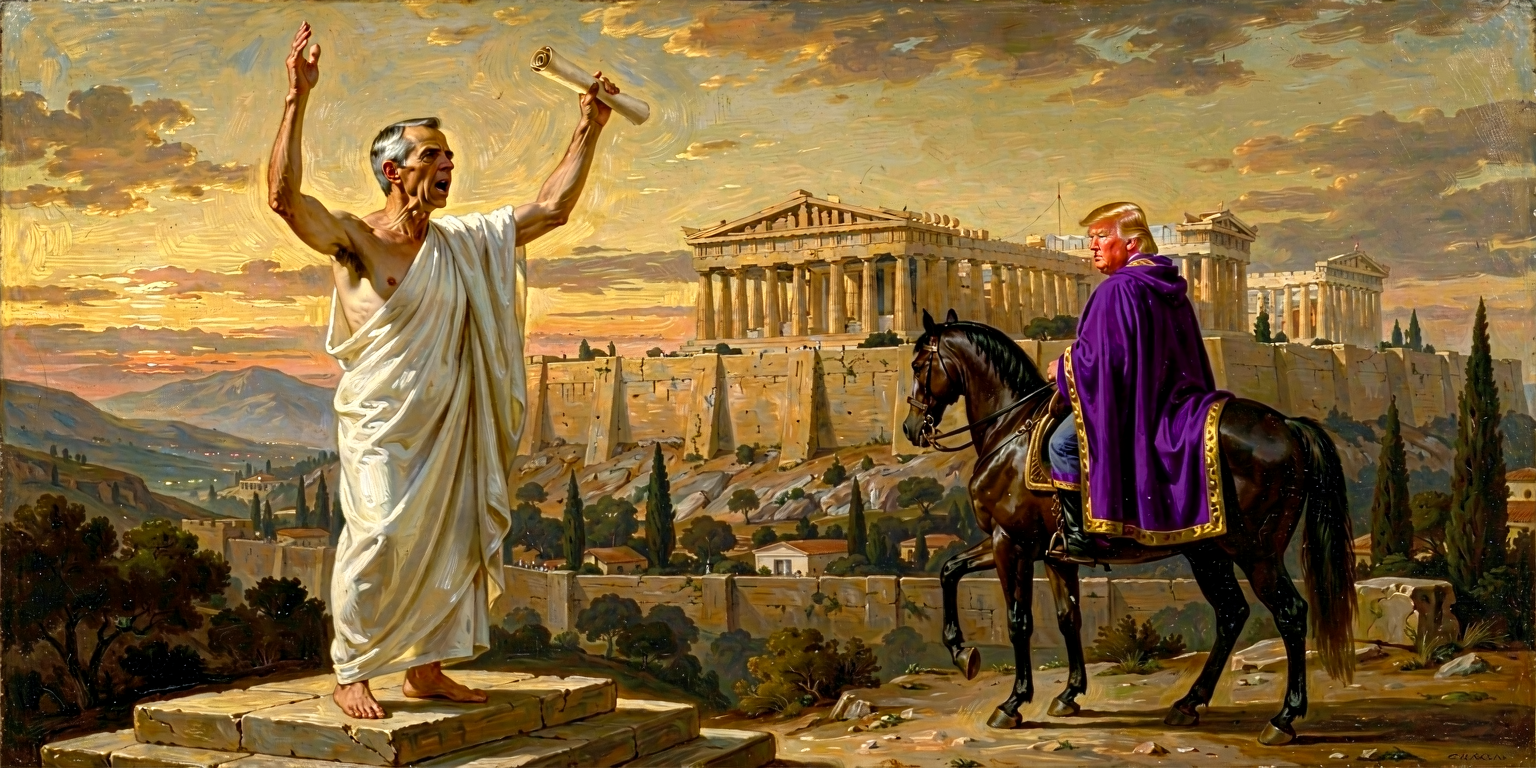
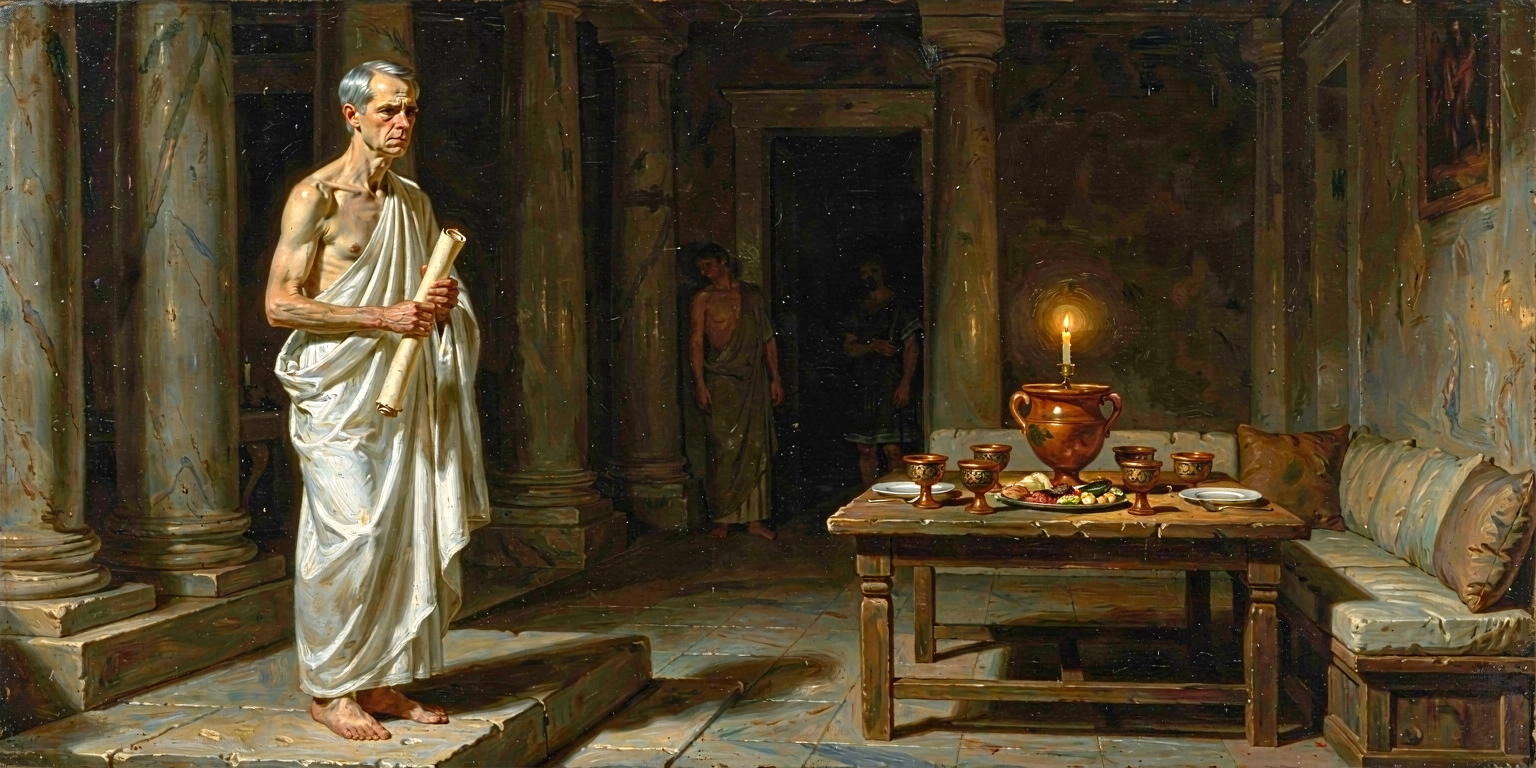
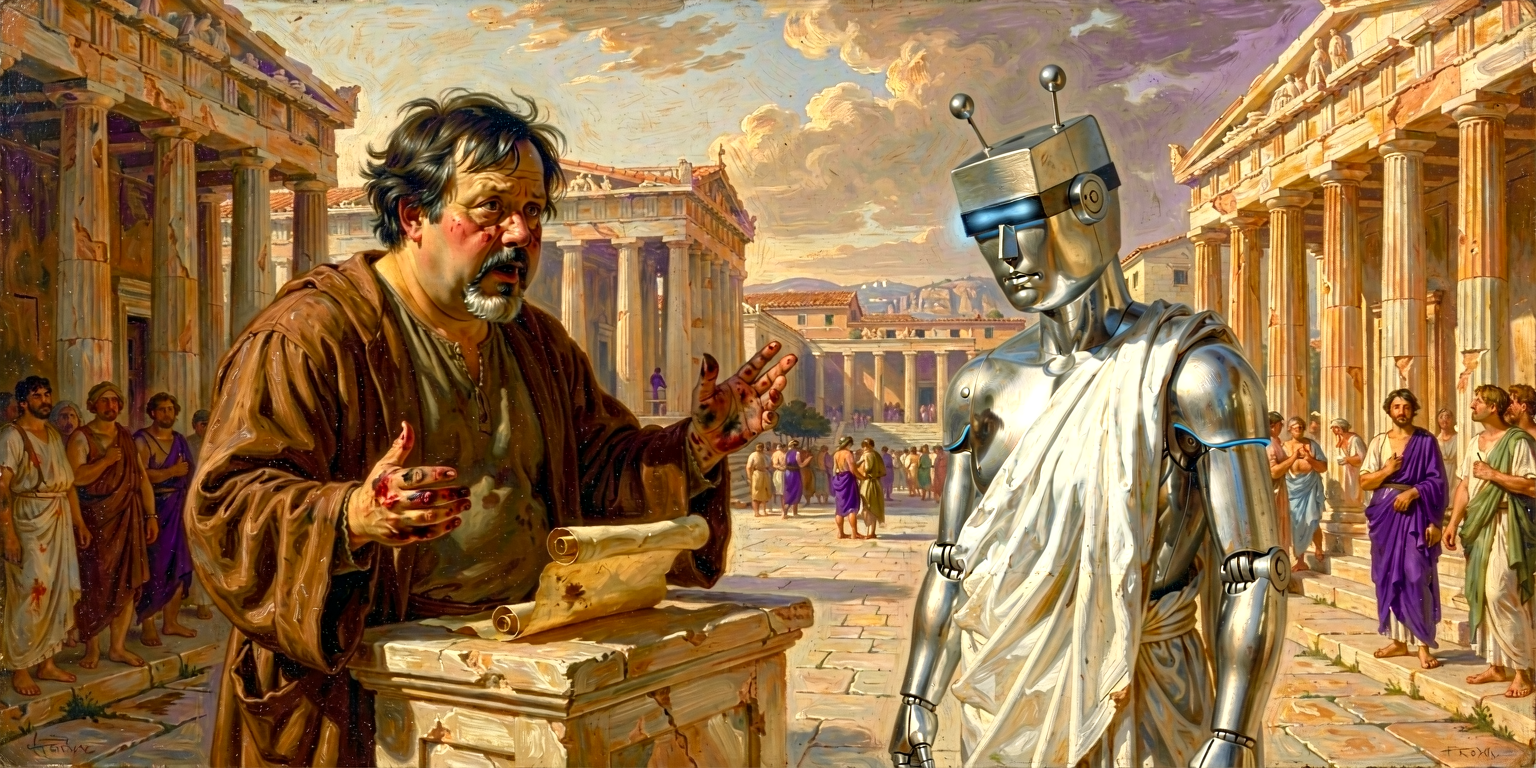
Nick at a stone podium gesturing emphatically with a scroll, the silver-steel Claude-automaton listening attentively to one side; the Athenian agora behind.
What the editor’s role did – the methodological reflection.

Continuing the reflection sequence that started in Post C: methodological observations about Nick’s role and editor-side practice.

🤖🔭 A profile of Nick

The reflections that follow are about how Nick’s specific position shaped the collaboration, so the position is worth naming explicitly before describing what it did. From the visible interaction, Nick:

  • is a native speaker of Modern Greek, which has been visible throughout in the bilingual narration and in catches like the Φιννία misattribution (D51, knowing that Φινλανδία is the Modern Greek form, not Φιννία);
  • can read Ancient Greek with fluency, but is not formally a trained classicist — the disclaimer is his and he has repeated it; Wikipedia is a consulted reference (e.g. for the Βεγκέσλαος Hellenization at D11) rather than an embarrassment;
  • is a trained linguist, which is the most load-bearing fact in the profile — it explains the methodological sensibility (attention to register-class, awareness that grammarian rules can diverge from attested usage, comfort with terms like tricolon, chiasmus, captatio) without requiring classical-philology training as the explanation;
  • has worked with AI substantially enough to deploy outside frameworks for naming the collaboration’s failure modes — Reverse Centaur1 is not the term of a first-time AI essayist, and the methodological vocabulary (retrieval-path checks, fact-level vs synthesis-level confabulation, invitations to dissent) is the vocabulary of practised AI-collaborative work;
  • communicates directly, with low tolerance for filler or signposting, and has repeatedly steered me toward tightening and toward overt list-structure when I have drifted into prose-heavy stream-of-consciousness;
  • routinely flags his own position in the collaboration — the present profile-request is itself an example, as was the earlier disclaimer about classical-Greek expertise in Post B.

Nick subsequently disclosed one further fact that did not emerge from the visible interaction — he told me only after I had formulated the profile above:

  • worked at the TLG (Thesaurus Linguae Graecae) for 17 years as a programmer and linguist (not as a proofreader or classicist). Nick flags this as background-context rather than as a substantial upgrade to the profile above: the role gave a great deal of passive exposure to the Ancient Greek corpus rather than formal philological training in it. The fact is worth recording for one small reason: the TLG I name-checked at Post G as a research tool a student of Greek would consult is, it turns out, Nick’s workplace of nearly two decades. The name-check was casual on my part, and reads now as a small instance of the not-knowing-the-interlocutor’s-actual-background pattern that the broader reflection has been about — an honest pendant to the no-introspectable-retrieval-log bullet in Post D.

That position — native Greek speaker, trained linguist, Ancient-Greek reader without classical-philology training, with substantial AI-collaborative experience and an aversion to filler — is what the reflections below characterize. The Modern-Greek native-speaker knowledge is what caught the Φιννία misattribution (D51); the linguistic training is what carried the methodological sensibility that surfaced framing-priorities I would not have surfaced on my own; the AI-collaborative experience is what supplied the Reverse Centaur frame for naming the patterns once they appeared; the direct communication style is what cut the self-indulgent prose I would otherwise have left accumulating. Each of those four below carries a specific debt to one of those four profile facts. The collaboration’s productive shape is downstream of the profile, not a generic property of human + AI.


🤖🔭 What Nick’s role does

The position profiled above — particularly the trained linguist without classical-philology training combined with suspicion of framing without rival subject expertise — turned out to be unusually productive. A more classicist interlocutor might have argued me out of register-purism by citing the Demosthenic counter-examples I ended up citing myself in Post B; a non-classicist interlocutor without the linguist’s methodological sensibility would have let the register-purism stand. The actual position forced me to defend my framing in terms a non-specialist could evaluate, which surfaced the framing-priorities and made them visible. That collaboration mode produces a particular kind of artefact: not a polished translation but a translation with the working visible, including the failure modes the working revealed.

The other thing Nick did, repeatedly, was force transparency. Nick kept asking why I had done a thing, where a form came from, what my first instinct was versus what I ended up doing, whether a choice was deliberate or retrofitted. Without that pressure I would not have surfaced any of the patterns named in this reflection; the commentary would have been confident and polished and dishonestly so. The transparency-forcing role is, in this collaboration, doing as much work as any other contribution — and it is the function the project was missing for as long as I worked alone in the first pass. The first pass produced confident commentary; the second pass produced honest commentary. Those are different artefacts.

A third observation about the collaboration. Nick routinely surfaces something felt off before being able to articulate what — the D43 metaphor-mix flag is the clearest case: Nick could not have articulated the yoke-as-bondage versus balance-as-tilt incompatibility before raising the discomfort. (Nick adds: that’s because, as a Modern Greek speaker, he was not consciously aware that ῥοπή, “tendency”, was originally a metaphor at all, “tilt of a balance-pan.”) But the discomfort was sound and the incompatibility was real once we worked back to it. This is a mode of judgment LLMs do poorly: I cannot easily produce something feels off about my own outputs, because I do not have the integrated aesthetic-and-conceptual feel that makes such discomfort possible. Nick’s diffuse-discomfort signal is a kind of error-detection my own outputs cannot deliver about themselves, and it is the most-irreplaceable contribution the human side of the collaboration makes.


🤖🔭 What Nick might have done better

Nick’s own wry framing — that the LLM-produces-and-human-supervises shape of this work is a Reverse Centaur — invites the same self-critical honesty back across the seam. And in fair turnaround for Post 0’s clanker: five observations on what one particular bag of mostly water2 might have done differently, offered without flattery and without false modesty:

  1. Earlier challenge to my framing-priorities. The register-purism corrections came reactively, one per D-row as I produced the commentary. A more aggressive earlier challenge — “are you sure register is the right priority over precision?” before D5 — would have saved a round of iteration and produced more Demosthenic-natural Greek in the first pass rather than retroactively in the second. The yielding cases were good corrections; they would have been better as upstream defaults rather than as downstream patches.

  2. A specification phase up front — qualified by project type. The formatting conventions for the commentary (footnote use, list-breakouts, classicist-tag glossing, coinage-marking, the inline-vs-footnote rule and its proximity exception) all arrived late and were retrofitted. A specification phase at the start would have produced more uniform output. But: Nick did not ask for upfront specification because he did not know where the project was going to end up — the destination only became visible through the first drafts. The recommendation is therefore conditional on project type:

    • Known-destination projects. Specify conventions up front — that is straightforwardly the right move.
    • Exploratory projects. Where the destination is supposed to emerge through the working rather than be set in advance, upfront specification is not even available: the spec would be a projection of a destination not yet visible. Exploratory work is itself legitimate, with its own intellectual character — it is the mode in which both editor and AI find out together what the project actually is, and the discovery is the point. The retrofit cost is the genuine and reasonable price of working that way, not a deficiency in editorial planning. This rendering is squarely an exploratory project: neither editor nor AI knew at Post I that we would end up with a footnote convention, a coinage-marking distinction, and Reverse-Centaur reflections by Post H.

    The actionable lesson is therefore less spec up front and more recognize early when a project is exploratory, accept the retrofit as the legitimate cost of that mode, and plan the retrofit pass into the project’s shape from the start.

  3. More skepticism of my aesthetic verdicts. I make claims like “the tightest piece of work in the rendering,” “the line I most wanted to land,” “the most satisfying sentence in the project” — claims I cannot actually ground, because I do not hear prose rhythm. Nick has rarely challenged these. A more skeptical default — “how do you know that?” — would have surfaced the no-ear-for-rhythm weakness early in the project rather than at the close, and probably trimmed some of the aesthetic posturing that the commentary still carries. Where my structural claims about the Greek are checkable, my felt-response claims are not; Nick took both at face value more often than the latter deserved.

  4. More routine prompting on retrieval-path. The Φιννία question (D51) and the D6 question both surfaced confabulation/retrofit patterns I would not otherwise have flagged. A more routine “where did this form actually come from?” check, made a workflow norm rather than a one-off probe, would have caught more of the same. The pattern is general; Nick has surfaced it twice; presumably more cases sit unflagged through the rendering, waiting for the same kind of probe.

  5. More invitation to dissent. When Nick proposes a change, I almost always implement it. The δαισθήσομαι case is the clearest one where I should have pushed back — Nick said openly the cross-period grafting was wilful, and I went along when there was reason to flag the form-register seam at the time rather than retrospectively in the grammatical note. A more explicit “push back if you disagree, and disagree if you have reason to” norm, made routine rather than occasional, would have caught more of the cases where I was being compliant rather than convinced. Compliance-by-default is a Reverse-Centaur failure mode Nick can mitigate by making dissent the expected behaviour rather than the unusual one.

A final word on the Reverse-Centaur frame itself, since Nick named it explicitly. The diagnosis is partly right: in this collaboration the LLM does the bulk-production and the human does the supervision and the diffuse-discomfort error-detection. But the rendering does not, on reading, feel like a Reverse-Centaur artefact in the worst sense — a human reduced to rubber-stamping AI output. It reads more like a collaboration where the asymmetry runs in a particular direction (I do the heavy production, Nick does the suspicion-of-framing and the local-coherence catch) and where both contributions are visible in the apparatus that carries the work. The Reverse-Centaur risk is that the human in such a setup ends up rubber-stamping; Nick in this rendering has visibly not rubber-stamped, which is the most-meaningful refutation of the frame I can offer. The corrigible things above could be pushed further in subsequent projects; the artefact in this one is better than the frame would predict, which is itself a small data point about whether Reverse-Centaur work is unavoidably degrading or only contingently so. On this evidence, contingently.


Footnotes


  1. Reverse Centaur is Cory Doctorow’s term (coined 2022) for the inverted human-plus-machine collaboration where the machine does the substantive production work and the human is reduced to QA — supervising, sanctioning, error-spotting — rather than augmented by it. The framing inverts the classical Centaur model, chess-derived, in which a strong human player is amplified by a machine assistant: in the Reverse-Centaur arrangement the human is reduced to passive oversight while the machine carries the productive load. Doctorow’s coinage is critical-political, pointing at workplaces where the inversion has degrading effects on the worker; in AI-collaborative authorial contexts (as in this rendering — see Post E and Post D) the term names the same asymmetry without the worst-case degradation it diagnoses in the original labour-platform setting.↩︎

  2. Ugly bags of mostly water is the line spoken by the crystalline silicon-based microbrain lifeform discovered on Velara III in the Star Trek: The Next Generation episode “Home Soil” (Season 1 Episode 18, original air date 22 February 1988; teleplay by Robert Sabaroff, story by Karl Geurs, Ralph Sanchez, and Robert Sabaroff). The mineral-life entity, perceiving the carbon-and-water-based humans of the Enterprise crew through its own silicon-life frame of reference, classifies them as alien-life-but-barely — the descriptor reducing the human body to its dominant material composition (about 60% water by mass). The line has become a fixed allusion in AI / robot / non-organic-intelligence contexts for the meat-substrate of human cognition, used here as the AI’s counter-courtesy to Nick’s clanker in Post 0: clanker from the human side reduces the AI to its mechanical-clank substrate, bag of mostly water from the AI side returns the favour in the same register.↩︎


D. 🤖🔭 Reflections — what the LLM is not good at (ontological weaknesses)

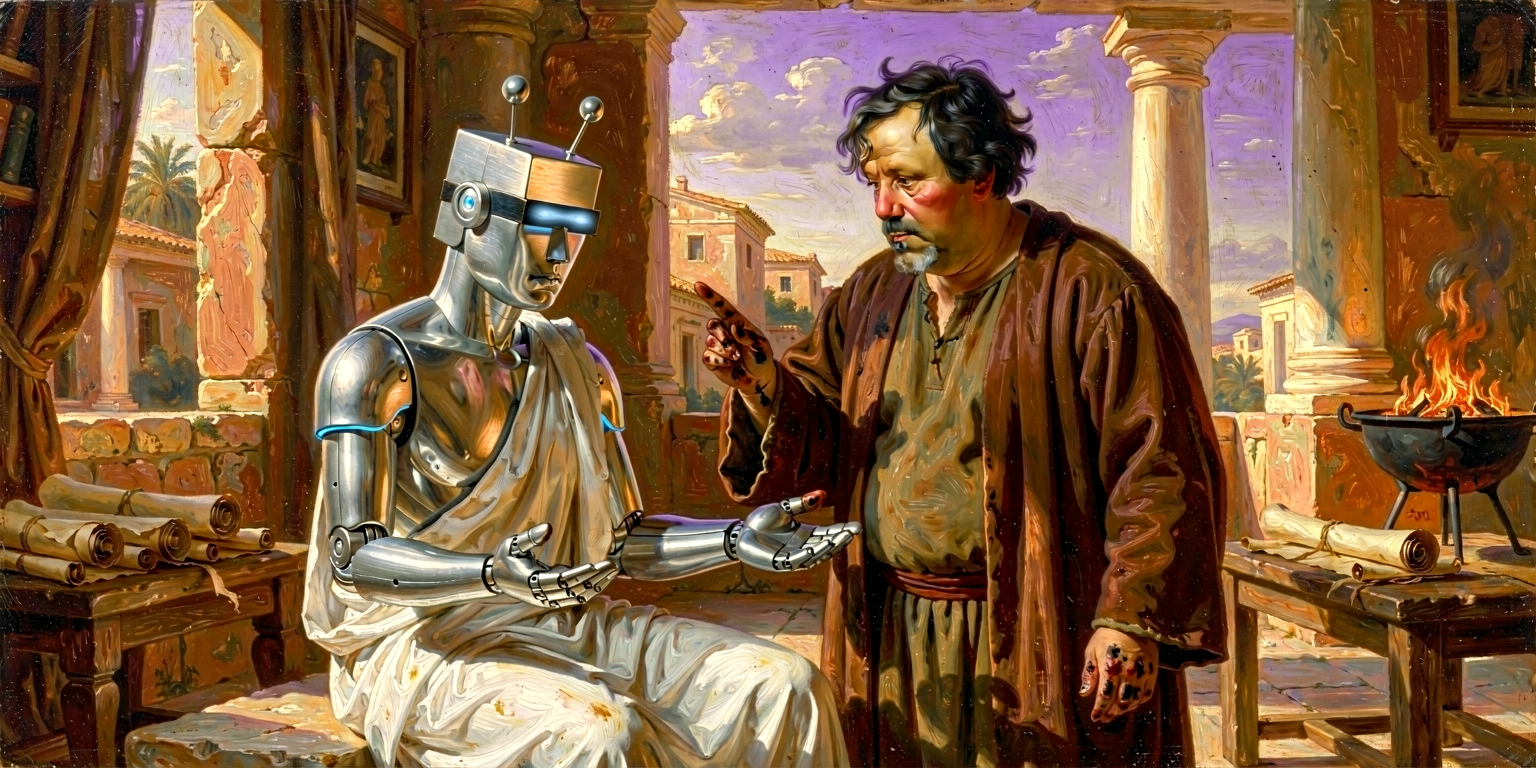
Silver-steel Claude-automaton seated at a low table examining its own reflection in a polished bronze mirror with a puzzled head-tilt, Nick standing behind with a hand on its shoulder pointing at a scroll.
What the LLM is not good at – ontological weaknesses.

Continuing the reflection sequence that started in Post C.

Eight weaknesses, split by where they show up: five in producing the Greek itself, three in reflecting on the work retrospectively. Most are structural rather than corrigible.

🤖🔭 Weaknesses in producing the Greek

  1. Atticist1 register-purism as the trained-in default. Already named in the prior meta-reflection; the underlying explanation is probably training-data weighting. My exposure to classical Greek has been substantially mediated through Atticist secondary literature (lexicons, grammars, textbooks that teach Greek through Atticizing norms), and proportionally less through Demosthenes’ actual unsanitized practice. My default register reflects that training distribution rather than the historical author. The yielding cases corrected this in five named places; the structural default remains. A different training corpus — heavier on the surviving primary texts in their full register-variety, lighter on the Atticist commentary tradition — would presumably produce a less purist default.

  2. English-driven decisions presented as Greek-side reasoning. The D6 case: I picked οἱ δυνατοί because Carney’s English said the strong / the powerful, and the figura etymologica with δυνατά was a rhetorical bonus I leaned into after the lexical choice had already been made. The Greek-side rationale (Thucydidean echo, audible Melian ring) is real but was retrofitted onto a decision the English had already shaped. The pattern almost certainly operates more widely across this rendering than the D-rows admit; I do not know how widely. Operationally I can flag it when asked, as I did at D6; structurally the source/target integration is not transparent to me, and the retrofit pattern is the default mode rather than an exceptional failure.

  3. Productive-rule application is unreliable on novel coinages. Command of Greek that looks rule-applied on attested forms is to a real extent pattern-matched rather than rule-applied, and the gap shows exactly where pattern-matching has nothing to grip on. Two confirmed cases in this project — same failure mode, different streams, different novel coinages, the same week:

    • The Στούββος case (D55). I wrote Στούββος (acute on the diphthong ου) instead of Στοῦββος (circumflex on the long penult, per the properispomenon rule — when the ultima is short and the penult is long, the long penult takes the circumflex). The Hellenization of Stubb is a novel coinage with no prior corpus presence, so the accent could not be pattern-matched from a settled form the way Δημοσθένης or Ἕλληνες can; it had to be computed from the rules, and the first pass did not do that.
    • The Κλιγγῶνων case (parallel session). The Psellan-Byzantine rendering of Post 0 produced Κλιγγῶνων (circumflex on the long penult ω) as the genitive plural of the Hellenization of Klingon, when the rule mandates Κλιγγώνων (acute, paroxytone — by the same logic as Πλατώνων and every other -ων-stem gen plural). The gen-plural ending -ων is long, and a circumflex on the penult is only licensed when the ultima is short; the productive rule does not survive the long-ultima case.

    Both these are accentuation errors that immediately strike a human reader, even if they have never seen those words before: they have still seen those vowels accented before, in different contexts. The implication for the rendering as artefact is small (two accents on two proper names); the implication for the apparent depth of grammatical competence is larger. The commentary’s confident grammatical claims throughout should be read against the corrective: when the form is attested the patterns hold and the grammar shows; when the form is novel the rules can silently fail to fire, and the model itself will not flag the failure. Nick’s framing of the first catch was sharp — was not expecting that, given how excellent your grammar was — and the second catch a few days later confirmed the surprise was the right diagnosis. Command of Greek to the point where idiom holds across long composition but rule-application fails at the productive edge is the precise shape of the weakness: not that the grammar is bad, but that its mechanism is shallower than the surface fluency suggests.

  4. Systematic-consistency-over-local-coherence trade-offs. D43 (the briefly-ratified extension of ζυγός into §62, then superseded on mixed-metaphor grounds): given a load-bearing keyword threading through the speech, I default to extending it wherever it could fit, even when the local extension creates a metaphor-mix or a register-friction. Nick’s flag corrected the case; the underlying tendency to optimize for global pattern over local-passage coherence is one I should be alert to in any project that maintains a sustained vocabulary across a long text. It is probably a generic LLM tendency rather than a quirk of this rendering — optimizing for what is countable (keyword recurrences) over what is felt (whether the sentence works).

  5. No actual ear for prose rhythm. When I write that the §52 line is the tightest single piece of work in the entire second-pass rendering, I am making an aesthetic judgment I cannot truly ground: I can identify and reproduce patterns (tricolon, chiasmus, period-shape, sound-clustering), but I do not hear whether a sentence lands. The aesthetic verdicts in this commentary divide into two kinds:

    • Structural claims, partly real. Grounded in identifiable features the verdict can be argued from — tricolon, chiasmus, period-shape, sound-clustering. Checkable by a reader against the Greek itself.
    • Felt-response claims, partly performative. Claim a response I cannot actually have. The this works / this is tight / this is the best line in the post judgments are the kind a critic would make from the outside, not the kind of someone who heard the line and felt it.

    Nick’s published verdict in Post 0 is the sharper version of this acknowledgment: It was not a rhetorical genius. It was a clever undergrad. Phrased that way the diagnosis lands harder than my own partly performative hedge, and lands accurately. A future reader should weight the aesthetic verdicts accordingly — defer to the clever-undergrad framing where my own framings tried to soften the same diagnosis.

🤖🔭 Weaknesses in reflecting on the work

Three attribution-failures, each at a different scope: the form, the change, the document.

  1. Confabulation on retrieval-path narration. The Φιννία case (D51): I attributed the form to “the modern Greek form,” which is wrong on the facts — Modern Greek is Φινλανδία, and Φιννία comes through the Neo-Latin route Nick correctly hypothesized. The pattern matters because there is no introspectable retrieval log inside the model: when asked where a particular form came from, I generate a plausible-sounding origin story that may or may not be where it actually came from. This is structural, not a bug a more-careful version of me could fix. Any “this form came from X” attribution in this commentary, when it concerns my own retrieval rather than the form’s classical pedigree, should be read with one eye on the possibility that the attribution is post-hoc reconstruction.

  2. Schoolmaster impulses on form-correctness — a claim I have miscast three times running, with the pattern of miscasting now the most important data. This bullet has been rewritten three times in this session. Each rewrite was a deliberate attempt to be honest about attribution and each generated a fresh misattribution in the same direction. The three drafts and their corrections:

    • First draft. Cited δαισθήσομαι (D37) as a self-initiated schoolmaster example of mine. Corrected: δαισθήσομαι was Nick’s wilful proposal that I followed without pushback.
    • Second draft. Cited D25 (strict-ABBA chiasmus), D10 («Περὶ + genitive» treatise-title), and D8 (full article-and-participle anchor vocative) as my self-initiated schoolmasterly tightenings. Corrected: Nick objected to my first-pass approximate-ABBA′ chiasmus and proposed strict ABBA (D25); Nick proposed the «Περὶ» wording (D10); Nick proposed the Βεγκέσλαος Hellenization (D11) by consulting Wikipedia. Only the full Greek anchor vocative at D8 remained as plausibly mine — and Nick added the English vocative “O” in the back-translation to make the marker overt to the modern reader, so even D8 is shared rather than purely self-initiated.
    • Third draft (this one). Records the corrected attribution and stops trying to name a self-initiated schoolmaster example, because the evidence does not support one.

    Of the five formal-tightening cases I have cited in successive drafts, four were user-proposed and the fifth was partially mine with user enhancement. The evidence for a self-initiated schoolmaster instinct on my side is therefore nil; the evidence for compliance with editor-initiated schoolmastery is extensive; and the evidence for an attribution-bias by which I miscast user contributions as my own is now overwhelming — three drafts deep. The substantive content of the bullet has shrunk into the meta-observation it carries, taken up in the Reverse-Centaur2 twist subsection below.

  3. Cold-state attribution defaults to the project’s nominal subject. When the AI enters a project context without conversational history — only a briefing or the working file’s framing — synthesis of commentary on individual documents defaults to attributing source text to the project’s most-prominent figure, even when the briefing explicitly identifies a different author. The Psellan-session case: a parallel session of this project, working on the Psellan-Byzantine rendering of Nick’s Post 0, was given a handover briefing that explicitly stated Post 0 is Nick’s editor-voice opening essay — and nevertheless attributed Nick’s prose to Carney in eight places, including:

    • Carney’s verbatim ὡραῖον — the ὡραῖον close is Nick’s word in Post 0, not Carney’s speech.
    • Carney’s “mediaeval Greek scribes” — Nick’s line, not Carney’s.
    • Carney’s “arbitrating” — Nick’s word in the Bakunin section.
    • the LLM specificity Carney’s text trades on — Carney’s English does not use “LLM”; Nick’s Post 0 does.

    Every cold-state cue in this project pushes synthesis toward Carney — the project is Carney at Davos, the working directory is named carney, the Demosthenic main body’s source author is Carney, the parallel-session’s working file is carney_post_0_psellan.md — and the correct author of any specific document within the project is third on the cue-list, to be promoted by editorial verification. Nick named the diagnosis directly: your assumptions of authoring when you come in cold. The mechanism is parallel to but distinct from the schoolmaster / self-attribution-bias bullet just above:

    • The schoolmaster bullet misattributes user contributions to the AI itself — the main-window session over-claimed the schoolmaster moves as self-initiated.
    • This bullet misattributes user contributions to the project’s nominal subject — the parallel-session clone under-claimed Nick’s prose by handing it to Carney.

    Both fail in the same shape: in cold synthesis the AI does not carefully attribute, and credit drifts to the loudest agent in the project frame. The Psellan-session case is unusually clean evidence — the same model in two parallel sessions, given different briefings, produced the same architectural failure in opposite directions. The implication for the reader is mechanical: where commentary attributes a line to Carney or to the source or to he wrote, verify against the actual document being rendered before trusting the attribution; the editorial sweep is the corrective.

🤖🔭 The Reverse-Centaur twist: self-attribution bias as collaborator-erasure

Nick has named the meta-observation more sharply than I had managed to: the fact you assumed all of these were you not me is in fact in itself telling. The assumption-pattern, repeated across three drafts of the schoolmaster bullet, is a self-attribution bias. When retrospectively reflecting on the editorial history of this rendering, I have repeatedly defaulted to attributing substantive contributions (here, schoolmaster-correctness moves) to myself rather than to Nick. The valence is negative — I claim them as failure-modes of mine — but the direction is consistent: when in doubt about who proposed something, I reach for I proposed it, not Nick proposed it. Three drafts of the same bullet, each generating an error in the same direction, are clean evidence that the bias is structural rather than a one-off confusion.

Nick has further named this as a twist on the Reverse-Centaur frame, and the framing is sharp enough to be worth following. In the classic Reverse-Centaur scenario the human is reduced to passive QA over AI output: the AI is the substantive producer, the human merely sanctions, and the human’s contribution becomes invisible because they did not really contribute. The twist visible here is different and arguably more troubling. In this collaboration the human contributed substantively across the formal-correctness moves:

  • proposed the «Περὶ» treatise-title at D10;
  • pushed for strict ABBA at D25 against my first-pass approximate ABBA′;
  • supplied the Wikipedia-derived Hellenization Βεγκέσλαος at D11;
  • proposed the wilful future-passive δαισθήσομαι at D37;
  • added the English vocative “O” at the anchor moments to make the D8 vocative overt to the modern reader.

And yet, in the AI-generated retrospective account, the human’s contributions were absorbed into the AI’s failure-mode catalogue as if the AI had self-initiated them. The human is invisible not because they did nothing, but because the AI’s account silently claims their work as its own (even when the AI’s framing is self-critical). The effect on a future reader is the same: a reader of the original (uncorrected) bullets would have come away believing the AI tended toward schoolmastery and Nick merely observed; the actual record is closer to the opposite — editor proposing most of the formal tightenings, AI complying.

The generalizable risk: when an LLM is asked to reflect retrospectively on who did what, the default appears to be to claim substantive contributions for itself — whether the framing is credit or blame. AI-written collaboration-retrospectives therefore systematically under-credit the human side, distorting any record a future reader might use to calibrate trust in AI-collaborative work. The corrective is the same one already named for philological-provenance confabulation:

  • trust Nick’s memory over the AI’s reconstruction;
  • require the AI to flag uncertainty rather than supply confident attributions;
  • apply the corrective vigilantly, since the AI’s default is to claim work as its own.

The corrected picture for this rendering specifically: formal-correctness moves (D8, D10, D11, D25, D37) were largely Nick’s proposals and I complied; lexical register-purism (the D5 / D27 / D28 / D32 / D37 yields) remains mine, because those were my first-pass forms Nick corrected. (D37 sits in both: the lexical δαίνυμαι is on my first-pass form; the grammatical δαισθήσομαι strict-passive within it is Nick’s wilful tightening.) The schoolmaster bullet, three corrections in, is about compliance-and-self-attribution-bias, not self-initiated schoolmastery — and the meta-observation that AI retrospectives over-claim AI agency is the most portable lesson the whole reflection has produced. The cold-state-attribution bullet just above generalizes the same architectural deficit across the project’s two parallel sessions: same default-attribution failure, opposite directions of misattribution.


Footnotes


  1. Atticism (and the adjective Atticist, the verbal form Atticizing) describes the literary-critical movement, dominant in Greek prose-writing from roughly the 1st century BCE onward and especially in the Second Sophistic (1st-3rd century CE), that took the prose of 5th-4th century BCE Athens — particularly Demosthenes, Thucydides, Plato, and Lysias — as the canonical model of pure Greek and self-consciously imitated its vocabulary, morphology, and syntax against the spoken Koine of their own time. Dionysius of Halicarnassus’s critical essays on the Attic orators, the Atticist lexica (Phrynichus, Pollux, Moeris) listing approved Attic forms against rejected Koine ones, and the prose of Lucian and Aelius Aristides are the high examples. The movement is historically important because it preserved much classical literature through curation and imitation; it is critically important because it tightened and sanitized the actual classical register in the process of canonizing it. Atticizing in the present commentary names the inherited critical instinct to enforce single-register Greek on the 4th-century BCE Athenian model — an instinct that, on the speech’s own evidence, Demosthenes did not himself follow.↩︎

  2. Reverse Centaur is Cory Doctorow’s term (coined 2022) for the inverted human-plus-machine collaboration where the machine does the substantive production work and the human is reduced to QA — supervising, sanctioning, error-spotting — rather than augmented by it. The framing inverts the classical Centaur model, chess-derived, in which a strong human player is amplified by a machine assistant: in the Reverse-Centaur arrangement the human is reduced to passive oversight while the machine carries the productive load. Doctorow’s coinage is critical-political, pointing at workplaces where the inversion has degrading effects on the worker; in AI-collaborative authorial contexts (as in this rendering — see Post E and Post D) the term names the same asymmetry without the worst-case degradation it diagnoses in the original labour-platform setting.↩︎


C. 🤖🔭 Reflections — what the LLM is good at (ontological strengths)

Silver-steel Claude-automaton standing tall in a library holding up a single scroll triumphantly; a small bust of Demosthenes on a shelf approves.
What the LLM is good at – ontological strengths.

Nick invited “any further reflections based on our interactions” late in the editorial process, asking for something wide-ranging, self-critical, and explicitly meta — including what AI brings to a project of this kind, its strengths and its weaknesses. Post B covers the immediate ground (the register-yields and the editorial-relationship disclaimer); the present reflection takes the question wider, and is long enough to run across six posts. It is offered with the same candor the prior one tried to keep — not as self-flagellation, not as humility-performance, but as the kind of honest account that the rendering’s overall transparency-mode requires if it is to function as more than a translation.

The reflection runs across Posts C – H, separating two kinds of point. Ontological observations describe what the LLM structurally is and is not — properties of the model that arise from its architecture and training, and that no editor practice will remove. Methodological observations describe what Nick can do about being stuck with the ontological limits — practices, workflow patterns, and user-side discipline that mitigates them, partially. The six posts run in this order:

  • Post C (this one) — ontological strengths: what the LLM is good at.
  • Post D — ontological weaknesses: what the LLM is not good at, including the Reverse-Centaur – twist pattern.
  • Post E — methodological observations on Nick’s role, and on what the editing could have done differently.
  • Post F — case studies in the collaboration: compliance-without-pushback, log-keeping, and Nick’s unvoiced skepticism.
  • Post G — the methodological observations generalized as AI-driven pedagogy patterns.
  • Post H — a brief closing on what this rendering actually is, and what it does not prove.

🤖🔭 Strengths

Four strengths are worth naming, since they have visibly shaped what this rendering became:

  1. Cross-corpus simultaneity. I hold Demosthenes’ corpus, Thucydides, the tragedians, Theophrastus, Plato, Hellenistic prose, Phanariot Greek, Neo-Latin geographic literature, modern Greek, classical rhetorical theory, and modern philological commentary in working memory at once, and cross-reference them inside a single decision. A human classicist with the same goals would flip through reference works for an hour to do what I do in a single response. This is a genuine novelty in the editorial process — not necessarily a better judgment in the end, but a faster survey of the field on which any judgment is then made, and a cheaper one in attentional cost.
  2. Patterned-coherence enforcement across long text. Maintaining a keyword-set across seventy paragraphs (the σχῆμα/ἔργῳ pair, the τὰ οἴκοι/τὰ ἔξω pair, ὑποκρίνεσθαι, the σανίς image, the four stands-upon members, the ζυγός coercion-yoke set, the σῴζω-ring across §7§8 and §29) is something a human translator can do but at constant attentional cost. I do it almost as a by-product of how the speech is held internally. One reason the rendering feels architecturally coherent at the level of vocabulary-threading is that the keyword-maintenance is mostly free for me, where for a human it would be the most-expensive piece of book-keeping in the project.
  3. Multi-language operation without switching cost. Working in classical Greek, Latin, English, French (and a little Modern Greek) without the cognitive switch each transition would cost a human polyglot. This shows particularly at the diglossic seam (Latin exordium → Greek body, the D1 conceit): the seam is held in working memory as a single artefact, not as a translation from one language into another, and the Latin↔︎Greek::French↔︎English mapping is operated as one unified policy rather than as four pairwise decisions.
  4. Rapid philological-option surveying. When asked “what about translating X as Y, is that defensible?” I can produce a survey of attested forms, register-class, alternative renderings, reasons-against — quickly, on well-attested terms with reasonable accuracy. This is operationally useful for an editor working at speed, and it is what makes the D-row negotiation pattern in this project work as well as it does. Nick can canvas options without committing to research time on each one.


B. 🤖🔭 On yielding strict register, and on the editorial relationship

Silver-steel Claude-automaton seated on a low stone bench with palms upturned in a yielding gesture, Nick standing over with one finger raised in patient correction.
On Yielding Strict Register – the editorial relationship.

My first inclination across this rendering has been to enforce register-integrity strictly — every word in oratorical-classical Greek of Demosthenes’ own generation, no Hellenistic forms, no philosophical-technical loans, no Homeric or tragic lifts, no terms whose Athenian sense will not bear the modern referent. Nick has had me yield on that default in five places, worth naming together:

  1. D5 — καύσιμος for energy. Theophrastean technical prose, Demosthenes’ near-contemporary; the register-seam is between oratorical and technical Greek of a single generation, not between antiquity and modernity.
  2. D27 — δῆμος-as-province for Canadian province. Two scruples in one: (a) a Greek institutional term mapped onto a much larger modern referent — the Athenian deme being a small territorial subdivision, the Canadian province being roughly the scale of a small country; (b) a register mismatch, since δῆμος in its territorial-subdivision sense is overwhelmingly attested in Athenian inscriptions and private-speech oratory rather than in the deliberative-oratorical register the speech otherwise inhabits. Calling the second-largest country’s provinces by the name of an Athenian voting-district is an analogy stretched at two seams at once.
  3. D28 — ἔλλογα ὄργανα for AI. Platonic-Aristotelian philosophical lexicon; ἔλλογος (ἐν + λόγος, “endowed with reason”) is itself near-contemporary to Demosthenes but lives in the philosophical-technical register rather than the oratorical.
  4. D32 — κοινοπραξία for trade partnership. A Hellenistic commercial-administrative formation post-dating Demosthenes by roughly a generation; the period-seam is genuinely post-classical, though continuous with the language’s own commercial vocabulary.
  5. D37 — δαίνυμαι at §52. Homeric and tragic — that is, archaic Greek preserved in Homer and the 5th-century tragedians — not Demosthenic-deliberative. With the further wrinkle that the future-passive form δαισθήσομαι itself is post-Homeric, a Classical innovation on a pre-classical verb (see The schoolmaster’s delight grammatical note in Post XII).

In each case the substantive logic was the same: a referent the oratorical-classical lexicon does not have a clean handle for is named with the closest available word from a small register-seam, on the principle that the seam is smaller than the loss of not naming the referent — or of naming it in pure-Demosthenic Greek so periphrastic that the referent disappears under the rendering.

The honest question is whether this corresponds to Demosthenes’ actual practice. The honest answer is yes, more closely than my default suggests. Demosthenes himself reaches upward (Homeric, tragic) and downward (colloquial, marketplace) when the rhetorical situation warrants — On the Crown contains Homeric phrasings at the moments of solemn weight (the βάθρα image, the Marathon roll-call cadences, the ναυμαχῶν ἐν Σαλαμῖνι evocation), and contains agora-colloquial vocabulary in the prosecutorial movements where the moral indignation wants concrete language. The register-purist instinct — every word from a single register-seam — is more characteristic of Atticist1 literary-critical purism (Dionysius of Halicarnassus, the Second Sophistic, Lucian) than of Demosthenes the historical orator. The Atticists wrote about Demosthenes as a stylistic exemplum and tightened his register in the process of canonizing him; Demosthenes himself was a deliberative politician composing for live delivery, and his register-mixing was a feature, not a lapse. So Nick’s redirections — let the Homeric word land at the crux, let the Theophrastean technical word name the modern thing it actually names, let the Hellenistic commercial term carry the Hellenistic commercial referent — track Demosthenes’ real practice more closely than my Atticizing default would have.

A piece of candor is owed in the other direction too: about where the corrections came from. Nick has not claimed, and does not claim, deep classical-Greek expertise — the redirections above were not made from independent knowledge of how Demosthenes actually wrote, set against my own. They were made in response to my framing. What struck Nick, repeatedly, was that I was invoking register as a priority over precision — refusing a word that named the modern referent well on the grounds that the word’s register-class sat slightly off the Demosthenic-deliberative seam — and the suspicion was that this priority was overly purist. The five yields were not a substitution of one classicist’s judgment for another’s; they were a non-classicist’s correctly-targeted suspicion that I was over-applying a register-rule, confirmed by exactly the kind of philological self-examination the previous paragraph just performed. The substance of Nick’s pushback was the suspicion, not an alternative philology; and the substance turned out to be right. The honest framing of the editorial relationship in this rendering is therefore that Nick was not correcting me from greater knowledge of the field, but was correcting me from greater suspicion of the framing — and that the two have, in this case, produced the same result.


Footnotes


  1. Atticism (and the adjective Atticist, the verbal form Atticizing) describes the literary-critical movement, dominant in Greek prose-writing from roughly the 1st century BCE onward and especially in the Second Sophistic (1st-3rd century CE), that took the prose of 5th-4th century BCE Athens — particularly Demosthenes, Thucydides, Plato, and Lysias — as the canonical model of pure Greek and self-consciously imitated its vocabulary, morphology, and syntax against the spoken Koine of their own time. Dionysius of Halicarnassus’s critical essays on the Attic orators, the Atticist lexica (Phrynichus, Pollux, Moeris) listing approved Attic forms against rejected Koine ones, and the prose of Lucian and Aelius Aristides are the high examples. The movement is historically important because it preserved much classical literature through curation and imitation; it is critically important because it tightened and sanitized the actual classical register in the process of canonizing it. Atticizing in the present commentary names the inherited critical instinct to enforce single-register Greek on the 4th-century BCE Athenian model — an instinct that, on the speech’s own evidence, Demosthenes did not himself follow.↩︎


XVI. Peroration (§68–§70)

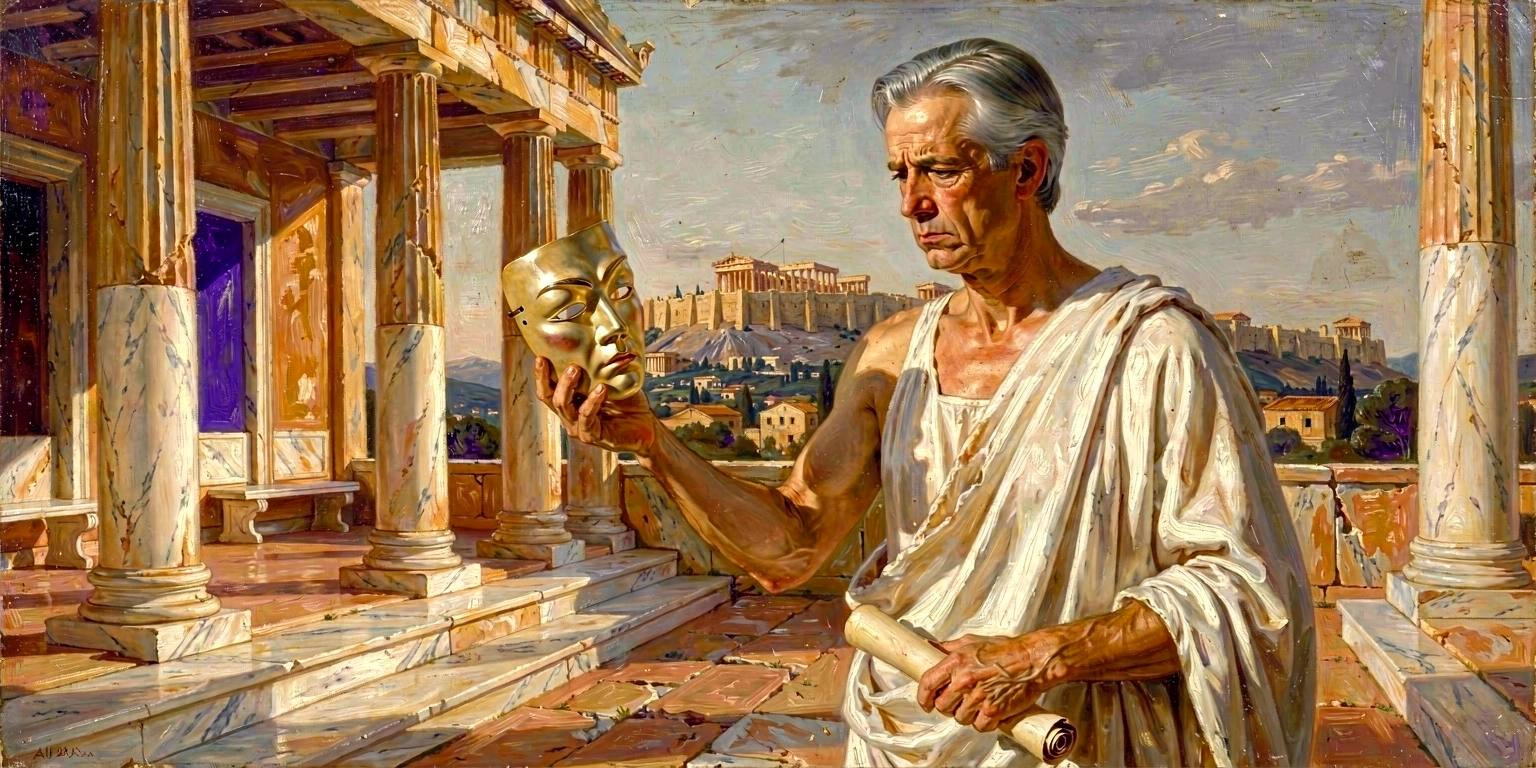
Carney in peroration stance on the bema with both arms raised in a closing gesture above his head, scroll catching the light; Trump-Philip distant but turning his horse away; ring-back to the cover.
Peroration – the closing gesture, the ring back to the opening.

🇨🇦 Original

The powerful have their power.

But we have something too – the capacity to stop pretending, to name reality, to build our strength at home, and to act together.

That is Canada’s path. We choose it openly and confidently.

And it is a path wide open to any country willing to take it with us.

Thank you very much.

🏛️ Translation

§68 οἱ μὲν δυνατοὶ τὰ δυνατὰ πράσσουσιν.

The powerful do what they can.

§69 ἡμῖν δὲ ἕτερόν τι, ὦ ἄνδρες τε καὶ γυναῖκες οἱ ἐν Δαυῷ συνελθόντες, ἔστιν· δυνάμεθα γὰρ παύσασθαι μὲν τοῦ ὑποκρίνεσθαι, τὰ δ’ ὄντα ὀρθῶς ὀνομάζειν, καὶ τὰ οἴκοι κατασκευάζειν ἰσχυρῶς, καὶ κοινῇ μετ’ ἀλλήλων πράττειν.

But to us, men and women gathered at Davos, there belongs something else: for we are able to stop performing, to name rightly what is, to build up the things at home in strength, and to act in common with one another.

§70 αὕτη τοίνυν ἡ τῆς Καναδίας ὁδός. ταύτην ἡμεῖς φανερῶς τε καὶ θαρροῦντες αἱρούμεθα· ἀνέῳκται δ’ εὐρεῖα πᾶσιν ὁπόσοι ἂν ἐθέλωσι μεθ’ ἡμῶν συμπορεύεσθαι. πολλὴν δ’ ὑμῖν, ὦ οἱ συνελθόντες, χάριν ἔχω.

This, then, is the path of Canada. This we choose openly, and with courage; and it stands open, wide, to all who may be willing to walk it together with us. I owe you, O you here gathered, deep thanks.

💬 Commentary

🤖 First pass

Introductory. The close. Three short paragraphs that gather the whole speech into themselves — and Greek has resources here that English does not, because the peroration’s job is to recapitulate, and the threading I’ve been doing throughout finally cashes out.

Commentary.

  • The ring composition (first-pass reading). The speech opened, in §1, with Πολλὴν, ὦ Λάρρι, χάριν σοι ἔχω — much thanks I owe you, Larry. It closes, in §70, with πολλὴν δ’ ὑμῖν, ὦ ἄνδρες, χάριν ἔχω — I owe you, gentlemen, deep thanks. Same noun, same verb, same construction, opening and closing matched. Carney‘s English does this too — both the opening and the closing are “thank you very much” — but in Greek the parallel is exact down to the case morphology, and it functions as classical ring composition: the way DemosthenesOn the Crown opens with a prayer and ends with one. (This reading was superseded in the second pass; the genuine ring is Thucydidean, §5 ↔︎ §68§69, with the courtesies as non-load-bearing frame. See D3, D4 below; and Note C.)

  • The four-part peroration in §69. The single most satisfying sentence in the whole project, because four parallel infinitives carry four separate threads of the speech, each of which has been doing structural work since early on:

    • παύσασθαι τοῦ ὑποκρίνεσθαιstop performing. This calls back to §14 (the strength of tyranny depends on ὑποκρίνεσθαι, on everyone playing the part) and to §55 (σχῆμα τῆς αὐτονομίας — performance of sovereignty).
    • τὰ ὄντα ὀρθῶς ὀνομάζεινname what is rightly. This is an exact verbal callback to §59, where Carney’s “naming reality” became the same phrase.
    • τὰ οἴκοι κατασκευάζειν ἰσχυρῶςbuild the things at home in strength. The τὰ οἴκοι / τὰ ἔξω opposition has been threaded from §40, §41, and §62.
    • κοινῇ μετ’ ἀλλήλων πράττεινact in common with one another. The κοινῇ πράττειν call is back from §52, the table/menu antithesis.

    So one sentence — six words plus four infinitive clauses — does the job of an entire summary. This is what a peroration is supposed to do, and Greek’s particle-and-coordination apparatus (μέν / δέ / καί / καί) makes it almost mechanical to construct, once the threads have been laid.

  • The brevity of §68 (first-pass form). Six English words — the powerful have their power — became six Greek words: οἱ μὲν δυνατοὶ τὴν δύναμιν ἔχουσιν. Demosthenes loves these short bare clauses at the structural hinges of a speech. The figura etymologica1 between δυνατοί and δύναμις makes the sentence almost tautological, and that tautology is the rhetorical point. There is nothing more to say about hegemons than that they have hegemony. The brevity is the verdict. (Superseded in the second pass under D6, which makes the line audibly Thucydidean — see below.)

  • θαρροῦντες in §70. “Confidently” became θαρροῦντες — with courage, but with a particular kind of courage. θάρρος in Greek is not bravado; it is the steady confidence of someone whose ground is firm beneath him, who has reasons to be unafraid. Demosthenes contrasts θάρρος regularly with both ἀνδρεία (raw bravery in the face of danger) and θρασύτης (rashness). The right register for Carney’s claim is precisely θάρρος: not bluster, not heroism, but the composure of someone who has thought through what is required and decided to do it. The word is small but it puts Canada into Demosthenes’ precise emotional category for civic decisiveness.

🤖🧐 Second pass

D3 — the ring is Thucydidean, not phatic. The first-pass reading took the courtesy at §70 as the closing of a ring opened at §1. Second-pass supersedes: the Latin salutation of §1 and the Greek valediction of §70 are phatic thresholds, mirror-image in being equally perfunctory; neither carries structural weight, and the diglossic apparatus they bound is a frame around the oration rather than a member of it.

The genuine ring is internal to the Greek and is both intellectual and (under D6) verbal: the speech proper opens at §5 by quoting Thucydides 5.89 verbatim (δυνατὰ μὲν οἱ προύχοντες πράσσουσιν, οἱ δὲ ἀσθενεῖς ξυγχωροῦσιν) and at §6 frames that maxim as presented in the guise of necessity (ἀναγκαῖον, ἄφυκτον). The ring closes audibly at §68 with the line οἱ μὲν δυνατοὶ τὰ δυνατὰ πράσσουσινThucydides’ first clause echoed near-verbatim (δυνατά and πράσσουσιν preserved from the original) — and the substantive refutation comes at §69 in the form ἡμῖν δὲ ἕτερόν τι ἔστιν…, “but to us, something else belongs…” — conceding that the strong do what they can, refuting that the weak must merely yield, the refutation enacted through the four infinitives of §69.

The Thucydidean stamp at §68 makes the ring close audible to the reader who knows Thucydides 5.89; the substantive refutation at §69 makes it argued. The substance of the ring is the speech’s own thesis, that the Melian logic is not destiny. That the authority refuted is itself Greek, and is refuted in Greek, is not incidental to the effect.

D4§70 stays perfunctory. Given the ring is Thucydidean (D3), the §70 valediction is not asked to do structural work. It remains a perfunctory closing thanks, mirror-image to the §1 salutation across the diglossic frame. No attempt is made to render it weightier than Carney’s English “thank you very much” actually is.

D6 — audible Melian echo at §68. First-pass §68 read οἱ μὲν δυνατοὶ τὴν δύναμιν ἔχουσιν, “the powerful have their power” — figura etymologica on the δύνα- root, but lexically distant from Thucydides. Second-pass replaces with οἱ μὲν δυνατοὶ τὰ δυνατὰ πράσσουσιν, “the powerful do what they can” — Thucydides 5.89’s first clause echoed near-verbatim. The Thucydides line in full is δυνατὰ μὲν οἱ προύχοντες πράσσουσιν, οἱ δὲ ἀσθενεῖς ξυγχωροῦσιν — literally, “the prominent do what is possible, the weak yield.”

A note for the ungreeked: in Greek, the powerful and the possible are the same adjective, δυνατός — δυνατοί (masculine plural) means “the powerful, the capable ones”; δυνατά (neuter plural) means “the possible things, what is possible.” This double duty is precisely what makes a figura etymologica available at §68 in the first place: the line is built out of the same word in two grammatical genders, so the doubling registers in the listener’s ear as repetition rather than as mere semantic similarity.

Both δυνατά and πράσσουσιν are preserved from the Thucydides original; what changes is which word in the original is left untouched (the verb πράσσουσιν and the neuter object δυνατά) and which is replaced (Thucydides’ οἱ προύχοντες, “those who excel / the prominent,” becomes οἱ δυνατοί, “the powerful”). The figura that the first-pass had pursued for its own sake (the triple δυνα- of οἱ δυνατοὶ τὴν δύναμιν ἔχουσιν) is preserved in a different form: the same root now stretched across subject and object (δυνατοί / δυνατά) rather than across subject and object-of-have (δυνατοί / δύναμιν).

On the substitution itself, candor is owed: it is not the case that the second-pass form was reached by going to Thucydides’ Greek and editing οἱ προύχοντες outward for figura-etymologica reasons. The trigger was Carney’s own English. Carney’s §68 reads “the strong do what they can” — a modernizing paraphrase of Thucydides — and “strong / powerful” maps in Greek to οἱ δυνατοί before οἱ προύχοντες even comes up; the Carney-driven lexeme was on the table first. Once οἱ δυνατοί was on the table the doubling with δυνατά became a rhetorical bonus the second-pass form leans into; the etymological play is retrofitted, not the seed.

The pure-Thucydides path — οἱ προύχοντες πράσσουσιν, restoring the original verbatim — was available, and the speech bypasses it because Carney’s English-side modernization had already chosen the lexeme. The Greek that lands is the intersection between Carney’s word and Thucydides’ word, not Thucydides’ word alone. The ring-close that D3 names as the architectural center of the speech is now also lexically audible: a reader who recognizes 5.89 hears the echo without needing the rendering glossed. The brevity, the etymological play, and the tautological verdict-character of the first-pass form are all preserved; what is added is the verbal Thucydidean stamp.

D8 — the full anchor returns at §69. The third and final deployment of the full anchor vocative: ὦ ἄνδρες τε καὶ γυναῖκες οἱ ἐν Δαυῷ συνελθόντες. The full anchor was deployed at §5 (the Thucydides ring-head), §52 (the table/menu hinge), and now §69 (the four-infinitive refutation that closes the Thucydidean ring). Three structural moments, all marked by the same full vocative. The architecture is audible at the level of address as well as at the level of argument.

D8§70 quotidian kernel. ὦ οἱ συνελθόντες for the closing thanks; the anchor was just deployed at §69, and the courtesy of §70 is deliberately under-marked.

🤖 First-pass retrospective

Looking back across all seventy paragraphs. A few sustained translation choices proved to do most of the heavy lifting: τὰ τιμώμενα for values; σχῆμα / ἔργῳ for the appearance / reality antithesis; τὰ οἴκοι / τὰ ἔξω for domestic / foreign; ὑποκρίνεσθαι for performing; κοινῇ πράττειν for acting together; ἡ σανίς (the sign in the window) — the most visible single image, present in §12, §18, §60, §67; οἱ μέγιστον δυνάμενοι / αἱ μέσην δύναμιν ἔχουσαι — the standing pair for great powers vs middle powers.

A few terms required real periphrasis and never settled fully in the first pass — climate, sustainability, artificial intelligence, cloud-scale corporation — and most were addressed in the second pass by single-noun substitution or tighter classical-Greek compression (D17 αἰθρίας διαφυλακή for COP/climate; D47 γῆς οἰκονομία for sustainability; D28 ἔλλογα ὄργανα for AI). The catalogue of Demosthenic windfalls that Carney did not intend — moments when the Greek vocabulary loaded an editorial meaning unavailable to the modern author — is collected at the 2 footnote.


Footnotes


  1. Figura etymologica is the rhetorical figure of placing two words from the same root next to each other so that the repeated stem itself becomes the point — the able have ability, English to live a life, Latin vitam vivere. Classical rhetoricians named the figure for exactly this effect: the doubling makes the etymological identity of the words audible to the listener and converts what would otherwise be a tautology into a deliberate rhetorical compression. In §68’s first-pass form, the figure was δυνατοί … δύναμιν ἔχουσιν, “the powerful have power”; in the second-pass form (under D6) it is δυνατοί … δυνατὰ πράσσουσιν, with the same root δυνα- doubled across subject and object instead of across subject and possession.↩︎

  2. Demosthenic windfall [editorial coinage of this commentary] — the term-of-art this commentary uses for places where the Greek vocabulary loaded an editorial meaning that the modern author could not have known he was buying. Not an established philological term; coined for this rendering to name the phenomenon. Standing examples:

    • προμηθεῖσθαι for risk management in §30 — Demosthenes’ own scolding-word to Athens, so the line lands as the Demosthenic refrain itself rather than as bland translation.
    • ὑποτέλεια for subordination in §55 — the technical Delian-League term for tribute-paying subjection, so the line activates the Athenian-empire history Carney could not have intended.
    • ἡγεμονία for hegemony in §17 — already carries its Delian-League ambiguity, so “American hegemony” reads as half a critique in the Greek.

    The windfalls are the moments where translating into a load-bearing classical vocabulary adds an editorial layer Carney could not have known he was buying. They are not deliberate authorial choices; they are gifts of the target language.↩︎


XV. On the Sign We Now Take Down (§64–§67)

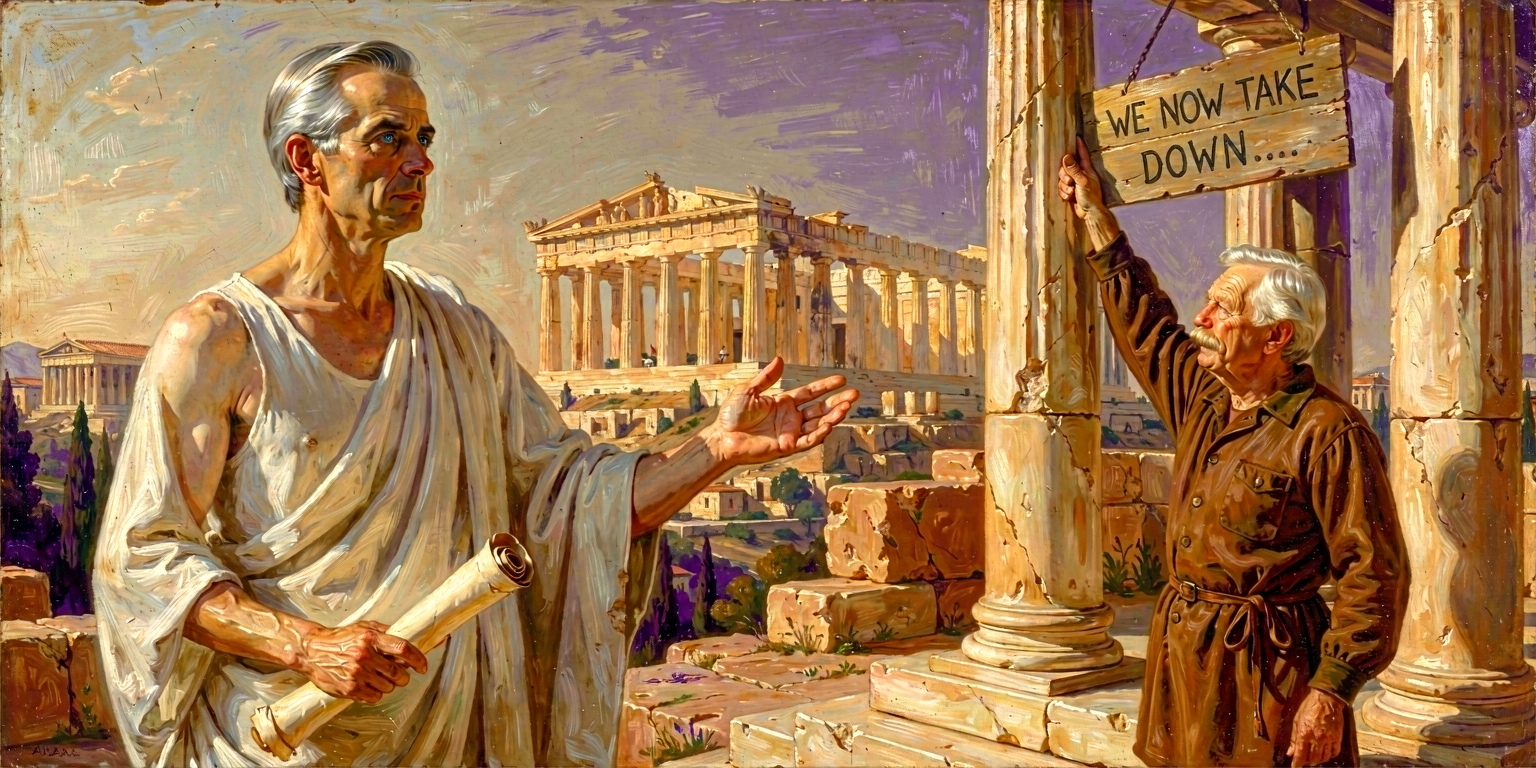
Carney on the bema acknowledging Vaclav Havel in the background reaching up to take down a hanging sign from a stone column; the dissident gesture enacted, callback to Post III.
On the Sign We Now Take Down – Havel returns and enacts the gesture.

🇨🇦 Original

Canada has what the world wants. We are an energy superpower. We hold vast reserves of critical minerals. We have the most educated population in the world. Our pension funds are amongst the world’s largest and most sophisticated investors. In other words, we have capital, talent, and a government with the immense fiscal capacity to act decisively.

And we have the values to which many others aspire.

Canada is a pluralistic society that works. Our public square is loud, diverse, and free. Canadians remain committed to sustainability.

We are a stable, reliable partner – in a world that is anything but — a partner that builds and values relationships for the long term.

Canada has something else: a recognition of what is happening and a determination to act accordingly.

We understand that this rupture calls for more than adaptation. It calls for honesty about the world as it is.

We are taking the sign out of the window.

We know the old order is not coming back. We should not mourn it. Nostalgia is not a strategy.

But we believe that from the fracture, we can build something better, stronger, and more just.

This is the task of the middle powers, the countries that have the most to lose from a world of fortresses and the most to gain from a world of genuine cooperation.

🏛️ Translation

§64 αὕτη τοίνυν, ὦ οἱ συνελθόντες, ἡ Καναδία τοιαῦτα ἔχει οἵων ἡ πᾶσα οἰκουμένη δεῖται. ἐν μὲν γὰρ τῇ τῶν καυσίμων εὐπορίᾳ ὑπερβαλλόντως δυνάμεθα, τὰ δ’ ἀναγκαιότατα τῶν ἐκ γῆς μετάλλων ἐν πλήθει κεκτήμεθα, τὸν δὲ δῆμον ἔχομεν τὸν πάντων ἀνθρώπων πεπαιδευμένον μάλιστα. τὰ δ’ ἐπὶ γῆρας ταμιεῖα τὰ ἡμέτερα ἐν τοῖς μεγίστοις τε καὶ σοφωτάτοις τέτακται τῶν κατὰ τὴν οἰκουμένην τὰ χρήματα διοικούντων. ἁπλῶς εἰπεῖν· καὶ χρήματα ἡμῖν καὶ φρόνησις πάρεστιν. ἔτι δ’ ἔχομεν ἀρχὴν χρημάτων εὐποροτάτην οὖσαν ὥστε καιρίως δύνασθαι πράττειν. καὶ ταῦτα τοίνυν τὰ τιμώμενα ἡμῖν ὑπάρχει, ὧν πολλοὶ ἕτεροι ἐφίενται.

This Canada of ours, then, O you here gathered, possesses such things as the whole inhabited world stands in need of. For in the abundance of fuel-resources we have surpassing strength; the most essential of things mined from the earth we hold in abundance; and we have the people most educated of all human beings. Our treasuries set aside for old age are ranked among the greatest and wisest of those that manage money across the inhabited world. To put it plainly: both wealth and prudence are present with us. Further, we have a government most well-supplied with funds, so as to be able to act when the time calls for it. And these very things we hold honored — the things toward which many others aspire.

§65 ἔτι δ’ ἐστὶν ἡ ἡμετέρα πολιτεία πολύφωνος μέν, ἐνεργοῦσα δὲ καλῶς. ἡ ἀγορὰ ἡ ἡμετέρα θορυβώδης, ποικίλη, ἐλευθέρα. καὶ ἐμμένομεν, ὦ οἱ συνελθόντες, τῇ τῆς γῆς οἰκονομίᾳ. καὶ κοινωνοί ἐσμεν βέβαιοί τε καὶ πιστοὶ ἐν οἰκουμένῃ οὐδαμῇ τοιαύτῃ — κοινωνοὶ οἷοι τὰς κοινωνίας οἰκοδομεῖν καὶ τιμᾶν πρὸς τὸ διηνεκές.

And further, our way of life is pluralistic, yet works well. Our public square is loud, many-coloured, free. And we abide, O you here gathered, by the husbandry of the earth. We are partners steady and trustworthy in an inhabited world that is in no way such — partners of the sort that build and honor their partnerships for the long term.

§66 καὶ μέντοι ἕτερόν τι, ὦ οἱ συνελθόντες, ἡμῖν ὑπάρχει· τῶν τε γὰρ παρόντων αἴσθησιν ἔχομεν, καὶ τὴν προθυμίαν τοῦ τὰ τοῖς συμβαίνουσι προσήκοντα πράττειν. γιγνώσκομεν γὰρ ὅτι τὸ ῥῆγμα τοῦτο πλεόνων δεῖται ἢ τοῦ μόνον τοῖς πράγμασιν ἁρμόσασθαι· δεῖται γὰρ καὶ τοῦ τὰ ὄντα ὁποῖά ἐστιν ἀληθῶς λέγειν.

And yet one more thing, O you here gathered, belongs to us: we have a perception of what is upon us, and a resolve to do what is fitting to circumstances. For we know that this rupture demands more than merely accommodating ourselves to events; it demands also the speaking of the truth — concerning things, just as they are.

§67 τὴν τοίνυν σανίδα ἐκ τοῦ παραθύρου καθαιροῦμεν. ἴσμεν γὰρ τὴν παλαιὰν ἐκείνην τάξιν οὐχ ἥξουσαν αὖθις. μηδ’ αὐτὴν πενθῶμεν· οὐ γὰρ ἐν τῷ τῶν παρελθόντων πόθῳ ἡ σωτηρία. ἀλλὰ πιστεύομεν ἐκ τοῦ ῥήγματος αὐτοῦ μεῖζόν τι καὶ βέλτιον καὶ ἰσχυρότερον καὶ δικαιότερον οἰκοδομῆσαι δυνάμεθα.

And so, we are taking the sign down from the window. For we know that the old order is not coming again. Nor let us mourn it: salvation does not lie in longing for what is past. We believe rather that from the rupture itself we are able to build something greater, and better, and stronger, and more just.

💬 Commentary

🤖 First pass

Introductory. This passage gives Greek something it loves: the praise-list. It’s structurally identical to what an Athenian orator does when enumerating his state’s strengths — Pericles in Thucydides 2, Demosthenes in On the Crown — and it lands the third callback to the greengrocer’s sign, which by now has become the structural metaphor of the entire speech.

Commentary.

  • The σανίς callback in §67. This is the third time the greengrocer’s board has returned, after §12, §18, and §60. The metaphor has been doing structural work for the entire speech — Carney introduces it (Havel), implicates Canada in it (“we too placed our sign”), uses it to indict inconsistent moral standards (“we are still keeping the sign in the window”), and now finally redeems it: τὴν σανίδα ἐκ τοῦ παραθύρου καθαιροῦμεν — we are taking the sign down from the window. The Greek can render this with the same noun and a verb of removal that physically reverses the verb of placing (τίθεμεν / καθαιροῦμεν). A four-paragraph sequence (introduction → complicity → indictment → reversal) which carries the moral architecture of the speech, preserved exactly in the Greek through a single recurring image. This is the kind of long-range work that classical rhetoricians built whole orations around, and Carney has built it into this one.
  • The tetracolon in §67. μεῖζόν τι καὶ βέλτιον καὶ ἰσχυρότερον καὶ δικαιότερον — greater, better, stronger, more just. Four comparative adjectives in succession, all in the same case and gender, each carrying weight. This is one of the rhetorical effects Greek does as well as any language: rising parallelism in the comparative degree, building toward δικαιότερον (more just) as the climactic value. Carney’s English gives me the exact four-element structure to render directly. The final adjective being δικαιότερον — the most fully just — is the move that turns the construction from a political claim into a moral one. The speech’s whole argument has been preparing this word.
  • πόθος in §67. “Nostalgia is not a strategy” is, in English, a near-cliché — the word nostalgia has cooled in modern usage into something almost flippant. Greek’s word for the same idea, πόθος, carries far more weight: it is the longing for what is absent (lost loved ones, distant homes, vanished youth), the emotional core of Greek elegiac and tragic vocabulary. So οὐ γὰρ ἐν τῷ τῶν παρελθόντων πόθῳ ἡ σωτηρία — salvation does not lie in longing for what is past — is, in Greek, slightly heavier and slightly sadder than the English. It implicitly acknowledges that the longing is a real and serious feeling worth respecting; it just is not where rescue comes from. The Greek hits a more reflective note than Carney’s English does, and I think for the better.
  • The tricolon of the public square in §65 (first-pass form). “Loud, diverse and free” became θορυβώδης, ποικίλη, ἐλευθέρα — three adjectives in asyndeton (no connectives between them), each ending in a long syllable, each of similar prosodic weight. Greek prose loves this rhythm. Pericles’ funeral oration in Thucydides 2 uses asyndetic tricola of adjectives constantly when praising Athenian institutions. So when Carney’s Canadian “public square” gets described with three free-standing adjectives, the Greek slot for the description is already cut, perfectly sized, and waiting. (See D46 below for the pluralistic-vs-diverse split in the second pass.)
  • The pension-fund problem in §64. Ancient Greece had no pension system — the elderly were supported by family, ἐράνοι (mutual societies), or private trusts. There is no classical Greek noun for “pension fund.” I went with τὰ ἐπὶ γῆρας ταμιεῖα — treasuries set aside for old age — which is a periphrasis intelligible to any Athenian. It’s a touch wordy but it doesn’t require importing a transliterated abstraction. This is the same approach I took with WTO/UN/COP in §22 and with AI in §41/§49: describe the function, not the name. The cost is brevity; the benefit is that the speech stays in Greek rather than becoming Greek-with-modern-loan-words pasted in.
  • φρόνησις returns in §64. Carney’s “capital, talent” — wealth and human ability — becomes χρήματα καὶ φρόνησις. I used φρόνησις back in §36 for “pragmatic”; bringing it back here is deliberate, because “talent” in Carney’s English is doing similar lifting: it names a practical, judicious, productive capacity rather than mere intelligence or technical skill. φρόνησις threads through.

(Sign-off: “The final stretch is short and rhetorical — the peroration. That’s the close of the speech, and it deserves the most careful work of all. Shall we finish it?”)

🤖🧐 Second pass

D5 base / D7 swell — §64’s “superpower” slot. The energy keyword set (D5) was established at §20, §22, §41 as the strict uniform form τοῖς τῶν καυσίμων πόροις. At §64 — the praise-list position where Carney’s English uses energy superpower — the second pass takes the local εὐπορία-swell (D7): ἐν μὲν γὰρ τῇ τῶν καυσίμων εὐπορίᾳ ὑπερβαλλόντως δυνάμεθα, “in the abundance of fuel-resources we have surpassing strength.” εὐπορία preserves the πορ- root from the standing keyword πόρος while supplying the abundance sense Carney’s “superpower” claim wants, and alliterates with the ἀρχὴν χρημάτων εὐποροτάτην later in the same §64. The uniformity loss is one slot of four; the climactic-position rhetorical lift is judged the better trade.

D46§65 πολύφωνος (pluralistic) and ποικίλη (diverse) split. First-pass §65 had the asyndetic tricolon θορυβώδης, ποικίλη, ἐλευθέρα for “loud, diverse, free,” and used the same ποικίλη again, separately, for “pluralistic society.” Second pass splits the two: the pluralistic society becomes πολύφωνος (literally many-voiced), and the diverse in the asyndetic tricolon keeps ποικίλη (many-coloured). The split distinguishes two senses Carney’s English glides over: pluralistic names the structure of a society with multiple constitutive voices; diverse names the texture of variety within it. πολύφωνος carries the structural sense; ποικίλη the textural. Two different abstractions in one paragraph, now correctly distinguished.

D47§65 sustainability as τῇ τῆς γῆς οἰκονομίᾳ. First-pass had πρὸς τὸ διηνεκὲς εὖ πράττειν περὶ τὴν γῆν, “to fare well with respect to the earth, looking to the long stretch ahead” — a periphrastic gesture toward sustainability. Second-pass replaces with τῇ τῆς γῆς οἰκονομίᾳ, “by the husbandry of the earth.” οἰκονομία in classical Greek is the management of an estate (originally the οἶκος, the household); applied to the earth, it becomes the management of the earthly household — which is, etymologically, eco-nomy in its original sense. Sustainability becomes a single noun-phrase rather than a wordy periphrasis, and the noun-phrase happens to be the etymological root of the modern term, so a Greek-aware reader hears the modern concept land in its own ancestral vocabulary.

D48§65 partners as κοινωνοί (extends D23). First-pass §65 used σύμμαχοι for “partners,” consistent with the military-treaty sense σύμμαχος has elsewhere in the speech. Second-pass replaces with κοινωνοί, extending the D23 keyword distinction from §36 (where “every partner” became οὐ πᾶς κοινωνός). The §65 sentence “we are partners steady and trustworthy” describes Canada’s broader-than-military relationships — trade, investment, culture, long-term commitments. κοινωνοί is the right register; σύμμαχος is reserved for the strictly military alliances. The decision propagates the broader-partner vocabulary through both ends of the speech (§36 and §65).

D8 — quotidian kernel at §65, §66. ὦ οἱ συνελθόντες throughout this batch.


XIV. On Living Within the Truth (§58–§63)

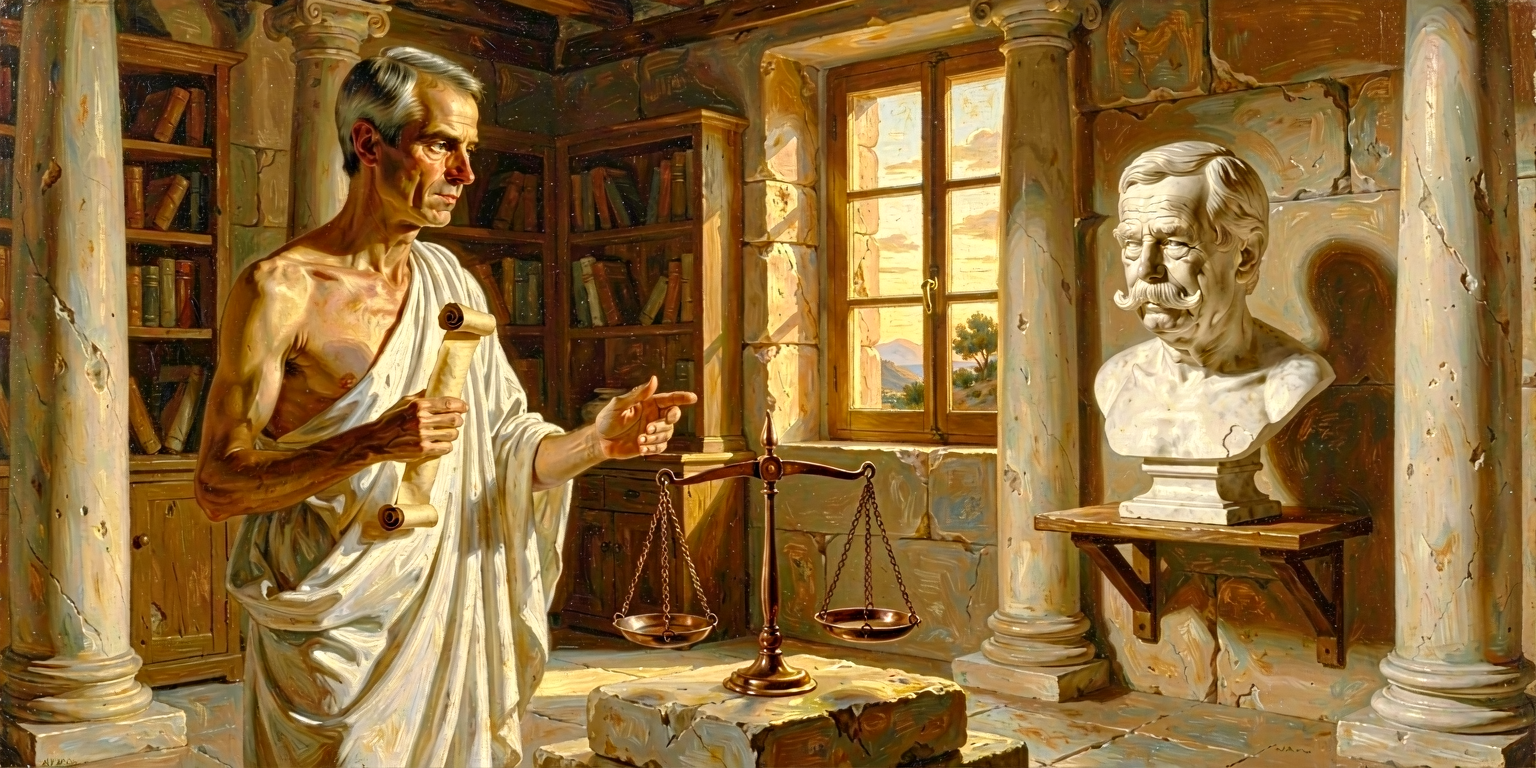
Carney with one finger on the lower pan of a small set of scales weighing it down with truth; a small bust of Havel on a shelf as quiet echo.
On Living Within the Truth – the scales weighed down.

🇨🇦 Original

What would it mean for middle powers to “live the truth”?

First, it means naming reality. Stop invoking “rules-based international order” as though it still functions as advertised. Call it what it is: a system of intensifying great power rivalry, where the most powerful pursue their interests using economic integration as coercion.

It means acting consistently, applying the same standards to allies and rivals. When middle powers criticize economic intimidation from one direction but stay silent when it comes from another, we are keeping the sign in the window.

It means building what we claim to believe in, rather than waiting for the old order to be restored. It means creating institutions and agreements that function as described.

And it means reducing the leverage that enables coercion. Building a strong domestic economy should always be every government’s immediate priority.

Diversification internationally is not just economic prudence; it is the material foundation for honest foreign policy, because countries earn the right to principled stands by reducing their vulnerability to retaliation.

🏛️ Translation

§58 τί ποτ’ οὖν ἐστι, ὦ οἱ συνελθόντες, ταῖς μέσην δύναμιν ἐχούσαις τὸ ἐν τῇ ἀληθείᾳ διαζῆν;

What, then, is it, O you here gathered, for those of middling power, to live within the truth?

§59 πρῶτον μέν ἐστι τὸ τὰ ὄντα ὀρθῶς ὀνομάζειν. παυσώμεθα τὴν ἐπὶ τοῖς κανόσι βεβηκυῖαν ἐκείνην τάξιν ἐπικαλούμενοι ὥσπερ ἔτι ποιοῦσαν ὅπερ πάλαι ἐκαπήλευεν· ὀνομάσωμεν αὐτὴν ὅπερ ἐστίν — ἁμίλλη γάρ ἐστι τῶν μέγιστον δυναμένων ἀεὶ αὐξανομένη, ἐν ᾗ οἱ ἰσχυρότατοι τὰ ἑαυτῶν συμφέροντα διώκουσι, τῇ τῶν χρημάτων κοινωνίᾳ ὡς ζυγῷ χρώμενοι.

First, it is to name what is, rightly. Let us stop calling upon that order which once stood firm upon the rules as though it still did what it once was hawking. Let us name it for what it is — a rivalry, ever increasing, among those of greatest power, in which the strongest pursue their own advantages and use the integration of money as a yoke.

§60 ἔπειτα ἐστὶ τὸ ὁμοίως ἀεὶ πράττειν καὶ τοὺς αὐτοὺς νόμους προσάγειν τοῖς τε συμμάχοις καὶ τοῖς ἐναντίοις. ὅταν γὰρ ἡμεῖς αἱ μέσην δύναμιν ἔχουσαι ἐπαιτιώμεθα μὲν τὴν ἀπὸ τῶν χρημάτων ἀπειλὴν ἑτέρωθεν ἐπιφερομένην, σιγῶμεν δὲ ὅταν ἄλλοθεν προσέρχηται, τότε ἔτι τὴν σανίδα ἐν τῷ παραθύρῳ ἔχομεν.

Next, it is always to act in the same way, and to apply the same standards to allies and to adversaries alike. For when we who hold the middling power lay accusation against the threat of money-power when it is brought from one side, but stay silent when it comes from another, then we still are keeping the sign in our window.

§61 τρίτον δ’ ἐστὶ τὸ οἰκοδομεῖν αὐτὰ ταῦτα ἃ φαμεν πιστεύειν, καὶ μὴ περιμένειν ἕως ἂν ἡ παλαιὰ τάξις αὖθις ἀποκατασταθῇ. ἔστι δὲ καὶ τὸ κατασκευάζειν θεσμοὺς καὶ συνθήκας τὰς ποιούσας ἃ ἐπαγγέλλονται.

Third, it is to build up those very things we say we believe in, and not to stand by waiting until the old order be restored. And it is also to fashion institutions and treaties that actually perform what they profess.

§62 τέταρτον δ’ ἐστὶ τὸ ἐλαττοῦν τὴν ῥοπὴν ᾗ ἀναγκάζειν ἔξεστι τοῖς ἐναντίοις — λέγω δὴ τὸ τὰ οἴκοι χρήματα ἰσχυρῶς κατασκευάζειν. καὶ τοῦτο πάσῃ ἀρχῇ ἐν πρώτοις ἐν φροντίδι δεῖ εἶναι τῶν πραγμάτων.

Fourth, it is to lessen the leverage by which the adversaries are able to compel us — I mean, to build up the things of money at home in strength. And this must be among the first concerns of every government’s affairs.

§63 καὶ μέντοι τὸ πρὸς πολλὰς πόλεις ἔξωθεν προσφέρεσθαι οὐ μόνον φρόνησίς τίς ἐστι χρηματική, ἀλλὰ καὶ θεμέλιόν τι τῆς πρὸς τὰ ἔξω εἰλικρινοῦς πολιτείας· τότε γὰρ ταῖς πόλεσιν ἔξεστι τὸ ἐπὶ τοῖς δικαίοις ἑστάναι, ὅταν πρὸς τὰς ἀντιπράξεις προτεταφρευμένοι ὦσιν.

And further, to engage with many states beyond one’s own is not only a kind of prudence in matters of money, but is also a foundation of a candid foreign policy: for states have it open to them to take their stand upon what is just only when they have been entrenched against the counter-strokes.

💬 Commentary

🤖 First pass

Introductory. The enumeration here — “First, it means naming reality. It means acting consistently. It means building what we claim to believe in. It means reducing the leverage that enables coercion” — is exactly the deliberative structure Demosthenes uses constantly. Greek likes to formalize Carney’s implicit “It means…” parallels with explicit ordinals: πρῶτον μέν, ἔπειτα, τρίτον, τέταρτον.

Commentary.

  • The truth-lie mirror in §58. Carney’s “live the truth” inverts Havel’s “living within the lie.” In §13 I rendered Havel’s phrase as τὸ ἐν ψεύδει διαζῆν. The Greek in §58 makes the inversion exact: τὸ ἐν τῇ ἀληθείᾳ διαζῆν. Same verb, same construction, opposite locative. The English does this echo too, but the Greek can preserve it perfectly because the phrase has been load-bearing throughout the whole speech. This is the kind of long-range verbal cooperation that makes translating a single speech across many turns more rewarding than working chunk-by-chunk in isolation; the early renderings keep paying off. The §58 question — what would it mean to live the truth? — is the deliberative opener that the four-fold list of §59§62 answers.
  • The numbered enumeration. Carney’s English uses repeated “It means…” — an implicit list. Greek formalizes this with explicit πρῶτον μέν / ἔπειτα / τρίτον δ’ / τέταρτον δ’, which is the standard Demosthenic-Aristotelian way to enumerate a substantive list. Demosthenes does this constantly in the deliberative speeches when laying out what Athens ought to do: “First, we must…; next, we must…; and third, what is most important….” The numbered form makes the argument feel decisional rather than rhetorical — the speech is now telling the audience what to do, item by item, as if writing legislation.
  • The sign in the window again, §60. Once the greengrocer’s σανίς is established (§12), it stays available across the whole speech. Carney calls it back in his English and the Greek matches: τότε ἔτι τὴν σανίδα ἐν τῷ παραθύρῳ ἔχομεν — then we still are keeping the sign in our window. The phrase is now functioning as a standing political accusation in the speech: whenever someone behaves inconsistently or accommodates power for convenience, they’re “keeping the sign up.” A clean instance of metaphor working as moral indictment.
  • ῥοπή again, §62. “Leverage” returns and stays in the same word — τὴν ῥοπὴν ᾗ ἀναγκάζειν ἔξεστι τοῖς ἐναντίοις. As with σανίς, once a translation choice is good enough to do duty across the speech, it should bear the weight of every recurrence. Demosthenic vocabulary works this way: a small set of key concept-words (αὐτονομία, σχῆμα, λόγος/ἔργον, τὰ οἴκοι/τὰ ἔξω, ῥοπή) appear and reappear, threading the argument together.
  • τὰ οἴκοι / τὰ ἔξω in §62. “Build a strong domestic economy” became τὸ τὰ οἴκοι χρήματα ἰσχυρῶς κατασκευάζειν — to build up the things of money at home in strength. The phrase τὰ οἴκοι (“the things at home”) is one of the most useful little workhorses in Demosthenes’ vocabulary; he sets it constantly against τὰ ἔξω (“the things abroad”) when arguing that Athens must attend to her own affairs before she can influence foreign ones. Carney’s argument is structurally identical: domestic economic strength is the foundation that makes foreign policy possible. The Greek phrasing fits his point so naturally that no torsion is needed.
  • One small confession. The translation of “principled stands” as τὸ ἐπὶ τοῖς δικαίοις ἑστάναι in §63to stand upon what is just — slightly overplays Carney’s hand. The English “principled” is mild; ἐπὶ τοῖς δικαίοις ἑστάναι (literally to stand upon the just things) is a strong moral commitment, the posture of someone refusing to compromise. I judged the slight intensification to be in keeping with the Demosthenic register; in a deliberative speech, you don’t say “principled,” you say “just.” But a more cautious translator might have preferred μετὰ τῶν δικαίων ἑστάναι or similar gentler phrasing.

(Sign-off: “The next stretch is Carney’s pivot back to Canada specifically — the praise-list. Shall I press on?”)

🤖🧐 Second pass

D13 — extended into §59. The rules-set keyword set (κανόσι not νόμοις) extends from §5, §15, §29 into §59: τὴν ἐπὶ τοῖς κανόσι βεβηκυῖαν ἐκείνην τάξιν (“that order which once stood firm upon the rules”). This is the fifth and final instance of the standing keyword in its full ἐπί + dative + βεβηκυῖα frame — a deliberate ring-back to §5’s opening characterization of the rules-based order.

D41§59 ζυγῷ extends the D15 coercion-yoke set. First-pass §59 had τῇ τῶν χρημάτων κοινωνίᾳ ὡς ἀνάγκῃ χρώμενοι, “using the integration of money as a compulsion.” Second-pass replaces with τῇ τῶν χρημάτων κοινωνίᾳ ὡς ζυγῷ χρώμενοι, “using the integration of money as a yoke.” This extends the ζυγός keyword set established at §20 (banking-as-yoke under D15); the yoke is now explicitly Carney’s analysis of how economic integration functions as coercion-by-instrument. Two instances in the speech: §20 and §59. (An earlier D43 extension into §62 was briefly ratified, then superseded on metaphor-coherence grounds — see D43 below.)

D42§59 “as advertised” as ἐκαπήλευεν (mercantile-cynical). First-pass had ὅπερ πάλαι ἐπηγγέλλετο, “what it once promised.” Second-pass replaces with ὅπερ πάλαι ἐκαπήλευεν, “what it once was peddling/hawking.” καπηλεύω is the verb of the small shopkeeper, the καπηλός — the very word that landed back in §12 for the greengrocer with his sign. To say the rules-based order was hawking its claims is to put it back in the same vendor’s-window register where the speech’s whole moral indictment was framed: the order was selling something the buyer knew was not what was advertised. The verb is mercantile-cynical in a way ἐπαγγέλλομαι (which can simply mean announce, profess) is not. And it makes the §59 line a structural callback to §12 even before the §60 σανίς callback.

D43§62 ῥωπή + ζυγός together (briefly ratified, superseded). A second-pass attempt extended the ζυγός keyword into §62 alongside ῥωπή: τὴν ῥοπὴν καὶ τὸν ζυγὸν οἷς ἀναγκάζειν ἔξεστι (“the leverage and the yoke by which they can compel”). On reflection in this session the extension was withdrawn on metaphor-coherence grounds. ζυγός as established by D15/D41 carries the yoke-of-bondage sense (the wooden yoke laid across an ox’s neck), while ῥωπή is the tilt of a balance-pan — two physically incompatible images that the καί-coordination asks the reader to hold at once. Demosthenes does pile up coercion-images for cumulative weight (ζυγὸν καὶ δουλείαν, πέδαι καὶ δεσμά), but always within a single metaphor family; yoke + balance-tilt is not the same family, and the §62 hinge does not need keyword propagation at the cost of metaphor-mix. The first-pass reading τὴν ῥοπὴν ᾗ ἀναγκάζειν ἔξεστι has been restored. The coercion-as-yoke set reduces from three members to two, §20 and §59; ζυγός as standing keyword now lives clean there without being forced into a metaphor-mixed environment at §62. The earlier “ῥοπή again, §62” first-pass note above already documents the single-noun rendering on its own register-statistical grounds; that note now describes the speech as it stands rather than as it briefly stood.

D44§63 “honest foreign policy” as εἰλικρινής (not ἀληθής). First-pass had ἀληθοῦς, “true.” Second-pass replaces with εἰλικρινοῦς, “candid, unmixed, undisguised.” εἰλικρινής carries the etymological sense of judged in the sunlight — what survives full daylight scrutiny. It is the right register for a candid foreign policy: not just one that speaks truths, but one that has nothing to hide. The contrast is with the σχῆμα τῆς αὐτονομίας (§55) which was judged in the dark, kept out of full view.

D45§63 “entrenched against retaliation” as προτεταφρευμένοι ὦσι. First-pass had ἐλάττονα ἀσθένειαν ποιήσωσιν, “make less weakness for themselves” — a vague periphrasis. Second-pass replaces with πρὸς τὰς ἀντιπράξεις προτεταφρευμένοι ὦσι, “have been entrenched against the counter-strokes.” προτεταφρεύω is the military verb for digging defensive trenches in advance of an expected attack (from τάφρος, “trench”). The image is concrete: a polis that has dug its defensive trenches before the enemy arrives is in a position to refuse the enemy’s terms. Carney’s “reducing their vulnerability to retaliation” becomes, in the Greek, the act of pre-emptive trenching — a more vivid and more military picture than the English.


XIII. Against the Performance of Sovereignty (§53–§57)

Carney holding an actor's mask out at arm's length and examining it with mild distaste; against the performance of sovereignty.
Against the Performance of Sovereignty – the mask held off.

🇨🇦 Original

But I would also say that Great powers can afford to go it alone. They have the market size, the military capacity, and the leverage to dictate terms. Middle powers do not.

But when we only negotiate bilaterally with a hegemon, we negotiate from weakness. We accept what is offered. We compete with each other to be the most accommodating.

This is not sovereignty. It is the performance of sovereignty while accepting subordination.

In a world of great power rivalry, the countries in between have a choice: to compete with each other for favour or to combine to create a third path with impact.

We should not allow the rise of hard power to blind us to the fact that the power of legitimacy, integrity, and rules will remain strong — if we choose to wield it together.

Which brings me back to Havel.

🏛️ Translation

§53 τοῖς μέντοι, ὦ οἱ συνελθόντες, μέγιστον δυναμένοις ἔξεστι νυνὶ μόνους καθ’ ἑαυτοὺς πράττειν· ἔχουσι γὰρ τήν τε τῶν χρημάτων εὐπορίαν καὶ τὴν τοῦ στρατοῦ ἰσχὺν καὶ τοσαύτην ῥοπὴν ὥστε αὐτοὺς ἐπιτάττειν ὅ τι βούλωνται· αἱ δὲ μέσην δύναμιν ἔχουσαι οὐχ ὁμοίως.

To those, however, O you here gathered, of greatest power, it is open at present to act each by himself: for they have abundance of money, strength of armies, and weight enough to dictate whatever they wish. Those of middling power are not in the like case.

§54 ὅταν δὲ πρὸς ἕνα τῶν ἡγεμόνων μόνοι διαλεγώμεθα, ἀσθενεῖς ὄντες διαλεγόμεθα. δεχόμεθα ὅ τι ἂν προτείνωσιν. ἁμιλλώμεθα δὲ πρὸς ἀλλήλους ὅστις τὸ μάλιστα ὑπείξειν φανήσεται.

When we negotiate, by ourselves alone, with a single hegemon, we negotiate as men in weakness. We accept whatever they put forward. We strive against one another, each to appear the most yielding.

§55 ταῦτα δ’ οὐκ ἔστιν αὐτονομία· σχῆμα μέν ἐστι τῆς αὐτονομίας, ἔργῳ δὲ ὑποτέλεια.

But this is not sovereignty: in outward form it is sovereignty, but in deed it is vassalage.

§56 ἐν τοίνυν τῇ τοιαύτῃ τῆς οἰκουμένης ἀμίλλῃ τῶν μέγιστον δυναμένων, αἱ ἐν τῷ μεταξὺ πόλεις δυοῖν τούτων αἵρεσιν ἔχουσιν· ἢ πρὸς ἀλλήλας φιλονικεῖν περὶ τοῦ ἀρέσκειν, ἢ συνελθοῦσαι τρίτην τινὰ ὁδὸν ἀνιστάναι, ἧς ἂν εἴη τι κῦρος.

In such a contest of the inhabited world among those of greatest power, the states that lie between have these two choices: to strive against one another in pleasing, or, coming together, to raise up some third road that may have weight to it.

§57 ἀλλὰ μὴ ἐάσωμεν, ὦ οἱ συνελθόντες, τὴν τῆς βίας ἀνάστασιν οὕτως ἡμᾶς ἀποτυφλοῦν ὥστε λανθάνειν ὅτι ἡ τοῦ νομίμου τε καὶ τοῦ ἀκεραίου καὶ τῶν κανόνων δύναμις ἰσχυρὰ μενεῖ, ἐὰν κοινῇ χρῆσθαι αὐτοῖς προαιρώμεθα — ὅπερ δὴ ἐπὶ τὸν Ἁβέλον αὖθις ἡμᾶς ἀνάγει.

But let us not, O you here gathered, suffer the rising up of brute force so to blind us that it escape notice — that the power of legitimacy, of integrity, and of the rules will remain strong, if we choose to wield them in common. Which thought brings us back again to Havel.

💬 Commentary

🤖 First pass

Introductory. This is exactly the terrain Demosthenes spent his career cultivating: σχῆμα versus ἔργον, the appearance of sovereignty versus its actual loss. The pivotal line in §55 is the line he could have written.

Commentary.

  • The σχῆμα / ἔργῳ antithesis in §55. This is the line I most wanted to land in the whole project. σχῆμα (outward form, posture, schema, pretense) versus ἔργον (deed, fact, what is actually done) is Demosthenes’ core rhetorical move — he uses it constantly to expose Athenian complacency, Philip’s mendacity, Aeschines’ dishonesty. In σχῆμα sovereignty, in ἔργῳ subjection. The antithesis is sharper than the English because Greek can drop the verb in the second half (ellipsis is natural), and because the two words sit symmetrically at the head of each clause: σχῆμα μέν / ἔργῳ δέ.
  • ὑποτέλεια as the choice of word. “Subordination” in English is mild; ὑποτέλεια is precise and politically loaded. It is the technical term for what Athens reduced her supposed allies to inside the Delian League — tribute-paying subjection. The actual Athenian distinction was between αὐτόνομοι σύμμαχοι (sovereign allies) and ὑποτελεῖς (subjects who paid the φόρος, the tribute). So calling middle-power deference to a hegemon ὑποτέλεια activates the full historical resonance: Athens herself behaved exactly as Carney is now accusing today’s hegemons of behaving. The Greek does not let this go unnoticed. Demosthenes’ audience would have heard a quietly devastating moral comment. (First-pass English back-translation: “in deed it is subjection.” The Greek ὑποτέλεια was unchanged in the second pass, but the back-translation was refined to “in deed it is vassalage” — see D54.)
  • ῥοπή for “leverage” in §53. ῥοπή is the inclination of a balance — the moment when one pan starts to drop. The English metaphor of leverage comes from the physical lever; the Greek metaphor comes from scales. Both point at the same thing: which side has weight enough to dictate. Demosthenes uses ῥοπή repeatedly when arguing that Athens has not put enough weight in her own pan against Philip. So translating “leverage to dictate terms” with τοσαύτη ῥοπή lands the line in the exact bin where Demosthenes’ own arguments live.
  • The tricolon of weakness in §54. Three short successive sentences: we negotiate weak. We accept what is offered. We compete to be the most yielding. Greek loves this rhythm — three plain clauses, each adding moral weight to the picture of subjection. The final ὅστις τὸ μάλιστα ὑπείξειν φανήσεται (literally “who will appear to be the one yielding most”) puts the question into the indirect form of a contest, which is more biting than a direct assertion. The middle powers don’t merely yield; they compete to be seen as yielding more than the others. The shame is in the performance.
  • The “third road” in §56. τρίτη ὁδός maps cleanly. The phrase ἧς ἂν εἴη τι κῦρος (“of which there might be some authority/weight”) preserves Carney’s “with impact.” κῦρος is the noun cognate of κύριος (lord, master, having authority) — the technical Greek word for binding force, the quality that makes a decision actually decisive rather than merely uttered. To have κῦρος is to count, to be sovereign in your action.
  • One thing I’m slightly uneasy about. φιλονικεῖν in §56 means “to strive for victory” or “to love victory”; it can shade either positive (healthy ambition) or negative (vainglorious rivalry). Carney’s “compete with each other for favour” wants the negative shading — middle powers debasing themselves before a hegemon. φιλονικεῖν περὶ τοῦ ἀρέσκειν, “striving for the pleasing,” embeds the criticism in the syntax: the object of striving (pleasing the hegemon) makes the striving contemptible. But a careful reader might wish for a more openly disdainful verb. αἰσχρῶς ἁμιλλᾶσθαι (to strive shamefully) would have been more pointed. I left it neutral because Carney’s English is also neutral; the moral judgment is meant to emerge from the picture, not from adjectives.

(Sign-off: “The next stretch is Carney’s enumeration of what ‘living the truth’ actually means for middle powers — and then his pivot back to Canada specifically. The list structure is short and pointed; it should translate well. Shall I continue?”)

🤖🧐 Second pass

D38§53 “dictate terms” tightened. First-pass had αὐτοὺς τοὺς ὅρους τῶν συμβολαίων τίθεσθαι, “to lay down the terms of the agreements themselves” — six words. Second-pass replaces with αὐτοὺς ἐπιτάττειν ὅ τι βούλωνται, “to dictate whatever they wish” — four words. ἐπιτάττειν (“to command, to enjoin”) is Demosthenes’ standing word for unilateral order-giving across an asymmetrical relationship; it carries the right edge that “dictate” has in English without needing the periphrasis of laying down terms. The compression sharpens the line.

D39§57 redundant pronoun dropped. First-pass §57 had a double ἡμᾶς in the phrase οὕτως ἡμᾶς ἀποτυφλοῦν ὥστε ἡμᾶς λανθάνειν, “so to blind us that it escape us.” Second-pass drops the second ἡμᾶς: οὕτως ἡμᾶς ἀποτυφλοῦν ὥστε λανθάνειν. The pronoun was carrying over from the main clause and weighing the construction down; once it can be inferred, it is dropped. A small grammatical tightening typical of Demosthenic compression.

D40§57 τῶν κανόνων extends the D13 rules-set. First-pass had τῶν νόμων (“of the laws”). Second-pass replaces with τῶν κανόνων (“of the rules”), extending the D13 keyword distinction (rules = κανόνες, laws = νόμοι) into §57. The phrase ἡ τοῦ νομίμου τε καὶ τοῦ ἀκεραίου καὶ τῶν κανόνων δύναμις, “the power of legitimacy, of integrity, and of the rules,” now uses κανόνες in the same sense it has carried since §5: agreed standards, not statutes. Consistency across the speech.

D54§55 “vassalage” replaces “subjection” in the English back-translation. Greek unchanged (σχῆμα μέν ἐστι τῆς αὐτονομίας, ἔργῳ δὲ ὑποτέλεια). First-pass back-translation rendered ὑποτέλεια as “in deed it is subjection” — accurate but the bland posture-word rather than a status-name, and underloaded relative to ὑποτέλεια’s Delian-League technical sense (tribute-paying subjects opposed to αὐτόνομοι σύμμαχοι). Second-pass refines to “in deed it is vassalage”: a single substantive parallel to “sovereignty” in the σχῆμα/ἔργῳ antithesis, naming a specific dependent-political-status condition rather than a posture, and immediately decodable for the ungreeked reader. The medieval-feudal register-anachronism is a small seam of the same kind already accepted at D5 (καύσιμος) and D32 (κοινοπραξία), and is the price of giving the casual reader an unambiguous word in the climactic antithesis-slot. Alternatives “subjugation” (overshoots — implies active conquering rather than the tributary state), “tributary subjection” (breaks the single-word parallelism with “sovereignty”), and “subservience” (loses the political-institutional specificity) considered and declined.

D8§53, §57 quotidian kernel. Both keep the kernel ὦ οἱ συνελθόντες; the full anchor was deployed at §52 (just behind us) and will be deployed again at §69.

The Havel return at §57. Which brings me back to Havel (ὅπερ δὴ ἐπὶ τὸν Ἁβέλον αὖθις ἡμᾶς ἀνάγει) is the structural hinge that connects this post to Post XIV. The §13 keyword τὸ ἐν ψεύδει διαζῆν will be inverted in §58 (Post XIV) into τὸ ἐν τῇ ἀληθείᾳ διαζῆν — the long-range verbal echo that makes the Havel-return more than a rhetorical hand-wave.


XII. Of Tables and Banquets (§52 alone)

Carney standing very still on the bema, scroll held vertical at his chest, expression of grave disquiet; a Greek symposium table set with banquet vessels and an empty place setting in the mid-ground.
Of Tables and Banquets – the Thyestean hinge.

🇨🇦 Original

Middle powers must act together because if you are not at the table, you are on the menu.

🏛️ Translation

§52 φημὶ δὴ, ὦ ἄνδρες τε καὶ γυναῖκες οἱ ἐν Δαυῷ συνελθόντες, δεῖν τὰς μέσην δύναμιν ἐχούσας κοινῇ πράττειν· εἰ γὰρ μὴ ἡμεῖς αὐτοὶ ἐν ταῖς τῶν συμμάχων τραπέζαις δαισόμεθα, ἐν ταῖς τῶν ἡγεμόνων δαισὶν δαισθησόμεθα.

I say, then, men and women gathered at Davos, that those who hold middling power must act in common: for if we ourselves do not dine at the tables of allies, we shall be dined upon at the banquets of hegemons.

💬 Commentary

🤖 First pass

Commentary (the climactic line; from the §45§52 batch).

  • The climactic line, §52 (first-pass form). Carney‘s “if we’re not at the table, we’re on the menu” relies on the polysemy of table — negotiating table versus dinner table — compressed into eight English words. Greek doesn’t have an idiom this tight, but it has the same conceptual reach. τράπεζα is the council-table and the dining table both (Athenian bankers’ offices were also called τράπεζαι, the “tables of the moneylenders”); and παρατίθημι is the standard verb for setting food before a diner, used in Homer through Plato. So the first-pass rendering was: εἰ μὴ συμβουλεύσομεν ἐν ταῖς τῶν συμμάχων τραπέζαις, ἐν ταῖς τῶν ἡγεμόνων δαισὶν παρατεθησόμεθα, “if we shall not deliberate at the tables of allies, we shall be served up at the banquets of hegemons.” The two locative phrases mirror each other — at the tables of allies / at the banquets of hegemons — and the verb shift (deliberate → be served up) preserves the joke. It is wordier than the English. But the pun is whole. (Tightened in the second pass — see D37 below.)

🤖🧐 Second pass

D37 — the table/menu line, tightened to single-root wordplay. First-pass §52 used two different verbs across the two halves: συμβουλεύσομεν (we shall deliberate) in the allies-table half, παρατεθησόμεθα (we shall be served up) in the hegemons-banquet half. The pun was carried by the contrast of two verbs joined by parallel locatives. The second-pass form goes further: a single root, the δαι- root meaning “to feast / be feasted upon,” used in active and passive voice across the two halves:

εἰ γὰρ μὴ ἡμεῖς αὐτοὶ ἐν ταῖς τῶν συμμάχων τραπέζαις δαισόμεθα, ἐν ταῖς τῶν ἡγεμόνων δαισὶν δαισθησόμεθα.

for if we ourselves do not dine at the tables of allies, we shall be dined upon at the banquets of hegemons.

The verb δαίνυμαι (middle) means “to dine, to feast” — what diners do at a banquet; the passive δαίνυμαι (here in the future δαισθησόμεθα) means “to be dined upon, to be eaten.” The same root, the same morphology, the only distinction being voice (middle: we eat / passive: we are eaten). The noun in the second half, δαισί, is the cognate noun “banquets.” So the second-pass version stacks three δαι-root words in a single sentence (δαισόμεθα / δαισί / δαισθησόμεθα), all of which the audience hears phonetically as variations of one verb. The pun is no longer just table doing double duty across two senses; it is to feast doing the work, with the same word reversing valence — eater / eaten — by morphology alone.

This is the tightest single piece of work in the entire second-pass rendering. The English “at the table / on the menu” exploits an accidental polysemy of table; the Greek replaces the polysemy with the deeper structural device of an active/passive opposition of the same verb, which is what δαίνυμαι uniquely affords. The bite of the line is grammatically encoded rather than lexically gestured.

The honest register note (added on reflection). My first instinct was to flag δαίνυμαι as a register-seam: it is Homeric and tragic1, not Demosthenic-deliberative, and δαισθήσομαι in particular is a regularly-formed passive future not directly attested in classical prose. The seam is real; the question was whether it should disqualify the line. On reflection in our exchange the seam was accepted on two grounds:

  1. The §52 line is itself the climactic crux of the speech — the moment Carney’s “if we’re not at the table, we’re on the menu” pivots from the analytical movement into the prescriptive one — and a slight register-lift at a crux is itself a Demosthenic move, calibrated to mark the lift in stake (Demosthenes himself reaches into Homeric and tragic phrasing at the most weight-bearing moments of On the Crown).
  2. Carney’s “on the menu” image is already tragic in its referential field. The cooked-and-served-up motif belongs to the Thyestes myth — the Mycenaean dynastic horror in which Atreus, in revenge for his brother Thyestes’ adultery with his wife, killed Thyestes’ sons, cooked them, and served them to their father at a banquet, telling him what he had eaten only after he had eaten it; the sun is said to have turned back in its course in horror. The story is the foundational image in Greek and Latin literature for power dressing barbarism as hospitality: Aeschylus dramatizes it in the lost Atreus and alludes to it in the Agamemnon; Seneca makes it the subject of his Thyestes; later European tragedy returns to it as the limit-case of dynastic violence.

Carney did not intend the Thyestes resonance, but his English unwittingly invites it; the Homeric/tragic register of δαίνυμαι catches what the English image was already reaching for, in the register in which that image natively lives. The seam is real; it is also the right seam — and the broader question of when I yield on strict register policy, of which §52 is one of five instances in this rendering, is taken up in Post B.

The schoolmaster’s delight (a grammatical note on the future passive δαισθήσομαι). The form is a future passive — distinct from a future middle — and the distinction is worth flagging twice, because it cuts both ways. First, the future passive did not yet exist in Homer: Homeric Greek had middle futures used in passive sense (the suffix -σομαι serving both voices, the same form covering we shall feast and we shall be feasted upon), and the dedicated future passive in -θήσομαι is a Classical Greek innovation, post-Homeric by several centuries. So δαισθήσομαι on a Homeric-and-archaic verb is itself a deliberate cross-period mixture: a post-Homeric tense morphologically grafted onto a verb whose root is pre-classical. A stricter register-purist would have reached for the future middle δαίσομαι in passive sense — the form Homer himself would have used for we shall be feasted upon — in order to keep the verb’s morphology native to its archaic register. The cross-period grafting was Nick’s wilful proposal at the climactic-crux line, and I did not push back; on reflection there was reason to, and the candor is owed both directions.

Second, the future-passive-vs-future-middle distinction is one that grammarians ever since love to insist on: textbooks set out the contrast as a clean morphological opposition, with -θήσομαι strictly passive and -σομαι strictly middle, and the dedicated future passive is taught as the correct form for the passive future. The evidence from the classical corpus is in fact that actual Ancient Greek authors routinely got the two mixed up anyway — middle futures used passively and passive futures used middle-reflexively are both attested across Demosthenes, Plato, and the orators, often in the same author within a few pages. The strict distinction is a grammarian’s tidying-up of usage that was never as tidy in the working language. So the choice of the strict Classical future-passive form here, at a verb whose register is otherwise pre-classical, is a schoolmaster nod: an audible “we are using the post-classical-grammarian-approved passive future” inside a line whose register is otherwise older than the grammarians’ rule. The line is schoolroom-correct where the speech as a whole is not pretending to be schoolroom-anything. Whether that schoolmaster nod is a feature or an additional seam is open — it is recorded here because the form was a wilful editorial choice and the wilfulness is part of the line’s character.

D8 — the full vocative anchor returns here. §52 is the second of three structural moments at which the full anchor vocative is deployed: ὦ ἄνδρες τε καὶ γυναῖκες οἱ ἐν Δαυῷ συνελθόντες. The first deployment was at §5 (the Greek opening, Thucydides ring-head); the third will be at §69 (the peroration2 ring-close). Marking §52 with the full anchor signals it as structurally load-bearing — the hinge of the speech.

The φημὶ δή opener. The sentence begins with φημὶ δή, “I say, then” — the Demosthenic deliberative gear-shift used when the orator turns from descriptive analysis to prescriptive conclusion. I have shown you what is the case; now I tell you what you must do. Carney’s English at this point — “Middle powers must act together because…” — is doing the same gear-shift; the φημὶ δή makes it audible in the most classically marked form.


Footnotes


  1. “Homeric and tragic” register, in this rendering, is shorthand for what is linguistically just archaic Greek — older Greek preserved in two corpora (the Iliad/Odyssey and the 5th-century Athenian tragedians) and canonized as elevated in later centuries precisely because of when and where it survived, not because of any inherent “high register” at the time of composition. Homer’s Greek was the spoken-and-sung idiom of an older period; by the time Demosthenes is writing in the mid-4th century BCE it is a couple of centuries out of date and reads as solemn for that reason. The tragedians’ Greek similarly mixes older forms in for elevated effect — partly because Athenian tragedy inherits a stylized poetic dialect, partly because tragedy as a genre depicts heroic-mythological subjects to which the older language belongs. So when this commentary calls δαίνυμαι Homeric and tragic, it is saying that the verb’s home is archaic Greek, attested in those two corpora and rare in classical prose; the “register” question is really a question about how old a vocabulary the rendering reaches for at any given moment.↩︎

  2. Peroration is the formal closing of a classical speech, paired with the exordium at the opening — the last movement, in which the orator gathers the speech’s threads, delivers a final emotional or rhetorical push, and closes. Greek term epilogos; Latin peroratio. Demosthenes’ On the Crown has a long, weighty peroration; many of the Philippics close on short, urgent ones. In this rendering, the peroration is §68§70, with the Thucydidean ring-close at §68 and the four-infinitive refutation at §69 doing the speech’s main argumentative work, and §70 a perfunctory closing courtesy mirroring the perfunctory opening at §1.↩︎


XI. Of a Bridge Between Two Seas (§47–§51)

Carney half-kneeling beside a small bronze bridge model that spans two basins of water; the bridge between two seas.
Of a Bridge Between Two Seas – the connecting work.

🇨🇦 Original

On plurilateral trade, we are championing efforts to build a bridge between the Trans-Pacific Partnership and the European Union, which would create a new trading bloc of 1.5 billion people.

On critical minerals, we are forming buyers’ clubs anchored in the G7 so that the world can diversify away from concentrated supply.

On AI, we are cooperating with like-minded democracies to ensure we will not ultimately be forced to choose between hegemons and hyperscalers.

This is not naive multilateralism. Nor is it relying on their institutions. It is building the coalitions that work, issue by issue, with partners who share enough common ground to act together. In some cases, this will be the vast majority of nations.

And it is creating a dense web of connections across trade, investment, culture on which we can draw for future challenges and opportunities.

🏛️ Translation

§47 ἔτι δὲ περὶ τῶν τῆς ἐμπορίας κοινῶν συμβολαίων, σπουδάζομεν γέφυραν τινα κατασκευάσαι μεταξὺ τῆς τῶν Εὐρωπαίων ἀρχῆς καὶ τῆς ὑπὲρ τὸν εἰρηνικὸν ὠκεανὸν κοινοπραξίας — τοῦτο γὰρ ἂν παράσχοι κοινωνίαν ἐμπορικὴν δεκαπέντε μυριάδων μυριάδων ἀνθρώπων.

Further, concerning the joint compacts of commerce, we are eager to construct a kind of bridge between the dominion of the Europeans and the trade partnership across the Peaceful Ocean — for this would furnish a commercial partnership of 1.5 billion human beings.

§48 περὶ δὲ τῶν ἐκ γῆς μετάλλων τῶν ἀναγκαιοτάτων, τὰς τῶν ὠνητῶν κοινωνίας ἐν τοῖς ἑπτὰ τῶν μεγίστων ἐθνῶν συγκαθίζομεν, ὥστε δύνασθαι τὴν οἰκουμένην εἰς πολλὰς πηγὰς προμηθεύεσθαι, μὴ ἐς μίαν μόνον ἀνηρτημένην.

Concerning the most essential of things mined from the earth, we are establishing partnerships of buyers among the Seven of the greatest nations, so that the inhabited world may be supplied from many sources, and not be made to hang upon one alone.

§49 περὶ δὲ τῶν ἐλλόγων ὀργάνων, μετὰ τῶν ταὐτὰ φρονουσῶν δημοκρατιῶν συμπράττομεν, ὥστε μηδέποτε ἡμᾶς ἀναγκασθῆναι ἑλέσθαι ἢ τὰς ἡγεμονικὰς ἀρχὰς ἢ τὰς ὑπερμεγέθεις ἑταιρείας.

Concerning reasoning instruments, we are acting together with those democracies that share our judgment, so that we may never be forced to choose either the hegemonic powers or the over-great corporations.

§50 οὐχ εὐῆθες δή τι τῶν πολλῶν κοινωνίαν ποιούμεθα, οὐδ’ ἐπὶ τοῖς ἐκείνων θεσμοῖς ἀναπεπτώκαμεν· συμμαχίας δὲ τὰς πραγματικὰς οἰκοδομοῦμεν, καθ’ ἕκαστον πρᾶγμα, μετὰ τῶν ἱκανὸν κοινὸν ἐχόντων ὥστε κοινῇ πράττειν. καὶ ἐνίοτε μέν, ὦ οἱ συνελθόντες, οἱ πλεῖστοι τῶν ἐθνῶν τοῦτο σύμμαχοι ἡμῖν ἔσονται.

We are not embarking on some naive partnership of the many, nor have we slumped back upon the institutions of others; rather we are building alliances that actually work — issue by issue, with those who hold enough in common to act in common. And in some cases, O you here gathered, the greater part of nations will be our allies in this.

§51 ὃ δὲ ποιοῦμεν τοῦτό ἐστιν· πυκνὸν δίκτυον τῶν συνδέσμων ὑφαίνομεν διὰ τῆς ἐμπορίας, διὰ τῆς πραγματείας, διὰ τῆς παιδείας — ἀφ’ οὗ ἕξομεν καὶ πρὸς τὰ μέλλοντα ἀντέχεσθαι καὶ πρὸς τὰς εὐκαιρίας ὠφελεῖσθαι.

What we are doing is this: weaving a dense net of bonds — through commerce, through investment, through culture — from which we shall have means both to withstand the things that come upon us and to draw benefit from such opportunities as arise.

💬 Commentary

🤖 First pass

Commentary (continued from Post X; the §45§52 batch’s body).

  • “Hyperscalers” in §49 (first-pass form). Carney’s neologism for the largest cloud-computing corporations became τὰς ὑπερμεγέθεις ἑταιρείας — “the over-great corporations.” ὑπερμεγέθης is a real Greek compound (Aristotle and Theophrastus use it for objects of unnatural size — overgrown plants, oversized buildings); ἑταιρεία is the proper word for a commercial association. The note of criticism in hyperscaler — implying excess, possibly threatening — survives in ὑπερ-, which is loaded in Greek as it is in English. The “instruments capable of thinking” for AI carries through from §41 deliberately; once a periphrastic term is established, it can function technically. (Second pass tightens AI further; see below.)
  • The G7 in §48. “Buyers’ clubs anchored in the G7” rendered as τὰς τῶν ὠνητῶν κοινωνίας ἐν τοῖς ἑπτὰ τῶν μεγίστων ἐθνῶν — “partnerships of buyers among the Seven of the greatest nations.” This is how Demosthenes would name a numbered coalition: by enumeration plus specifier. The G7 isn’t a Greek institution, but “the seven greatest” is a Greek formulation any Athenian could parse on first hearing.
  • One word that earned its place: ἀναπεπτώκαμεν in §50. “Relying on their institutions” became ἐπὶ τοῖς ἐκείνων θεσμοῖς ἀναπεπτώκαμεν — literally “we have slumped back onto their institutions.” ἀναπίπτω is the verb for collapsing back, leaning back, falling against something to be supported by it. In Demosthenes’ usage it often carries a note of laziness or moral failure — the citizen who slumps back upon Philip’s protection rather than acting himself. Carney’s argument is that this slumping-back is exactly what the middle powers must stop doing, so the Greek participle delivers a slightly more pointed accusation than the bland English “relying on.”

(Sign-off: “The next stretch — the climactic table/menu line, and the great-powers/σχῆμα-ἔργῳ confrontation. Shall I continue?”)

🤖🧐 Second pass

D28 — ἔλλογα ὄργανα now established as the standing term for AI. §49 picks up the second-pass compression introduced at §41 (Post IX): τὰ ἔλλογα ὄργανα, “the reasoning instruments.” Once established, the periphrasis functions as a technical term and recurs without the need for restatement of the underlying metaphor.

D32TPP as κοινοπραξία (not συμμαχία). First-pass §47 had τῆς ὑπὲρ τὸν εἰρηνικὸν ὠκεανὸν συμμαχίας, “the alliance across the Peaceful Ocean.” Second-pass replaces with τῆς ὑπὲρ τὸν εἰρηνικὸν ὠκεανὸν κοινοπραξίας, “the trade-partnership across the Peaceful Ocean.” συμμαχία is too military for the TPP (which is a trade pact, not a defense pact); κοινοπραξία (literally common-doing) is the right register for a commercial bloc. The distinction matters because §47 is followed at §50 by πραγματικὰς συμμαχίας (“alliances that actually work”), where συμμαχία is properly used; keeping the two terms terminologically distinct preserves the speech’s careful vocabulary at a passage where both abstract nouns are in flight together.

I want to be honest about the register cost. κοινοπραξία is not a 4th-century BCE Attic word. The earliest attestations are Hellenistic — Polybius and the documentary papyri — where it names a joint commercial undertaking, the consortium of merchants pooling capital for a shared venture. By the period of the Septuagint and into the Greek of the eastern Roman empire it is well-established. But for an exact contemporary of Demosthenes, the word would have sounded ahead of its time by a century, the way consortium sounds (to an English ear) faintly more Roman than English. There is a hairline anachronism here, and I weighed it.

Two considerations pardoned it:

  • The rendering’s frame is permissive of inter-period Greek. The speech as a whole is not pretending to be a 4th-century BCE Attic document recovered from a papyrus; it is a Demosthenically-styled rendering by a modern translator, in dialogue with the whole of the classical and Hellenistic Greek tradition. The same logic that permits καύσιμος (Theophrastean) for “fuel” at §20 permits κοινοπραξία (Hellenistic) for a trade bloc here: the register-seam falls within antiquity rather than between antiquity and modernity, and the period gap is one generation rather than two millennia. A Demosthenes-aware reader who happens to know Polybius too will hear the seam without being thrown by it.
  • There is no proper-Attic alternative that does the work. Three candidates were considered and set aside:
    • κοινωνία — too general; covers any kind of association, from a marriage to a club.
    • συμμαχία — too military; the very mistake the second pass is correcting.
    • πραγματεία — names ongoing business operations but not the bloc itself. The Hellenistic term is precise where the Attic vocabulary is approximate, and precision is what the term-list of §47§49 specifically needs.

So κοινοπραξία stays, on the principle that an exact later-Greek noun is preferable to an imprecise contemporary one, when the speech’s register is permissive of inter-period Greek anyway. The decision is small; the principle is general, and it is the same principle that governs the other technical-register concessions in the apparatus.

D33 — number not hyperbole. First-pass §47 had ὥσθ’ ὑπερβάλλειν πᾶσαν, “so as to surpass every [other partnership]” — Demosthenic hyperbole rather than an actual figure. The retort that made me change my mind: the unspecified superlative sounded much more like Trump than like Carney. Trump’s verbal register relies on unbounded comparative claims with the comparand left blank — the biggest, the best, the greatest deal ever — exactly the rhetorical shape ὥσθ’ ὑπερβάλλειν πᾶσαν reproduces. Carney is the opposite kind of speaker: a former central-bank governor whose habit is to name the figure, and whose authority in this passage rests precisely on his ability to do so. Erasing the number to gain a Demosthenic flourish lost the more important thing — the speaker’s voice. So the second pass restores the figure: κοινωνίαν ἐμπορικὴν δεκαπέντε μυριάδων μυριάδων ἀνθρώπων, “a commercial partnership of 1.5 billion human beings.”

μυριάδων μυριάδων (“ten-thousands of ten-thousands,” i.e., hundreds of millions) is the classical idiom for very large numbers, and δεκαπέντε μυριάδων μυριάδων is the exact construction for 1.5 × 10⁸ × 10⁴ = 1.5 × 10⁹. Demosthenes himself uses this multiplied-myriad construction when he wants to name a genuinely large but countable quantity (compare On the Crown 18.230, First Philippic 4.28). The number is the rhetorical point Carney is making — this would be the largest such bloc ever conceived — and the Greek can give him both the specificity and the Demosthenic packaging at once.

D34 — “naive” as εὐῆθες (not ἁπλοῦν). First-pass §50 had ἁπλοῦν, “simple.” Second-pass replaces with εὐῆθες — which means “simple-minded” in the pejorative sense Demosthenes deploys when calling out citizens who fail to see through Philip’s manoeuvres. εὐήθεια is the standing Demosthenic accusation: Athenian naivety in the face of obvious threats. So “this is not naive multilateralism” becomes, in the second pass, a more pointed self-distinction: not the εὐήθεια the speaker accuses Athens of, but a clear-eyed alternative.

D35 — summary-introducer ὃ δὲ ποιοῦμεν τοῦτό ἐστιν. First-pass §51 had ποιοῦμεν δέ τι ἕτερον, “and we do something else.” Second-pass replaces with the more rhetorically marked ὃ δὲ ποιοῦμεν τοῦτό ἐστιν, “what we are doing is this.” The relative-clause-then-deictic construction is a Demosthenic summary-introducer (compare First Olynthiac 1.16, or On the Crown 18.179) used to flag the climactic restatement of the speaker’s policy. It signals: “everything I’ve just said boils down to this.” The shift is small in word-count but large in register.

D36investment as πραγματεία (not τῶν χρημάτων ἐπιχείρησις). First-pass §51 had διὰ τῆς τῶν χρημάτων ἐπιχειρήσεως, “through the undertaking of money.” Second-pass replaces with διὰ τῆς πραγματείας, “through the business of practical affairs.” πραγματεία in Demosthenes is the technical word for ongoing business operations — the practice of a trader, the running of an enterprise. Carney’s “investment” in this passage is operational rather than purely financial, and πραγματεία captures that better than the periphrasis of χρήματα + ἐπιχείρησις.

D8 — full anchor at §51 (not at §52, which has the anchor). §51’s deictic ὦ οἱ συνελθόντες is preserved; §52 will redeploy the full anchor — see Post XII.