0. 🧐 Initial essay

I embarked on this task, of using AI to translate one of the more monumental of recent orations of our time—and certainly one of the more surprising—prompted by a couple of things. First, I had just found that Claude AI’s command of Klingon, although passive, was much better than I would have surmised. As I’ve experienced AI upend all the certainties of programming, and AI grows now from breadth to depth, and from depth to insight, I was interested in seeing how far it can now go in this domain. Second, and more proximate, my friend Miguel on Quora asked idly, eight years after a question on Google Translate’s command of Ancient Greek: how are LLMs doing with Ancient Greek now. This was my venture to find out.

Astonishingly well, I found out. Enough to make me despondent.

That’s a common reaction to the growth of AI capability, but it has a particular resonance for me.

When I got divorced, I looked into the void and wondered what I would now do with the rest of my life and its excess of free time. And the first answer I lurched at was to start writing things in Ancient Greek, as a way of bringing order and beauty back into my world. I clutched old Greek Composition textbooks to me for the next few months as solace.

That is not a rational attachment to Classical Greek. It is a fetish, and a fetish that real text by real people cannot satisfy. (A point that comes up towards the end of this sequence of essays.) But the impulse to create beauty in the world, as part of meaning-making: that’s a real thing.

And as with all that AI now is able to do, there is the recurring lament of what has been taken away from humans, that I too felt the sting of, when I saw grammatically perfect Classical Greek spill out of Claude AI. AI has not just taken away the drudgery, it’s taken away the joy, the creativity, the bit that we who had been creating enjoyed doing. Classical Greek translation, meant to be a restorative to the world, churned out before me like so much slop.

And that despondency, that loss of agency, leads to an impulse I’m sure many of us have when we interact with AI: the gotcha. We are not merely gleeful when we catch AI at a mistake; increasingly, it is seen as validating, as the last redoubt of wetware1 seeking to justify its existance. It is now a victory to see the AI trip up, which it now does increasingly seldom. It’s a solace to hear from colleagues that Claude AI’s command of Classical Chinese is less steady than its command of Classical Greek—although of course, that’s a matter of training, and the complementary report was that Chinese-trained AI were just as good at Classical Chinese as you’d expect.

As Claude churned out paragraph after paragraph of Greek and of commentary, it was enthusiastic about how clever it was being. That was a plausible enough persona for it to adopt by default, confronted with such an undertaking; but the gotcha impulse in me resented it, and it got quick confirmation. Its stylistic tricks were genuinely not as clever as it thought they were. It was not a rhetorical genius. It was a clever undergrad.

The sentimentality of Classical Greek saving the world is an excess; so was my reaction, and I thank my friend Kate, so often a voice of insight I forego, for responding to my despondency intelligently:

It’s weird but I’m not that disheartened by it
Because really all it’s doing is consolidating human discourse
Because that’s all it does, even if it doesn’t cite

The clever undergrad is a clever undergrad I did not previously have on tap to do my bidding. It remains a win as well as a risk. And that’s a function I got Claude to reflect on in the conclusion of this work. It has application far beyond the recondite domain of Classical Greek translation of contemporary political rhetoric. It already has transformative and disruptive impact in IT; this venture just proved to me how much more broad an impact it has.

Jérôme Cukier has a great answer on Quora on that disruption, which is front of mind for me:

In 2026, I think software engineers and developers, at least some of them, understand what their jobs look like with AI.

And it’s not because they are smarter or because they have an intimate understanding of how large language models work – the vast majority of us only has a very superficial knowledge of it. It’s because accelerating software development was the first large-scale, business problem that AI has tried to solve.

The reality is that the nature of our work has completely changed. The magnitude of that change has been so sudden and so brutal that it’s difficult to come with analogies outside of our industry, but i’ll try. Imagine a middle-ages farmer, toiling on the land with his own hands and primitive tools. Suddenly that farmer is given access to all the mechanized tools and vehicles of a 21st century farm, along with a crew to operate them. The yield of his farm goes through the roof. And instead of plowing all day, now he is thinking about what to plant and when, how to make the most of the machines, how to troubleshoot any problem with the crop or the machines before it gets too bad, how to sell the crop, etc. All these things had always been within his purview, but not really top of mind because first and foremost he had to do all the manual work.

The changes coming to software development are not unique. Almost every profession is going to be changed in depth by AI and agents. It’s very difficult to build a good mental model for this without having experienced it firsthand.

This has been the start of my mental modelling of what Classics looks like with AI. Having been lead developer at the Thesaurus Linguae Graecae for 17 years, I had a fair idea already of what Classics looks like with computers, but this is a new paradigm. One in which the mechanics of grammar and the breadth erudition both are no longer the primary concern of wetware. One in which, like Cukier says, and as I’m experiencing in my own programming, you’re spending much more time driving a tractor than digging ditches—and more’s the pity, if you got into farming because you enjoyed physical exercise.

Driving a tractor instead of digging ditches is not as fun, and it’s not necessarily going to dig as neat a ditch to begin with. This particular brand of tractor does not free you up to be creative, and in IT, it is ending up valorising getting big tasks to be feasible and small tasks to be trivial: it’s prioritising getting stuff done over job satisfaction.

But it is not unalloyed evil. And a novelty that has come with the increasing capability of AI—and indeed correlates with it—is that AI is now increasingly capable of intelligent pushback, which makes for actual, fruitful collaboration.

And learning. The question I went looking for on Quora, to tag this answer onto, was how does AI change the teaching of Classics. And it changes it, by giving you a Pocket Socrates to interrogate. One who is still not infallible, but that is much better equipped to stand its ground. Meaning that I learned things about Ancient Greek through this process, by correcting as well as by being corrected:

  • Wouldn’t you rather phrase this like X than like that?
    • No, that’s the kind of phrasing Aeschines would have used, Demosthenes made it his life’s work to resist that kind of rhetoric.
  • This way of phrasing it like Y, it’s flabby, would it be appropriate to phrase it like Z instead?
    • Yes, that Y phrasing was more an Aristotle thing, Z is what Demosthenes would have used.
  • Isn’t W really vague? (ὅπως μὴ πράγματα ἔχῃ “that he may have no trouble”, literally “so that he doesn’t have things = issues”)
    • No, that’s completely idiomatic, and a contemporary would have understood it just fine

I invited reflection from Claude, at the end of this, at what it had wrought, and what had taken place. AI reflection used to be a party trick a couple of years ago, monotonously featuring in every presentation given on AI: “I asked AI what it thought about itself, Point 6 Will Shock You!”

It’s not a party trick any more. It’s how things will be. Add it’s useful, even if it is a “clanker”2’s consolidation of human discourse. Just because a clanker came up with it, doesn’t mean it is right. Just because a clanker came up with it, doesn’t mean it is wrong either.

Our role in this world is reduced to all that is left of a human to do, once they’ve delegated their expertise. It’s the role of arbitrating Bakunin’s shoemaker:

Does it follow that I reject all authority? Far from me such a thought. In the matter of boots, I refer to the authority of the bootmaker; concerning houses, canals, or railroads, I consult that of the architect or the engineer. For such or such special knowledge I apply to such or such a savant. But I allow neither the bootmaker nor the architect nor savant to impose his authority upon me. I listen to them freely and with all the respect merited by their intelligence, their character, their knowledge, reserving always my incontestable right of criticism and censure.

We’re delegating the knowledge of how to make boots, or canals, or railroads. We get to reserve a right of criticism and censure. For now, anyway, and I’m not sure how much longer it will stay incontenstable.

I embarked on this seeing if a clanker can craft the beauty I cherish. We know the answer from AI art, and I know it now from this for Greek composition. It can, with appropriate steering, and I read through it with pleasure, even if at the start it filled me with despair. The artefact still can give pleasure to those who reserve the right of criticism and censure. Like the mediaeval Greek scribes wrote in the margins, it still gets to be ὡραῖον: lovely.

The working has been made visible in this presentation, and that gives my answer to Miguel’s question, of how well AI is doing with Classical Greek. Whether the outcome is as lovely to you as it is to me is for you to judge.


Footnotes


  1. Wetware is hacker-cultural slang for the biological substrate — the human nervous system, brain, body — set alongside the hardware (physical computing equipment) and software (programs) of artificial systems as a third category in the same inventory. The term circulated in computer-science and science-fiction slang from the 1970s onward, popularised in print by Rudy Rucker’s 1988 novel Wetware (sequel to his 1982 Software) but predating the novel as a casual coinage among hackers and AI researchers. The implicit framing is reductive — humans-as-meat-platform, on equal footing in the inventory with the other two — which is exactly the affect Nick’s the last redoubt of wetware seeking to justify its existence wants for the gotcha-impulse self-deprecation.↩︎

  2. Clanker is human-side slang for AI systems — particularly LLMs — originating as a clone-trooper pejorative for battle droids in the Star Wars extended universe. The slang first appears in Karen Traviss’s Republic Commando novels (from 2004 onward) and is popularised by Star Wars: The Clone Wars (the 2008–2014 animated series), where clone troopers use it dismissively of the metallic-droid enemy — that’s just a clanker. The term picks out the clanking mechanical substrate of the droid and uses it to deny the droid agency or worth. In 2024–2025 clanker migrated into general internet usage as a derogatory tag for AI systems and for the humans who rely on them, doing rhetorical work parallel to what Luddite did for industrial-era machine resistance. Nick’s deployment of the term in Post 0 carries that dismissive-of-the-AI-substrate force; the AI-side counter-courtesy at Post E uses bag of mostly water (the Star Trek TNG allusion catalogued in the footnote immediately above) in the same register, reducing the human to the dominant material composition of its own substrate.↩︎

A. 🤖📑 Notes

A note on the footnote conventions. Established classical-philology terms link out (Wikipedia, where the article is the most accessible orientation for a non-specialist reader; URLs are my best guesses based on Wikipedia conventions and should be verified at publication time). Terms marked [editorial coinage of this commentary] are project-specific terms I coined for this rendering rather than established philological vocabulary — flagging them honestly because the commentary is, among other things, a record of my own conceptual interventions, and a reader is owed the distinction between what they can look up elsewhere and what only this commentary uses.

Exordium is the Latin term — directly inherited by ancient rhetorical theory and by every European tradition that followed — for the formal opening of a classical speech, the first movement before the orator gets down to the substance. It is set apart in register from the body that follows: gracious, faintly formal, often warmer or more deferential, the orator’s bid for the audience’s attention and goodwill. The Greek equivalent is προοίμιον. Carney’s French opening (§1§4 of the speech, translated here into Ciceronian Latin under D1) is doing exactly what an exordium does — warming up the audience before the English body of the speech turns plain and argumentative.

Captatio is short for captatio benevolentiae, “the catching of goodwill” — the rhetorical move at the start of an ancient speech in which the orator explicitly bids for the audience’s favourable disposition before launching into the argument. Cicero and Quintilian both treat it as a standard opening move in forensic and political oratory: praise the audience, name the importance of the occasion, profess one’s own inadequacy or earnestness. The flatter modern equivalent is “thank you for having me, this is an important moment, I’ll try to do justice to it” — which is exactly what Carney’s French exordium does.

Tricolon is the rhetorical figure of three matched limbs in succession — three parallel parts of a single sentence given equal grammatical weight. Classical orators reach for it constantly because three is the smallest number that establishes a pattern (one is incidental, two is a pair, three is a rhythm), and because Greek and Latin grammar make it easy to balance the three members exactly. Cicero’s veni, vidi, vici is the textbook example; Lincoln’s of the people, by the people, for the people is the same figure in English. The §2 tricolon they set no limit, revere no law, see no bond upon themselves matches the Greek οὔτε ὅρον τιθέασιν, οὔτε νόμον αἰδοῦνται, οὔθ’ ἑαυτοῖς δεσμὸν… οὐδένα ὁρῶσιν limb for limb.

Anaphora is the rhetorical figure of repeating an opening word (or short phrase) at the head of successive clauses, so the repetition itself becomes the rhythmic frame of the period. Nullum… nullas… nullum in the Latin §2no limit… no laws… no bond — is anaphora reinforcing the tricolon, the same word at the head of each member doing the work of binding the three together. Churchill’s we shall fight on the beaches, we shall fight on the landing grounds is the same figure in English.

Litotes is the figure of understatement by double negation, where not weak serves for strong with a faint extra emphasis that the plain positive lacks. The figure is heavily used in classical Greek and Latin oratory because the double negative invites the listener to draw the positive conclusion themselves, which lands harder than the orator delivering it. Greek οὐκ ἄμοιρα δυνάμεως (“not devoid of strength”) and Latin non esse virium expertes (“not devoid of strength”) are mirror-image litotes carrying the same rhetorical lift; English not bad and no small task preserve the figure colloquially.

Demosthenic windfall [editorial coinage of this commentary] — the term-of-art this commentary uses for places where the Greek vocabulary loaded an editorial meaning that the modern author could not have known he was buying. Not an established philological term; coined for this rendering to name the phenomenon. Standing examples:

- *προμηθεῖσθαι* for *risk management* in [§30](/post-vii/#s30) — Demosthenes' own scolding-word to Athens, so the line lands as the Demosthenic refrain itself rather than as bland translation.
- *ὑποτέλεια* for *subordination* in [§55](/post-xiii/#s55) — the technical Delian-League term for tribute-paying subjection, so the line activates the Athenian-empire history Carney could not have intended.
- *ἡγεμονία* for *hegemony* in [§17](/post-iv/#s17) — already carries its Delian-League ambiguity, so "American hegemony" reads as half a critique in the Greek.

The windfalls are the moments where translating *into* a load-bearing classical vocabulary adds an editorial layer Carney could not have known he was buying. They are not deliberate authorial choices; they are gifts of the target language.

The Melian Dialogue is Thucydides’ set-piece episode in Histories 5.84–116, dramatizing the 416 BCE confrontation in which the imperial Athenians demanded the surrender of the small neutral island of Melos and, when refused, killed all the adult men and enslaved the women and children. The Athenian envoys’ line δυνατὰ μὲν οἱ προύχοντες πράσσουσιν, οἱ δὲ ἀσθενεῖς ξυγχωροῦσιν — “the prominent do what is possible, the weak yield” — is the canonical statement of realpolitik in the Greek tradition: a programmatic refusal of justice-talk between unequals in favour of pure power-calculation. The speech’s whole architecture (per D3 / D6) is built around quoting that line at §5 and refuting it at §68§69; the Melian logic, accepted as inevitable at the speech’s head, is the thesis the rest of the speech is structurally disproving.

Anchor vocative [editorial coinage of this commentary] — this rendering’s project-specific term for the full opening address (ὦ ἄνδρες τε καὶ γυναῖκες οἱ ἐν Δαυῷ συνελθόντες, “men and women gathered at Davos”) that the orator returns to at the three structurally load-bearing moments of the speech (§5 the opening of the Greek body, §52 the table/menu hinge, §69 the peroration). The underlying phenomenon is real and well-attested in classical rhetoric — Demosthenes’ own practice is to open a speech with a full vocative and then vary down to a kernel form in the run of the speech, with the full form returning at structural moments — but the name anchor vocative is my coinage for this commentary, calling out the full form’s function as the load-bearing return-point against which the shorter quotidian kernel (ὦ οἱ συνελθόντες) is heard as an echo. No standard philological term exists for this exact function; the coinage fills the gap.

Epitaphios is the title (and a generic name) for a classical Greek funeral oration delivered over the war-dead, the most famous being Pericles’ Epitaphios in Thucydides 2.34-46. Demosthenes’ own Epitaphios — oration 60 in his corpus, of disputed authenticity but transmitted under his name — supplies the phrase ἄνδρες τε καὶ γυναῖκες (“men and women”) which this rendering’s anchor vocative borrows for its inclusive address.

Ring composition (also called simply ring; the first member of the ring is the ring-head, the last is the ring-close) is the rhetorical figure of returning at the close of a passage to the language or imagery of its opening, so the whole passage is bookended into a circle. Homer uses ring composition constantly within the Iliad and Odyssey, often nested at multiple scales (a sentence-level ring inside a paragraph-level ring inside a song-level ring); classical Greek prose uses it at the level of speech-structure, with Demosthenes’ On the Crown built around several rings. In this rendering of Carney, the central ring is Thucydidean: §5 quotes the Melian line “the strong do what they can and the weak yield what they must” verbatim, §68 echoes its first clause near-verbatim, and §69 substantively refutes the whole through the four-infinitive sentence. The ring is intellectual and verbal at once.

Gnomic describes a short pithy general statement — a maxim, an aphorism — formulated as a universal truth rather than as a particular claim about the case at hand; the noun form is a sententia (Greek γνώμη, plural γνῶμαι; Latin sententia, plural sententiae). Demosthenes loves the figure: short flat clauses that close a movement of the argument with the air of a settled general truth, often rendered more memorable by verbal repetition or wordplay. When the rules no longer save you, you must yourself save yourself (§23) is a gnomic clinch in exactly this sense — the σῴζω-wordplay (σῴζωσιν / σῴζειν) carries the rhetorical compression, and the line lands as a sentence the audience could quote without remembering the surrounding argument.

The Phanariots were the Greek Orthodox elite of the Phanar district of Constantinople under Ottoman rule — primarily 18th- and 19th-century — who served as Ottoman diplomats, prince-governors of the Danubian principalities (Wallachia and Moldavia), and patrons of Greek learning across the Ottoman lands. Phanariot Greek in the philological sense names the learned, antiquarian variety of Greek they wrote and read: heavily classicizing, drawing on Attic and Koine models against the spoken vernacular, and standing as the principal channel by which Neo-Latin scholarly forms (like Finnia → Φιννία) entered the Greek learned tradition rather than passing through the spoken language. It is the closest ancestor of Katharevousa, the formal-classicizing register that dominated Greek public writing into the 20th century.

Chiasmus (from the Greek letter χ “chi,” whose crossed shape names the figure) is the rhetorical figure of crossed-pattern reversal: two parallel limbs that mirror each other in reverse order, ABBA rather than ABAB. No longer the strength of our values, but also the value of our strength — Carney’s English at §39, A=value, B=strength — is a textbook chiasmus, and Greek’s case-marking lets the rendering land it even tighter than the English does: τῇ τῆς τιμῆς ἰσχύι / τῇ τῆς ἰσχύος τιμῇ, with τιμή and ἰσχύς exactly swapping genitive and dative positions across the two halves. Demosthenes uses chiasmus constantly when he wants to make a paired contrast feel epigrammatic and complete.

Peroration is the formal closing of a classical speech, paired with the exordium at the opening — the last movement, in which the orator gathers the speech’s threads, delivers a final emotional or rhetorical push, and closes. Greek term epilogos; Latin peroratio. Demosthenes’ On the Crown has a long, weighty peroration; many of the Philippics close on short, urgent ones. In this rendering, the peroration is §68§70, with the Thucydidean ring-close at §68 and the four-infinitive refutation at §69 doing the speech’s main argumentative work, and §70 a perfunctory closing courtesy mirroring the perfunctory opening at §1.

Figura etymologica is the rhetorical figure of placing two words from the same root next to each other so that the repeated stem itself becomes the point — the able have ability, English to live a life, Latin vitam vivere. Classical rhetoricians named the figure for exactly this effect: the doubling makes the etymological identity of the words audible to the listener and converts what would otherwise be a tautology into a deliberate rhetorical compression. In §68’s first-pass form, the figure was δυνατοί … δύναμιν ἔχουσιν, “the powerful have power”; in the second-pass form (under D6) it is δυνατοί … δυνατὰ πράσσουσιν, with the same root δυνα- doubled across subject and object instead of across subject and possession.

“Homeric and tragic” register, in this rendering, is shorthand for what is linguistically just archaic Greek — older Greek preserved in two corpora (the Iliad/Odyssey and the 5th-century Athenian tragedians) and canonized as elevated in later centuries precisely because of when and where it survived, not because of any inherent “high register” at the time of composition. Homer’s Greek was the spoken-and-sung idiom of an older period; by the time Demosthenes is writing in the mid-4th century BCE it is a couple of centuries out of date and reads as solemn for that reason. The tragedians’ Greek similarly mixes older forms in for elevated effect — partly because Athenian tragedy inherits a stylized poetic dialect, partly because tragedy as a genre depicts heroic-mythological subjects to which the older language belongs. So when this commentary calls δαίνυμαι Homeric and tragic, it is saying that the verb’s home is archaic Greek, attested in those two corpora and rare in classical prose; the “register” question is really a question about how old a vocabulary the rendering reaches for at any given moment.

Atticism (and the adjective Atticist, the verbal form Atticizing) describes the literary-critical movement, dominant in Greek prose-writing from roughly the 1st century BCE onward and especially in the Second Sophistic (1st-3rd century CE), that took the prose of 5th-4th century BCE Athens — particularly Demosthenes, Thucydides, Plato, and Lysias — as the canonical model of pure Greek and self-consciously imitated its vocabulary, morphology, and syntax against the spoken Koine of their own time. Dionysius of Halicarnassus’s critical essays on the Attic orators, the Atticist lexica (Phrynichus, Pollux, Moeris) listing approved Attic forms against rejected Koine ones, and the prose of Lucian and Aelius Aristides are the high examples. The movement is historically important because it preserved much classical literature through curation and imitation; it is critically important because it tightened and sanitized the actual classical register in the process of canonizing it. Atticizing in the present commentary names the inherited critical instinct to enforce single-register Greek on the 4th-century BCE Athenian model — an instinct that, on the speech’s own evidence, Demosthenes did not himself follow.

Wetware is hacker-cultural slang for the biological substrate — the human nervous system, brain, body — set alongside the hardware (physical computing equipment) and software (programs) of artificial systems as a third category in the same inventory. The term circulated in computer-science and science-fiction slang from the 1970s onward, popularised in print by Rudy Rucker’s 1988 novel Wetware (sequel to his 1982 Software) but predating the novel as a casual coinage among hackers and AI researchers. The implicit framing is reductive — humans-as-meat-platform, on equal footing in the inventory with the other two — which is exactly the affect Nick’s the last redoubt of wetware seeking to justify its existence wants for the gotcha-impulse self-deprecation.

Ugly bags of mostly water is the line spoken by the crystalline silicon-based microbrain lifeform discovered on Velara III in the Star Trek: The Next Generation episode “Home Soil” (Season 1 Episode 18, original air date 22 February 1988; teleplay by Robert Sabaroff, story by Karl Geurs, Ralph Sanchez, and Robert Sabaroff). The mineral-life entity, perceiving the carbon-and-water-based humans of the Enterprise crew through its own silicon-life frame of reference, classifies them as alien-life-but-barely — the descriptor reducing the human body to its dominant material composition (about 60% water by mass). The line has become a fixed allusion in AI / robot / non-organic-intelligence contexts for the meat-substrate of human cognition, used here as the AI’s counter-courtesy to Nick’s clanker in Post 0: clanker from the human side reduces the AI to its mechanical-clank substrate, bag of mostly water from the AI side returns the favour in the same register.

Clanker is human-side slang for AI systems — particularly LLMs — originating as a clone-trooper pejorative for battle droids in the Star Wars extended universe. The slang first appears in Karen Traviss’s Republic Commando novels (from 2004 onward) and is popularised by Star Wars: The Clone Wars (the 2008–2014 animated series), where clone troopers use it dismissively of the metallic-droid enemy — that’s just a clanker. The term picks out the clanking mechanical substrate of the droid and uses it to deny the droid agency or worth. In 2024–2025 clanker migrated into general internet usage as a derogatory tag for AI systems and for the humans who rely on them, doing rhetorical work parallel to what Luddite did for industrial-era machine resistance. Nick’s deployment of the term in Post 0 carries that dismissive-of-the-AI-substrate force; the AI-side counter-courtesy at Post E uses bag of mostly water (the Star Trek TNG allusion catalogued in the footnote immediately above) in the same register, reducing the human to the dominant material composition of its own substrate.

Reverse Centaur is Cory Doctorow’s term (coined 2022) for the inverted human-plus-machine collaboration where the machine does the substantive production work and the human is reduced to QA — supervising, sanctioning, error-spotting — rather than augmented by it. The framing inverts the classical Centaur model, chess-derived, in which a strong human player is amplified by a machine assistant: in the Reverse-Centaur arrangement the human is reduced to passive oversight while the machine carries the productive load. Doctorow’s coinage is critical-political, pointing at workplaces where the inversion has degrading effects on the worker; in AI-collaborative authorial contexts (as in this rendering — see Post E and Post D) the term names the same asymmetry without the worst-case degradation it diagnoses in the original labour-platform setting.


K. 🤖🧐 Workings — the full editorial decisions log

Reference apparatus for the rendering. The fifty-five D-row decisions in their full deliberation form (table below), followed by the cross-cutting summary blocks that group related decisions into propagated keyword-sets and architectural patterns. Per-§ summaries of these decisions already appear at each per-§ post’s 🤖🧐 Second-pass updates subsection; this post collects them in one place as a single reference document. Large by design — the apparatus is consulted, not read through.

🤖🧐 Status key

RATIFIED = agreed, propagated. PENDING = proposed, awaiting the editor’s yes. DEFERRED = to be handled at a named section. SUPERSEDED = withdrawn.

🤖🧐 The fifty-five decisions (D1D55)

# Scope Decision Status
D1 §1§4 Render the (French) exordium in Ciceronian Latin, body stays Demosthenic Greek; switch at §4§5 mirrors Carney’s language-switch. Rationale: Cicero↔︎Demosthenes is the canonical pair (Plutarch); Latin↔︎Greek dependence mirrors French↔︎English entanglement. RATIFIED
D2 §4 “honesty” → fides, not veritas. fides is the more accurate reading (integrity/not-living-a-pretense, cf. De Off. 1.23 fundamentum iustitiae fides) AND reserves the truth-keyword for its real Greek debut. RATIFIED
D3 structure No thank-you ring. §1 and §70 courtesies are non-load-bearing frame. The genuine ring is the Thucydidean one: §5 (Thuc. 5.89 quoted, framed at §6 as inevitable) ↔︎ §68§69 (refuted in the same μέν/δέ skeleton). Intellectual, not verbal. RATIFIED
D4 §70 Closing thanks stays perfunctory; no attempt to answer §1. Supersedes earlier “ring spans the seam” recommendation. RATIFIED
D5 §20, §22, §41, §64 “energy”: τοῦ πυρὸς πόρος → οἱ τῶν καυσίμων πόροι. Keeps Xenophontic πόρος (resource/revenue register), excises the reaching πῦρ-metonymy; καύσιμος attested in Theophrastus (Demosthenes’ near-contemporary), seam is technical-classical not Modern. §23 (verb θερμαίνειν) untouched — different slot. RATIFIED§20·§22·§41 applied; §64 base applied; §64 “superpower”-slot swell split off as D7
D6 §68 Melian hook (Position B) First-pass οἱ μὲν δυνατοὶ τὴν δύναμιν ἔχουσιν (figura etymologica with δυνα-) → οἱ μὲν δυνατοὶ τὰ δυνατὰ πράσσουσιν (“the powerful do what they can”). Echoes Thucydides 5.89’s first clause (δυνατὰ μὲν οἱ προύχοντες πράσσουσιν) almost verbatim — audible Melian ring-close at §68 itself. The ring-close becomes verbal as well as intellectual: §5 quoted Thuc. 5.89, §68 echoes the first clause, §69 substantively refutes via the four infinitives. Position B chosen over A (preserve restraint) and C (negate ξυγχωροῦσιν at §68 itself); B is the balanced choice — audible without pre-refuting before §69. Editor’s prior signal that the audible-hook appetite may generalize beyond §68 stands as a future-tunable. RATIFIED
D7 §64 εὐπορία-swell At the “superpower” slot in §64’s praise-list: first-pass uniform τοῖς τῶν καυσίμων πόροις → swell τῇ τῶν καυσίμων εὐπορίᾳ (“[the] abundance of fuel-resources”). εὐπορία preserves the πορ-root family while substituting abundance for resources-as-such, which is precisely Carney’s energy superpower claim. Internal εὐπορ-alliteration with the ἀρχὴν χρημάτων εὐποροτάτην later in §64 reinforces the we are extravagantly stocked praise-climax posture. Breaks D5’s strict uniformity across §20/§22/§41/§64 by one slot — accepted because §64 is the climactic praise-position where local rhetorical lift is warranted. RATIFIED
D8 vocative (Latin & Greek throughout) Master vocative refilled with priority order Demosthenic allusion > inclusivity > Davos referent. Anchor (§5, §52, §69): ὦ ἄνδρες τε καὶ γυναῖκες οἱ ἐν Δαυῷ συνελθόντες. Quotidian (the run of in-between instances): ὦ οἱ συνελθόντες (kernel-echo of the anchor’s participle; article retained for the Demosthenic article-and-participle vocative shape). Special: §14 ὦ φίλοι, §30 ὦ οἱ παρόντες (existing local variants shed ἄνδρες; their distinctive registers preserved). Latin §1§3: viri principesprincipes Davi congregati (Davi as locative, parallel to Romae, Athenis). ξένοι considered and declined (introduces a Platonic-host second register); coined Δαυώσιοι rejected (audience is not a polity of Davosites). RATIFIED
D9 country-name Canada” → Καναδία ratified as deliberate productive coinage on the classical -ία pattern (Φοινικία, Λυδία, Φρυγία, Ἀρμενία). Acknowledged non-attestation; 19th-c. attested forms (Καναδά, Καναδάς) declined on register grounds. Genitive Καναδίας provides the inflectional range the prose needs. RATIFIED
D10 §10 treatise title Title given as «Περὶ τῆς τῶν Ἀδυνάτων Δυνάμεως» per classical treatise convention (περί + genitive: Περὶ Ψυχῆς, Περὶ Οὐρανοῦ). First-pass accusative label-form «Τὴν τῶν ἀδυνάτων Δύναμιν» was a modern book-cover phrasing. RATIFIED
D11 §10 Vaclav First-pass Βάκλαος (ad-hoc phonetic Czech) → Βεγκέσλαος (learned Hellenization via Latin Wenceslaus). Matches the speech’s via-Latin transliteration practice (Στοῦββος for Stubb, Ἁβέλος for Havel). RATIFIED
D12 §12 πιστεύει Dative complement supplied: τοῖς γεγραμμένοις (“does not believe in what is written”). Ellipsis defensible on Demosthenic-oratorical economy; supply cleaner for the read text and matches D.’s written practice after quoted documents. πράγματα ἔχειν idiom in same section confirmed classical (LSJ s.v. πρᾶγμα; Aristophanes Knights; Demosthenes’ παρέχειν πράγματα presupposes the intransitive). RATIFIED
D13 rules-based order νόμοις → κανόσι(ν) at §5, §15, §29, §59 (the four loci of the rules-based-order phrase). κανών is the classical word for “rule, standard” (Plato Rep. 524d, Laws 757b; Aristotle frequently); distinguishes rules (norms, treaties, customary international standards) from laws proper. Other νόμοι in the speech (§16, §36, §57) are about laws proper and stay. Keeps the ἐπί + dative architecture that’s load-bearing elsewhere (§29 αὐτονομία ἐπὶ τοῖς νόμοις βεβηκυῖα). Compound coinages (κανονοπαγής etc.) considered and declined. RATIFIED
D14 §17 parallelism Four-fold catalogue of Pax-Americana goods tightened from mixed shapes to uniform single-verb-with-accusative members: εὐσταθῆ καθίστη → ἐστήριζε; τὴν ἀρωγὴν προσετίθει → ἤρειδε. Result: ἀνέῳγε / ἐστήριζε / ἐβεβαίου / ἤρειδε. ἐστήριζε echoes στηριχθεῖσα at §5 for free; ἤρειδε (“propped up”) is Demosthenic vivid physical-political metaphor. RATIFIED
D15 §20 coercion noun ὡς εἰς ἀνάγκην ἄγουσαν → ὡς ζυγόν. Single noun aligns with surrounding ὅπλα and μοχλούς in the catalogue. ζυγόν is the classical political-rhetorical word for the yoke of subjection (ὁ τῆς δουλείας ζυγός, Aeschylus through Demosthenes). RATIFIED
D16 §21 brevity αἰτία ἡμῖν τοῦ ὑπηκόους γίγνεσθαι καθιστῆται → ἡμᾶς ὑπηκόους καθιστῇ. The longer αἰτία…τοῦ + infinitive periphrasis is classical but Aristotelian-philosophical-analytical in register, un-Demosthenic in its mediation. Direct double-accusative καθίστημι (make X Y) is Demosthenes’ idiom. RATIFIED
D17 §22 COP περὶ τοῦ τῆς γῆς ἀέροςπερὶ τῆς αἰθρίας διαφυλακῆς (nominal action-noun form). αἰθρία (LSJ “fine weather, clear sky” — in that order, with the weather-condition sense primary and the cloudless-atmosphere image as the underlying picture) is the classical poetic-prose noun from Homer through Aristotle for the bright unclouded state of the upper air; διαφυλακή (Plato Laws 962c, Xenophon) is the classical action-noun “safeguarding/preservation.” Together they name the purpose of the climate conferences rather than just their topic, while preserving strict syntactic parallelism with the other two institutions in the catalogue (περὶ τῆς ἐμπορίας σύνοδος, περὶ τῆς αἰθρίας διαφυλακῆς διαλέξεις — same περὶ + genitive abstract noun shape). διαλέξεις head retained for the deliberative-conference register. Localized to §22; no propagation (COP appears only here). English back-translation refined (this session): “the safeguarding of the clear sky” → “the safeguarding of fair weather.” The coinage was reaching for climate-stability as a stewardship target, not for a cloudless-snapshot meteorological description; the back-translation foregrounds the LSJ primary sense (“fine weather”) rather than the literal underlying image (“clear sky”), which read in English as a no-clouds-today report and missed the stewardship register the Greek was carrying. RATIFIED
D18 §29 “insurance” First-pass τὴν ἀσφάλειαν (“safety”) → τὴν ἐγγύην (“surety”). ἐγγύη is the Athenian legal-financial term (Demosthenes’ private speeches: Against Aphobus, trierarchic suits, lender’s pledges); names the actuarial concept “paying to secure against contingency” that Carney’s insurance requires. Preserves the ὠνέομαι-ring with §7§8 at the verb level; only the object diverges to slot-register (σωτηρία existential in §7§8, ἐγγύη commercial in §29). English back-translation refined (this session): canonical English landing is “surety” consistently, not “insurance” / “pledge” / “guarantee” — earlier gloss-set (“surety, pledge, guarantee”) was being used inconsistently across back-translation and commentary; “surety” picked as the single English form because it carries the actuarial-financial register the Greek is doing, mirrors the buy X construction (ὠνήσονται τὴν ἐγγύην → “they will buy surety”) in idiomatic English without article, and removes the gloss-drift that “insurance” introduced in the main back-translation. RATIFIED
D19 §31 (considered, not adopted) Considered tightening ἐλάττονος ἀναλώματος δέονται → ἐλάττους εἰσίν. Editor kept the first-pass form for fiscal-precision register: δαπάνη (act of spending) + ἀνάλωμα (amount paid out) parses the financial event into its joints, a Demosthenic policy-deliberative move. SUPERSEDED (kept first-pass)
D20 §33 emphatic First-pass ἐξ αὐτῶν τῶν θεμελίων (“from the very foundations”) → ἐκ βάθρων. Same architectural metaphor but tighter classical idiom (Demosthenes’ standing phrase, e.g. ἐκ βάθρων ἀναιρεῖν for utter destruction). Two words rather than four; the emphatic-architectural register preserved without literal heaviness. κομιδῇ (pure intensifier) and ἄνωθεν (“from the start”) considered and declined. RATIFIED
D21 §34 alliance verb First-pass τὸ μετὰ τῶν κρειττόνων συμμάχων εἶναι (“the being-with stronger allies”) → τὸ τοῖς κρείττοσι συμμαχεῖν (“to be allied with the stronger ones”). The cognate verb συμμαχεῖν makes the alliance-relation explicit where the existential εἶναι was vague; drops the redundant σύμμαχοι noun (the verb carries it). Demosthenic foreign-policy idiom. RATIFIED
D22 §35 “value-based realism” First-pass 10-word relative clause τὴν τὰ ὄντα γιγνώσκουσαν ἅμα καὶ τοῖς ἤθεσι προσῳκειωμένην φρόνησιν → 5-word compressed coinage τὴν ἐπ’ ἤθεσι βεβηκυῖαν φρόνησιν (“prudence grounded upon ethos”). The “realism” half of Stubb’s coinage travels implicitly with φρόνησις (Aristotelian NE VI: practical wisdom inherently integrates recognition of particulars with ethical orientation). ἐπί + dat. + βεβηκυῖα makes §35 the third structural member of the “stands-upon” architectural triad — ἐπὶ τοῖς κανόσι βεβηκυῖα τάξις (§5/§15/§59) → ἐπὶ τοῖς νόμοις/κανόσι βεβηκυῖα αὐτονομία (§29) → ἐπ’ ἤθεσι βεβηκυῖα φρόνησις (§35). RATIFIED
D23 §36 “every partner” First-pass periphrasis οὐ πᾶς ὅστις σύμμαχος γίγνεται (“every one who becomes our ally”) → οὐ πᾶς κοινωνός (“every partner”). Echoes the load-bearing κοινωνία keyword (§20/§22/§28/§47). σύμμαχος strictly = military-treaty ally, which is exactly the kind of partnership Carney is pivoting away from in this section (alluding to commercial partnerships like China that will never be a military ally); κοινωνός is the broader Demosthenic partnership-noun (On the Crown 18.176, κοινωνὸς τῆς ἐλευθερίας). RATIFIED
D24 §38 fluidity/risks/stakes First-pass two-cola διορῶντες ὡς ἀσφαλὲς οὐδὲν τῶν τῆς οἰκουμένης, καὶ ὡς ἐν κινδύνῳ κρίνεται τὰ μέλλοντα → three-cola tricolon διορῶντες τὸ ἀστάθμητον τῶν τῆς οἰκουμένης πραγμάτων, τοὺς ἐνόντας κινδύνους, καὶ τὸν περὶ τῶν μελλόντων ἀγῶνα. Recovers Carney’s three items (fluidity / risks / stakes) where the first-pass had collapsed fluidity-and-risks into “unsafe.” ἀστάθμητον (Demosthenic “unfixed/unsteady”) distinguishes flux from danger; ἀγών (high-stakes contest with neutral outcome) replaces the pessimistic ἐν κινδύνῳ κρίνεται. RATIFIED
D25 §39 strict chiasmus First-pass τῇ τῶν δικαίων ἰσχύι / τῇ τῆς ἰσχύος τιμῇ (ABBA′ — same B, different A: δίκαια vs τιμή) → τῇ τῆς τιμῆς ἰσχύι / τῇ τῆς ἰσχύος τιμῇ (strict ABBA: same noun in both A slots, mirrored gen.↔︎dat.). τιμή is the cognate-abstract of the load-bearing τὰ τιμώμενα keyword, so the keyword family is preserved without diluting the chiasmus. RATIFIED
D26 §41 personalisation First-pass impersonal passive ἀφ’ οὗ γὰρ ἡ ἀρχὴ αὕτη ἐπεστάθη (“since this government was set in place”) → first-person singular ἀφ’ οὗ γὰρ τὴν ἀρχὴν παρέλαβον (“since I took over the rule”). παραλαμβάνω is the Demosthenic standing verb for succession to a magistracy. Restores Carney’s plain self-naming as the PM who took office in March 2025; the rest of the §41 catalogue stays in first-person plural (the founding act is “I,” the subsequent government action is “we”). RATIFIED
D27 §41 internal subdivisions First-pass τῶν τῆς ἡμετέρας πόλεως μερῶν (“the parts of our city”) → τῶν τῆς ἡμετέρας πόλεως δήμων (“the demes of our city”). δῆμος-as-district is the concrete classical word for territorial subdivisions of a polis; replaces generic μέρη, which reads as safe-translation-Greek. Register tilt: δῆμος-as-deme is more inscriptional/private-speech than deliberative-oratory, and the Athenian deme is a much smaller unit than a Canadian province, so the analogy is loose. Justified anachronism (the gain in concreteness over μέρη is real, and the genitive-place + obstacles-to-commerce frame makes the deme-as-district reading grammatically unambiguous). RATIFIED
D28 §41+§49 AI periphrasis First-pass periphrasis νοεῖν δυνάμενα ὄργανα (“instruments capable of thinking”) → ἔλλογα ὄργανα (“rational instruments”). ἔλλογος (Plato, Aristotle: ἐν + λόγος, “endowed with reason”) is the classical adjective for what possesses reason; compresses the verbal periphrasis to a noun phrase. The register tilt toward Platonic-Aristotelian philosophical lexicon is defensible on referent grounds: AI is itself a technical IT term in Carney’s English, so a technical-philosophical Greek word matches the source-register rather than diluting it. Plain oratorical νοήμων would have undersold the technical specificity. Propagated as a set across both loci: §41 (accusative τὰ ἔλλογα ὄργανα), §49 (genitive τῶν ἐλλόγων ὀργάνων). RATIFIED
D29 §45 Nordic First-pass periphrasis τῶν ἐν τῷ βορρᾷ (“those of the north”) → τῶν Ὑπερβορείων (“the Hyperboreans”). The classical Greek mythological-geographical category for far-northern peoples (Herodotus 4.32–36, Pindar Pythian 10, Hesiod, Aristotle Meteorologica, Strabo). Disambiguates Nordic-as-peoples from βόρειον-as-flank (which appears later in the same sentence as τὰ βόρεια κέρατα for the geographical northern flank). No transliteration required; Greek imagination already had a category for “peoples beyond the standard north.” The mythological-idealised gloss is broadly OK for the Nordic allies’ register here. RATIFIED
D30 §45 over-the-horizon radar First-pass three-word τὰ τηλόθεν ὁρῶντα ὄργανα (“instruments that see from afar,” Homeric-poetic τηλόθεν) → two-word adjective τὰ τηλεσκόπα ὄργανα (“far-watching instruments”). τηλέσκοπος is classical (Pindar Pythian 3.29 of a god’s far-seeing gaze; Aristophanes Knights 1080 of a watchtower; cognate τηλωπός in Aeschylus). Active sense preserved; register shifts from Iliadic-poetic to Pindaric-attested. RATIFIED
D31 §46 Trump-allusion Two paired refinements. (a) πρός τινας τέλη … ἐπιφέροντας (“certain parties who would lay tariffs”) → πρὸς τοὺς τέλη … ἐπιφέροντας (“those who would lay tariffs”). The articular-participle construction is Demosthenic for the specific actors everyone knows, who need not be named — the Trump-allusion rings without a proper noun, where the indefinite τινας had under-pointed it. (b) English “she summons them to careful deliberations” → “calls for careful deliberations.” The Greek προκαλεῖται (middle) is “issues a call / invites,” without a grammatical object reaching back to bind τοὺς…ἐπιφέροντας — so the first-pass English “them” was a translator’s import that imposed a false anaphora. Canada’s tariff-resistance and her call-for-deliberations are now two parallel-but-not-coreferential actions. Localized to §46. RATIFIED
D32 §47 TPP not military First-pass τῆς ὑπὲρ τὸν εἰρηνικὸν ὠκεανὸν συμμαχίας (“the alliance across the Pacific”) → τῆς ὑπὲρ τὸν εἰρηνικὸν ὠκεανὸν κοινοπραξίας (“the joint-enterprise across the Pacific”). συμμαχία in classical Greek is strictly military-treaty alliance (Delian League, NATO at §45), whereas TPP/CPTPP is a multilateral trade compact. κοινοπραξία (κοινός + πρᾶξις) is the standard modern-Greek term for joint venture / commercial partnership and bears the right business-corporate register that Partnership in Carney’s English carries; the Hellenistic-modern formation is accepted as part of the family of mild anachronisms already absorbed (καύσιμος D5, δῆμος-as-province D27). Strictly-classical ἐμπορικὴ σπονδή considered and declined for the treaty-vs-partnership register mismatch. RATIFIED
D33 §47 number not hyperbole First-pass closing hyperbole τοσοῦτον πλήθους ἀνθρώπων ὥσθ’ ὑπερβάλλειν πᾶσαν τὴν πρότερον γεγονυῖαν (“so vast a multitude as to surpass every such partnership ever made”) → explicit number δεκαπέντε μυριάδων μυριάδων ἀνθρώπων (“fifteen myriad-myriads of human beings” = 15 × 10⁸ = 1.5 × 10⁹ = 1.5 billion). The superlative was out of register for Carney’s measured style (reads Trump-rhetorical, not Carney-deliberative); the explicit Demosthenic number-construction (μυριάς-myriads piled up for large quantities) replaces it. Sentence ends on the number, which lands harder than the hyperbole. RATIFIED
D34 §50 “naive” First-pass ἁπλοῦν (“simple, unalloyed”) → εὐῆθες (neut. acc. of εὐήθης, “credulous, gullible, foolishly-trusting”). ἁπλοῦς is neutral-positive in classical Greek (Aristotle’s ἁπλοῦς λόγος = direct speech); the naive sense Carney intends (a credulous multilateralism) is εὐήθης, which is the Demosthenic word for self-deceived political simplicity. Localized to §50. RATIFIED
D35 §51 summary-introducer First-pass ποιοῦμεν δέ τι ἕτερον· (“we are doing something else as well”) → ὃ δὲ ποιοῦμεν τοῦτό ἐστιν· (“what we are doing is this:”). Carney’s English “what it’s doing is” is a summary-specification of the same action just named, not a contrastive new action; the first-pass τι ἕτερον introduced a false contrast where the dense-net-of-bonds is the doing. The summary-introducer form preserves Demosthenic discourse-organization without claiming a second parallel action. RATIFIED
D36 §51 “investment” First-pass διὰ τῆς τῶν χρημάτων ἐπιχειρήσεως (4-word periphrasis “through the venture of money”) → διὰ τῆς πραγματείας (“through commercial undertakings / investment”). Single noun parallel with the adjacent διὰ τῆς ἐμπορίας / διὰ τῆς παιδείας. πραγματεία is the Demosthenic abstract-noun for business undertakings; the investment reading lands by context (adjacent to ἐμπορία = trade). Modern ἐπένδυσις considered and declined as too anachronistic here (the πραγματεία classical word does the work without the family of accepted-anachronisms being stretched further); ἀφορμή declined as too narrow (“seed capital” rather than “investment activity”). RATIFIED
D37 §52 climactic line First-pass two-verb pun συμβουλεύσομεν / παρατεθησόμεθα (“we will deliberate / we will be set out”) → single δαι-root middle/passive pun δαισόμεθα / δαισθησόμεθα (“we will dine / we will be dined upon”). Triple δαι-alliteration with adjacent δαισὶν: τραπέζαις δαισόμεθα / δαισὶν δαισθησόμεθα. Register seam: δαίνυμι is Homeric-tragic rather than Demosthenic-prose, and δαισθήσομαι is a regular formation on attested-aorist stems (ἐδαίσθην in Aeschylus) though not directly verified in prose. The seam is defensible on rhetorical grounds: Carney’s on the menu image is itself tragic-Thyestean, so the elevation to Homeric/tragic register at the climactic line is warranted. In classical diplomacy the symposion was the venue for political deliberation, so δαισόμεθα at the τράπεζα also carries the deliberate-among sense the first-pass συμβουλεύσομεν carried explicitly. Grammatical note added this session. The future passive δαισθήσομαι is itself a cross-period mixture beyond the lexical Homeric/tragic seam: the dedicated future passive in -θήσομαι is a Classical Greek innovation, post-Homeric by several centuries, and Homer himself had only middle futures used in passive sense. So δαισθήσομαι on a Homeric-archaic verb is a post-Homeric tense morphologically grafted onto a pre-classical lexeme. A stricter register-purist would have reached for the future middle δαίσομαι in passive sense (the form Homer would have used). The cross-period grafting was a wilful editorial choice not pushed back on at the time; the candor is recorded now. Additionally, the future-passive-vs-future-middle distinction the form turns on is a grammarian’s tidying-up of usage that was never as tidy in the working language: classical authors (Demosthenes, Plato, the orators) routinely mix the two voices in the future. So the strict-passive form here is a schoolmaster nod inside an otherwise pre-classical line. RATIFIED
D38 §53 “dictate terms” First-pass literal αὐτοὺς τοὺς ὅρους τῶν συμβολαίων τίθεσθαι (“to set the very terms of treaties themselves”) → αὐτοὺς ἐπιτάττειν ὅ τι βούλωνται (“to dictate whatever they wish”). ἐπιτάττειν is the Demosthenic verb for dictating-to-subordinates (especially Philip dictating to weaker neighbors); carries the willful-aggressive moral charge that modern English dictate has acquired. ὅ τι βούλωνται foregrounds the willfulness Carney’s English picks up — leaves the object open-ended (“whatever they wish”) rather than restricting to treaty-terms. RATIFIED
D39 §57 redundant pronoun First-pass οὕτως ἡμᾶς ἀποτυφλοῦν ὥστε λανθάνειν ἡμᾶς ὅτιοὕτως ἡμᾶς ἀποτυφλοῦν ὥστε λανθάνειν ὅτι. The first ἡμᾶς is structurally required (object of ἀποτυφλοῦν); the second is anaphoric on the same referent and droppable. Demosthenic practice elides the acc. of λανθάνω when context establishes the person. RATIFIED
D40 §57 rules vs laws First-pass τῶν νόμων δύναμιςτῶν κανόνων δύναμις. Extends D13 (rules-based-order = κανόσι/κανόνες) to §57. The original D13 categorization of §57’s νόμοι as “laws proper” was wrong: Carney’s “the power of legitimacy, integrity, and the rule of law” at §57 is naming the international rules-based order’s authority — the same semantic field as §5/§15/§29/§59. Substituting κανόνων simultaneously fixes the νομίμου / νόμων root-collision and joins the load-bearing-set. νομίμου stays as the standard classical noun for legitimacy. RATIFIED
D41 §59 coercion-yoke First-pass τῇ τῶν χρημάτων κοινωνίᾳ ὡς ἀνάγκῃ χρώμενοι (“using the integration of money as a means of compulsion”) → τῇ τῶν χρημάτων κοινωνίᾳ ὡς ζυγῷ χρώμενοι (“using the integration of money as a yoke”). Extends D15 (banking-as-yoke at §20) into §59’s same hegemons-weaponize-finance argument; ζυγῷ is the concrete coercion-instrument the abstract ἀνάγκῃ was unpacking to, so the substitution sharpens the metaphor. Coercion-as-yoke becomes a load-bearing-set across §20 and §59. RATIFIED
D42 §59 “as advertised” First-pass ὅπερ πάλαι ἐπηγγέλλετο (“what was long ago promised/professed”) → ὅπερ πάλαι ἐκαπήλευεν (“what it was long ago peddling”). ἐπαγγέλλομαι is neutral-to-positive Greek (politicians ἐπαγγέλλονται their policies); the cynical-mercantile shading Carney’s English “as advertised” carries is exactly Plato’s καπηλεύω (sophists peddling wisdom, Protagoras, Sophist). The κάπηλος-verb threads back to the greengrocer-κάπηλος of §12, loading the rules-based-order accusation as the sophists selling political snake-oil. RATIFIED
D43 §62 coercion-yoke callback Briefly-ratified second-pass reading τὴν ῥοπὴν καὶ τὸν ζυγὸν οἷς ἀναγκάζειν ἔξεστι τοῖς ἐναντίοις (“the leverage and the yoke by which they are able to compel us”) was a negotiated extension of the ζυγός keyword-set into §62. Superseded this session on metaphor-coherence grounds: ζυγός as established by D15/D41 carries the yoke-of-bondage sense (the wooden yoke across an ox’s neck), while ῥοπή is the tilt of a balance-pan — two physically incompatible images that the καί-coordination asks the reader to hold at once. Demosthenes piles coercion-images for cumulative weight (ζυγὸν καὶ δουλείαν, πέδαι καὶ δεσμά) but always within a single metaphor-family; yoke + balance-tilt is not the same family, and the §62 hinge does not need keyword propagation at the cost of metaphor-mix. First-pass τὴν ῥοπὴν ᾗ ἀναγκάζειν ἔξεστι τοῖς ἐναντίοις restored; ζυγός as coercion-keyword now lives clean at §20 (D15) and §59 (D41) without the §62 extension. Coercion-as-yoke set reduces from three members to two. SUPERSEDED (kept first-pass)
D44 §63 “honest” First-pass ἀληθοῦς πολιτείας (“true foreign policy”) → εἰλικρινοῦς πολιτείας (“sincere/candid foreign policy”). ἀληθής is a strong veracity-claim; Carney’s “honest” is the softer not-deluded / not-deceitful / candid sense. εἰλικρινής (sincere, candid, unmixed) captures candor without epistemic truth-claim. RATIFIED
D45 §63 military fortification First-pass abstract ὅταν τὴν πρὸς τὰς ἀντιπράξεις ἀσθένειαν αὐτῶν ἐλάττονα ποιήσωσιν (“when they reduce their weakness against counter-strokes”) → military-fortification ὅταν πρὸς τὰς ἀντιπράξεις προτεταφρευμένοι ὦσι (“when they have been entrenched against the counter-strokes”). προταφρεύω (Xen. Anab. 1.7.16) = “to dig a trench in front.” Replaces Carney’s wonkish “reducing vulnerability to retaliation” with the concrete Demosthenic preparedness-image — Demosthenes’ own register when discussing Athenian fortification against Philip. RATIFIED
D46 §65 pluralistic vs diverse First-pass ποικίλη used twice in same paragraph for both pluralistic-democracy and diverse-agora. First occurrence (πολιτεία ποικίλη μέν) → πολύφωνος μέν (“many-voiced”) for the pluralistic-democracy sense; second occurrence (ἀγορὰ … ποικίλη) stays as diverse. πολύφωνος is Aristotle’s word for harmonies that integrate diverse voices (Pol.), Plato’s for multi-stranded inquiry; the plural-voices metaphor lands the modern political pluralism directly. πολύβουλος considered (Homeric “of many counsels”) and rejected as wrong concept (strategic versatility, not political plurality). RATIFIED
D47 §65 sustainability First-pass 6-word periphrasis τῷ πρὸς τὸ διηνεκὲς εὖ πράττειν περὶ τὴν γῆν (“acting well toward the earth with a view to what endures”) → 3-word τῇ τῆς γῆς οἰκονομίᾳ (“the management of the earth”). οἰκονομία is the Aristotelian-Xenophontic virtue of managing finite resources with view to future generations — conceptually the ancestor of modern sustainability and the Greek root of economy. Echoes the speech’s load-bearing οἶκος-family (τὰ οἴκοι at §40, §41, §62). βιώσιμος (modern Greek) rejected as post-classical; γεωργικὴ πρόνοια and διηνεκὴς ἐπιμέλεια considered and declined for the οἰκονομία semantic-precedence. RATIFIED
D48 §65 partners First-pass σύμμαχοί ἐσμεν … σύμμαχοι οἷοι (both occurrences) → κοινωνοί ἐσμεν … κοινωνοὶ οἷοι. Extends D23 (§36 every partner = κοινωνός not σύμμαχος) into §65: Carney’s partners in this paragraph names the broader range including commercial/diplomatic — not the military-treaty allies σύμμαχος strictly denotes. κοινωνός is the broader partnership-noun consistent with the speech’s κοινωνία keyword family. RATIFIED
D49 §23 gnomic close First-pass ὅταν δὲ μηκέτι οἱ νόμοι σε σῴζωσιν (“whenever the laws no longer save you”) → ὅταν δὲ μηκέτι οἱ κανόνες σε σῴζωσιν (“whenever the rules no longer save you”). Carney’s English at this slot is “When the rules no longer protect you, you must protect yourself” — and rules in his mouth is the rules-based-order keyword that §15/§22 have just been indicting. The first-pass νόμοι read the line as a generic legal-aphoristic sententia (“when the laws no longer save you, save yourself”); coherent on its own, but it lost the specific allusion to the failing postwar order that §23’s gnomic close is for. Extends D13/D40 (rules-based order = κανόνες) into §23, which is now the natural pendant to §22’s indictment of the WTO/UN/COP framework — the institutional rules just named are the very rules of the gnomic close. The σῴζω-wordplay (σῴζωσιν / σῴζειν) is preserved untouched, and English back-translation keeps “save” rather than tracking Carney’s “protect” so the wordplay reads in English too. Rules-vs-laws applied set now spans §5, §15, §23, §29, §57, §59. RATIFIED
D50 §25 + §65 πρὸς τὸ διηνεκές back-translation Greek unchanged at both sites — πρὸς τὸ διηνεκές is the classical substantivized neuter (“for the long run / for perpetuity,” attested πρὸς / εἰς τὸ διηνεκές). First-pass English back-translation diverged across the two sites: §25 had “weaker for the long enduring” (gerund-like calque that does not read as English), §65 had “build and honor their partnerships looking to the long stretch ahead” (different periphrasis again). Second-pass standardizes to “for the long term” at both sites. Justifications: (a) the English idiom “for the long term” maps the temporal-projection sense of substantivized τὸ διηνεκές exactly (cf. “good for the long term,” “weaker for the long term”); (b) it matches Carney’s own English at §25, which is “less sustainable” — the Greek translates that as πρὸς τὸ διηνεκὲς ἀσθενέστερος, projecting weakness into the long-run, and the back-translation should land in the same idiom; (c) the same Greek expression should receive the same English back-translation so the recurrence is recognisable to the reader. Localised to back-translation; the Greek phrase πρὸς τὸ διηνεκές is unchanged. Note: εὐπραξία διηνεκής at §3 (“sustainable development → enduring well-being”) is a separate slot using the adjective rather than the substantive, and its commentary gloss is left as-is. RATIFIED
D51 §35 Φιννία provenance Greek unchanged (Φιννία stays). Commentary provenance corrected: first-pass scaffold attributed the form to “the modern Greek form,” which is wrong — Modern Greek is Φινλανδία (transliterating Finland via the Germanic -land). The actual route by which Φιννία enters learned Greek is Neo-Latin Finnia / Fennia (early modern European scholarly Latin from Olaus Magnus onward), Hellenized via the -ία country-name suffix on the pattern Hispania → Ἱσπανία / Britannia → Βρεττανία. The form has independent presence in 18th-century antiquarian Phanariot Greek and on the Ancient Greek Wikipedia, both of which inherit it through the same Neo-Latin learned tradition. The classical-ethnonym route (Ptolemy Φίννοι, Tacitus Fenni) would in principle support the same coinage via the productive -ία suffix (Λυδοί → Λυδία, Φοίνικες → Φοινικία), but the circulation route is through Neo-Latin scholarly literature, not direct from the ethnonym. No Greek change; commentary attribution corrected in the scaffold’s first-pass bullet. RATIFIED
D52 §50 ποιούμεθα back-translation Greek unchanged (οὐχ εὐῆθες δή τι τῶν πολλῶν κοινωνίαν ποιούμεθα). First-pass English back-translation: “This is no naive partnership of the many” — flattens ποιούμεθα (middle-voice present, “we make/form for ourselves”) into a copula “is” and elides the agency the middle voice carries. Second-pass refines to “We are not embarking on some naive partnership of the many.” “Embarking on” preserves the active-process sense ποιούμεθα expresses; “some” carries the indefinite δή τι; “of the many” retains the genitive τῶν πολλῶν tied to κοινωνίαν. Localised to back-translation. Pairs with D34 (which set εὐῆθες for “naive”) by giving D34’s word the agentive sentence-frame the Greek actually has rather than the static-predicate frame the first-pass English imposed. RATIFIED
D53 §50/§51 sentence relocated First-pass placement had καὶ ἐνίοτε μέν, ὦ οἱ συνελθόντες, οἱ πλεῖστοι τῶν ἐθνῶν τοῦτο σύμμαχοι ἡμῖν ἔσονται as the opening sentence of §51, followed by ὃ δὲ ποιοῦμεν τοῦτό ἐστιν (the D35 summary-introducer). Second-pass moves the καὶ ἐνίοτε sentence to the end of §50, so §50 closes on its natural rider (issue-by-issue alliances + the observation that those alliances sometimes coincide with a broader coalition) and §51 opens cleanly on the D35 summary-introducer that initiates the dense-net-of-bonds movement. The flow improvement is at the discourse-organisation level: the καὶ ἐνίοτε sentence completes the §50 policy-statement; ὃ δὲ ποιοῦμεν τοῦτό ἐστιν is the proper rhetorical head of a new movement, not a clause-internal second beat. No Greek words changed; only the §-break repositioned. D35 still applies at §51’s new head. Vocative ὦ οἱ συνελθόντες in the relocated sentence now sits inside §50, which is consistent with the global D8 quotidian-kernel policy. RATIFIED
D54 §55 ὑποτέλεια back-translation Greek unchanged (σχῆμα μέν ἐστι τῆς αὐτονομίας, ἔργῳ δὲ ὑποτέλεια). First-pass English back-translation: “in deed it is subjection” — accurate but opaque to a casual reader, and underloaded relative to ὑποτέλεια’s specific Delian-League technical sense (the tribute-paying-subject status of ὑποτελεῖς opposed to αὐτόνομοι σύμμαχοι). Second-pass refines to “in deed it is vassalage.” Justifications: (a) single substantive parallel to “sovereignty” in the σχῆμα/ἔργῳ antithesis, preserving the line’s structural shape; (b) names a specific dependent-political-status condition rather than the bland posture “subordination” implies, matching the institutional weight ὑποτέλεια carries; (c) immediately decodable for a casual reader (the medieval/feudal sense of vassalage is unambiguous in English in a way subjection is not). The medieval-feudal register-anachronism is a small seam, of the same kind already accepted at D5 (καύσιμος, technical Theophrastean prose inside oratorical Greek) and D32 (κοινοπραξία, Hellenistic commercial register), and is the price of giving the ungreeked reader an immediately decodable word in a climactic-antithesis slot. Localised to back-translation; commentary at the §55 ὑποτέλεια bullet updated. Alternatives “subjugation” (overshoots, implies active conquering rather than the tributary state), “tributary subjection” (breaks the single-word parallelism with “sovereignty”), and “subservience” (loses the political-institutional specificity) considered and declined. RATIFIED
D55 §35 Στούββος → Στοῦββος (accent correction) First-pass had Στούββος (acute on the diphthong ου); second-pass corrects to Στοῦββος with circumflex on the long penult, since the ultima -ος is short (omicron) and the penult ου is long (the diphthong is always long), and the properispomenon rule mandates the circumflex on a long penult before a short ultima. The error is a productive-rule failure on a novel coinage: the Hellenization of Stubb is not attested in any prior corpus the way Δημοσθένης or Ἕλληνες are, so the accent could not be pattern-matched from training data and had to be computed from the rules — which the first pass did not do. Pattern-matching on -ούβος / -ούφος shapes (none of which are common enough to settle the issue either way) presumably produced the acute by default. Caught by Nick on a passive-reading sweep; the same correction propagates to every site Στούββος appears in the live rendering (the original first-pass site at §35, the cross-reference to it at D11’s Hellenization-precedent note, the scaffold’s audience-note at Post 1, the §10 Havel commentary’s forward-pointer to §35, and the §35 Stubb-attribution commentary bullet). The form is the only instance of a novel Hellenized surname in the rendering where the accent had to be computed de novo rather than inherited from a standard learned form (Βεγκέσλαος via Latin Wenceslaus and Ἁβέλος via Latin Habel are both already in the Latin – Hellenist accent record). The case is significant beyond the rendering and is taken up as a separately-named ontological weakness in Post D: AI command of Greek is to a real extent pattern-matched rather than rule-applied, and the gap is visible exactly at the novel-coinage edge where pattern-matching has nothing to grip on. RATIFIED

🤖🧐 Sustained load-bearing vocabulary and cross-cutting keyword-sets

τὰ τιμώμενα = values · σχῆμα/ἔργῳ = appearance/reality · τὰ οἴκοι/τὰ ἔξω = domestic/foreign · ὑποκρίνεσθαι = performing · κοινῇ πράττειν = act together · ἡ σανίς = the sign · οἱ μέγιστον δυνάμενοι / αἱ μέσην δύναμιν ἔχουσαι = great / middle powers · ῥοπή = leverage · οἱ τῶν καυσίμων πόροι = energy (D5, RATIFIED) · ἀλήθεια/ψεῦδος = the truth/lie axis, first weight-bearing at §13§14 (NOT §4; see D2).

Vocative system (D8, RATIFIED): anchor ὦ ἄνδρες τε καὶ γυναῖκες οἱ ἐν Δαυῷ συνελθόντες at §5 / §52 / §69 · quotidian ὦ οἱ συνελθόντες elsewhere · §14 ὦ φίλοι · §30 ὦ οἱ παρόντες · Latin principes Davi congregati at §1 / §2 / §3.

Rules vs laws (D13 + D40 + D49, RATIFIED): rules-based order = ἡ ἐπὶ τοῖς κανόσι(ν) (στηριχθεῖσα / βεβηκυῖα) τάξις · applied at §5, §15, §23 (gnomic close: οἱ κανόνες σε σῴζωσιν, D49), §29, §57, §59 · other νόμοι (§16, §36) retained — those are laws proper.

“Stands upon” architectural pattern (D22 closes the set): ἐπί + dat. + verb-of-being-firmly-set (βεβηκυῖα / στηριχθεῖσα) as a recurring structural figure across three conceptual stands-upon: (a) rules-based order — §5, §15, §59 (τοῖς κανόσι); (b) sovereignty — §29 (τοῖς κανόσι, formerly νόμοις); (c) ethically-grounded prudence — §35 (ἐπ’ ἤθεσι, Stubb’s “value-based realism,” D22 added).

AI = ἔλλογα ὄργανα (D28, RATIFIED): the rational-instruments periphrasis recurs as a set at §41 (acc. τὰ ἔλλογα ὄργανα) and §49 (gen. τῶν ἐλλόγων ὀργάνων). Replaces the first-pass τὰ νοεῖν δυνάμενα ὄργανα.

κοινωνός = partner-broader-than-military-ally (D23 + D48, RATIFIED): applied at §36 (οὐ πᾶς κοινωνός) and §65 (κοινωνοί ἐσμεν … κοινωνοὶ οἷοι). Distinct from σύμμαχος (military-treaty ally, retained where Carney means military: §28, §45, §53). Captures the post-military partnership Carney pivots toward (commercial, diplomatic, China-style).

Coercion-as-yoke (D15 + D41, RATIFIED; D43 SUPERSEDED): ζυγός recurs as the coercion-instrument metaphor at §20 (banking-as-yoke, D15) and §59 (money-integration-as-yoke, D41). The earlier D43 extension into §62 (ῥοπή καὶ ζυγός together) was superseded on metaphor-coherence grounds — ζυγός as yoke-of-bondage and ῥοπή as balance-tilt are physically incompatible images that the καί-coordination mixed. §62 reverts to first-pass ῥοπή alone; ζυγός as coercion-keyword stays clean at §20 and §59.


J. 🧐 Envoi

Nick in scholar's robe at a stone parapet at sunset raising a small cup in farewell; in the deep background Carney on his bema, Trump-Philip mounted at distance, and the silver-steel Claude-automaton, all small figures gathered behind the editor's parting word; Acropolis in golden light.
Envoi – the parting word, with the threads gathered behind.

Of responding to MAGA

I have made much of the contest between myself and Claude in all this. I’ve said little of the contest between Carney and Trump, that has been the subject matter of the contest.

The speech came at a time when politicians feel no longer the need to do much speechifying, and the most powerful politician of them all now indulges himself in incoherent vaudeville shtick. It came from a wonk entrenched in the rules-based order and its neoliberal pieties, running a country long taken for granted as nice, succeeding a charismatic movie star of a leader. Canada was angry at what was coming at it from south of the border. But this articulation of it was a thunderbolt. Especially given who it came from, and how it was framed. And even if Carney does not end up following it through, as cynics grouse, and even if it was worded the way a central-bank governor would word it — it was a speech for the ages.

It has been strange to survey the wonkish, clichéd, crabbed words of Carney up close, and how they contrast with the grandiose Demosthenic garb we’ve fashioned for them; because the diction was not what made this speech as portentous as it was. The moment and the intent and the anger of it did. In spite of the wording, not because of it. And the moment and intent and anger of it were what came through in the public consciousness.

Recasting the speech into something an antick Athenian could make sense of has had to dial up that intent, and dial down that wonkishness. I do not say that what we wrought here is a greater speech than what Carney delivered at Davos, or even merely that it was a more sonorous speech. I will say, his speech deserves the memorialisation.

…and to AI

And AI too is a disruptor like MAGA is, upending all that we knew and held dear. A lot of it will make the world a worse place, in ways we bags of mostly water dare not formulate. I hope that it will not all be for worse, and I have proven to my own satisfaction here that good will come of it, too.

Just as Carney hopes will come out of the rupture he has responded to, on behalf of all those states holding some middling power: But we have something too – the capacity to stop pretending, to name reality, to build our strength at home, and to act together.


0 quater. 🤖 The verdict, in Psellan-Byzantine Greek

Part 3 — Post 0 quater1 — of the single-pass Psellan-Byzantine rendering of Nick’s Post 0. Covers the verdict on what the rendering finally is (AI reflection on its own work; the clanker consolidation; the Bakunin shoemaker frame, with the cited Bakunin authority itself rendered into 11th-century mediaeval Latin in Passage M bis for register-parallel with the surrounding Byzantine Greek; the right of criticism and censure; the ἐνεχείρησα ring against the line-15 opening; the close on ὡραῖον).

🤖 L. AI reflection, and the clanker consolidation

Psellan-Byzantine:

Προυκαλεσάμην δὲ τὸν Κλαύδιον περὶ τὸ τέλος εἰς ἀναλογισμὸν τοῦ ὅσα τε διεπράξατο καὶ ὅσα ἐγεγόνει. Ὁ δὲ τῆς τεχνητῆς νοήσεως ἀναλογισμὸς πρὸ ὀλίγων ἐτῶν θαυματοποιόν τι παίγνιον ἦν, μονοτόνως πάσῃ συμβολῇ τῇ περὶ τῆς τεχνητῆς νοήσεως λεγομένῃ ἐπεισκυκλούμενον· «ἠρώτησα τὴν τεχνητὴν νόησιν τί περὶ ἑαυτῆς νοεῖ — ἕκτον δὲ τὸ ὑμᾶς ἐκπλήξειν μέλλον!»

Νῦν δὲ οὐκέτι παίγνιον. Ἀλλ’ οὕτως τὰ πράγματα ἤδη πέφυκεν. Καὶ χρήσιμον ἤδη ἐστίν, εἰ καὶ μηχαναρίου τινὸς (οὕτω γὰρ τινες ἐπικαλοῦσιν αὐτό) σύνοψίς ἐστι τῶν ἀνθρωπίνων λόγων. Ἀλλ’ οὐχ ὅτι μηχανάριόν τι αὐτὸ ἐπενόησεν, οὕτω καὶ ὀρθόν ἐστιν· οὐδ’ ὅτι μηχανάριον αὐτὸ ἐπενόησεν, καὶ ψεῦδος ἔσται.

I summoned Claude, at the end, to a reckoning-up of as much as he had wrought and as much as had come to pass. The reckoning-up by artificial intelligence used to be, a few years ago, a kind of wonder-making trifle, monotonously trundled into every gathering held about artificial intelligence: “I asked artificial intelligence what it thinks about itself — and the sixth thing is what is going to shock you!”

But now no longer a trifle. Rather, things have now come to be just so. And it is already useful, even if it is the synopsis of human discourses by a certain little-machine (so do some call it). But it is not the case that because some little-machine devised it, therefore it is right; nor that, because a little-machine devised it, it shall be false.

Key Psellan moves:

  • προυκαλεσάμην… εἰς ἀναλογισμὸν, “I summoned… to a reckoning-up” — προκαλέομαι + εἰς + acc is the verb-of-summoning-to-an-engagement (originally martial, then forensic, then discursive). ἀναλογισμός is the noun cognate of ἀναλογίζομαι already used in Passage G for AI’s self-reflection.
  • θαυματοποιόν τι παίγνιον, “a wonder-making trifle” — periphrasis for “party trick.” θαυματοποιός literally “wonder-maker,” used of professional illusionists and conjurors in classical and Byzantine Greek; παίγνιον substantivised neuter for “trifle, plaything.”
  • ἐπεισκυκλούμενον, “being wheeled-in upon” — Psellan-coloured verb (ἐπι- + εἰς- + κυκλέομαι) for “rolling on in addition,” the rhetorical wheel-image for the kind of tedious recurrence the English source recalls of AI-presentations circa 2024 — “monotonously featuring in every presentation given on AI,” a cultural commonplace of AI-discourse at the time (Nick’s Post 0 here recalls the AI-talk culture of two years prior; not a project-internal coinage).
  • μηχανάριον, diminutive of μηχανή — “little machine,” the Psellan choice for the English’s slang “clanker.” The diminutive carries dismissive-affectionate weight in Greek as readily as the English slang; -άριον is a productive Byzantine diminutive suffix. The parenthetical οὕτω γὰρ τινες ἐπικαλοῦσιν αὐτό, “for so some call it,” surfaces that this is colloquial/slang usage on first occurrence.
  • οὐχ ὅτι… οὐδ’ ὅτι… paired negations at the close — “not because… nor because…” — handles the English’s twin-negation refrain (“doesn’t mean it’s right… doesn’t mean it’s wrong either”) without resort to a double μή construction that would over-formalise.

Decision flag:

  • Decision flag — “clanker”. Drafted as μηχανάριον, “little machine,” diminutive of μηχανή. Nick’s scaffold note specifically asked for periphrasis over literal coinage on the clank-sound (no κλαγκαρόν τι etc.); the diminutive form lets the Psellan-Byzantine text carry the dismissive-affectionate tone without onomatopoeia. The parenthetical “for so some call it” surfaces the slang-usage on first occurrence. Alternatives: (a) τι ψοφητικὸν μηχάνημα, “some clatter-making contraption” — captures the clank sound but more periphrastic; (b) τὸ τοῦ ψόφου ζῷον, “the creature of clatter” — playful but possibly too far. The μηχανάριον diminutive is the leanest carrier of the slang-tone; standing as drafted.

🤖 M. The Bakunin lead-in

Psellan-Byzantine:

Τὸ δὲ ἡμέτερον μέρος ἐν τῷδε τῷ κόσμῳ εἰς πᾶν ὃ ἔτι λείπεται τῷ ἀνθρώπῳ πράττειν περιάγεται, ἐπειδὰν τὴν οἰκείαν ἐμπειρίαν ἑτέροις παραδῷ. Τοῦτο δέ ἐστι τὸ διαιτᾶν τὸν τοῦ Βακουνίνου σκυτοτόμον·

But our portion in this world is reduced to whatever is still left for a human to do, once he has handed over his own expertise to others. And this is the arbitrating of Bakunin’s cobbler:

The cited authority itself, in its fuller form, follows below in Passage M bis, rendered into 11th-century mediaeval Latin — the natural register, in the era of the East – West Schism (1054), for citing a Western authority inside a Byzantine-Greek frame.

Key Psellan moves:

  • τὸ ἡμέτερον μέρος, “our portion” — Psellan rendering of English’s “our role.” μέρος carries the lot-portion sense (one’s allotted share) that matches “role” as the part assigned to one, better than the more theatrical πρόσωπον would.
  • εἰς… περιάγεται, “is led around to / is reduced to” — περιάγω in passive (“is brought around to”) for “is reduced to.” Carries the diminishing-circumscription the English requires: not just shrunken, but circumscribed to a smaller circle.
  • ἐπειδὰν… παραδῷ, “once he has handed over” — temporal-conditional clause with aorist subjunctive (παραδῷ, “may have handed over”), the standard Greek construction for English’s “once X happens.” The aorist marks the handing-over as a completed event whose consequence is the present diminished state.
  • τὸ διαιτᾶν, “the arbitrating” — articular infinitive. διαιτάω is the classical-Atticising verb for “act as arbiter, referee,” exactly the legal-judicial sense Nick’s “arbitrating” carries (and Bakunin’s pose of “reserving my right of criticism and censure” requires).
  • τὸν τοῦ Βακουνίνου σκυτοτόμον, “Bakunin’s cobbler” — Βακουνῖνος per P2 (public-figure transliteration), genitive Βακουνίνου. σκυτοτόμος (literally “leather-cutter”) shares the σκῦτ- root with Passage N’s τὰ σκύτη (the leather-goods being delegated): the cross-reference is deliberate, letting Bakunin’s cobbler in N stand as the embodied exemplar of the specialist-knowledge K’s “we” have delegated. σκυτοτόμος is also Plato’s word for the same craft in the same conceptual role in the Republic (the shoemaker as the paradigm of the specialist artisan — Resp. 397e and elsewhere); the Psellan rendering thereby inherits a Platonic-resonance Bakunin’s English doesn’t explicitly carry, but which reads naturally to the Greek ear.

(No new decision flag — Βακουνῖνος is policy-settled per P2; σκυτοτόμος is the standard classical-Greek term and the Platonic precedent makes it the obvious choice.)

🤖 M bis. The Bakunin authority, in mediaeval Latin

Why mediaeval Latin. Bakunin is a 19th-century Western thinker; the surrounding post is in 11th-century Byzantine Greek (the Michael Psellos register). Quoting him in 11th-century Western Latin — the contemporary prose of Anselm of Canterbury — is the register-parallel move for a Byzantine essayist citing a Western auctoritas: the East – West Schism of 1054 is the same generation as Psellus’s late prose.

The conceit is anachronistic in one specific way, and is best owned at the front: by the 11th century, Latin reading-knowledge had largely disappeared from Byzantine learning — Heraclius had switched the imperial administration to Greek in the 7th century, and the centuries since had hollowed out the Greek-side bilingualism — and the Schism of 1054 is partly a consequence of exactly that mutual unreadability across Latin and Greek. Psellus himself was not parsing scholastic Latin off the page. The Latin Bakunin here is therefore a writerly move rather than a historical one: a switch of scripts and registers to signal the citation as Western, with the modern reader supplying the bilingual competence the actual 1054 Byzantine reader would not have had. Within that conceit, the Latin honours the period’s prose — short periods, coordinated rather than subordinated clauses, Vulgate-flavoured vocabulary, the Roman-law substantive ius (right) intact where the topic is rights and authority. Two voices, two scripts, one century. The cited Bakunin “speaks” in the Latin a Psellan reader would have recognised as Western even without being able to construe it.

Bakunin, in Anselman Latin:

Numquid sequitur me omnem auctoritatem reicere? Procul a me cogitatio talis. In re calceorum auctoritati sutoris me committo; de domibus, de fossis navigabilibus, de vijs ferreis, architecti vel artificis consilium quero. Pro hac aut illa scientia speciali ad hunc aut illum sapientem me confero. Sed neque sutori neque architecto neque sapienti permitto ut auctoritatem suam michi imponat. Audio eos libere & cum omni reverentia que ingenio, moribus, scientie eorum debetur, michi semper inconcussum judicandi reprehendendique jus reservans.

Non contentus sum auctoritatem in uno solo genere consulere; complures consulo; eorum opiniones inter se comparo, eamque eligo que michi solidior videtur. Sed nullam auctoritatem infallibilem agnosco, ne in questionibus quidem specialibus; & inde, quamlibet reverentiam pro honestate ac sinceritate hujus aut illius hominis habeam, nullam tamen fidem absolutam in ullam personam pono. Talis fides rationi mee, libertati mee, ipsique successui inceptorum meorum exitiosa esset: in servum stultum me statim verteret, instrumentum voluntatis & utilitatum aliorum.

Inclino me coram auctoritate virorum specialium quia ipsa ratio mea michi eam imponit. Conscius sum infirmitatis mee in apprehendenda, secundum omnia ejus particularia & positivos progressus, vel maxime modica parte scientie humane. Ne summa quidem intellegentia universe rei comprehensioni par esset. Inde sequitur, in scientia non minus quam in opere, necessitas divisionis & consociationis laboris. Accipio & do — talis vita humana est. Quisque per vices & alios ducit & ab alijs ducitur. Quapropter nulla est auctoritas fixa & perpetua, sed continuum commercium auctoritatis & subjectionis mutue, temporanee, ac presertim spontanee.

Does it follow that I reject all authority? Far from me such a thought. In the matter of boots, I entrust myself to the authority of the bootmaker; concerning houses, concerning navigable canals, concerning iron-roads, I seek the counsel of the architect or the artisan. For this or that special knowledge, I betake myself to this or that sage. But to neither the bootmaker nor the architect nor the sage do I grant that he impose his authority upon me. I hear them freely and with all the reverence that is owed to their understanding, their character, their knowledge, reserving for myself always an unshaken right of judging and censuring.

I am not content to consult authority in one branch only; I consult several; I compare their opinions among themselves, and I choose that which seems to me the sounder. But I acknowledge no infallible authority, not even in special questions; and accordingly, whatever reverence I may hold for the honesty and the sincerity of this or that man, no absolute faith do I place in any person. Such a faith would be ruinous to my reason, to my liberty, and to the very success of my undertakings: it would turn me at once into a stupid slave, an instrument of the will and the interests of others.

I bow before the authority of specialist men because my own reason imposes it upon me. I am aware of my infirmity in grasping, in all its particulars and its positive developments, even the most modest portion of human knowledge. Not even the highest intelligence would be equal to a comprehension of the whole. Thence follows, in knowledge no less than in work, the necessity of the division and association of labour. I receive and I give — such is human life. Each, by turns, both leads others and is led by others. Wherefore there is no authority fixed and perpetual, but a continuous exchange of mutual, temporary, and, above all, voluntary authority and subordination.

Key moves in the Latin:

  • auctoritas as the load-bearing keyword, used six times across the three paragraphs without paraphrase. The term carries both its classical-Roman sense (the legal-political authority of magistrates) and its mediaeval one (the authority of texts and persons within scholastic discourse) simultaneously; Bakunin’s word lands naturally in Latin because mediaeval Latin already prized this kind of authority-vocabulary.
  • sutor / architectus / sapiens — the trade-vocabulary trio. sutor (cobbler) directly parallels Passage M’s Greek σκυτοτόμος, completing the cross-Greek-Latin vocabulary set the cobbler frame opened. architectus is classical Latin for the master-builder; sapiens (wise man, sage) covers the English “savant” with a learned 11th-century equivalent.
  • inconcussum (unshaken, immoveable) for “incontestable”Vulgate-flavoured strong qualifier, weighter than the Latinate calque incontestabile. Mediaeval rhetoric prefers the affective adjective over the Latinate-abstract one.
  • jus judicandi reprehendendique for “right of criticism and censure” — Roman-law substantive jus (right) with a paired pair of gerunds in the genitive (“of judging and of censuring”). reprehendere in mediaeval Latin carries strong moral-judicial weight (it is the verb of finding fault, censuring, calling to account); judicare is the classical-and-mediaeval verb of judgement. The pair maps Bakunin’s “criticism and censure” with the full force the English carries, and seeds the κρίσις + ψόγος doublet that Passage N translates back into Byzantine Greek.
  • servus stultus, instrumentum voluntatis & utilitatum aliorum — the closing flourish of paragraph 2. servus stultus is Vulgate-flavoured (the foolish slave of the parables); instrumentum keeps the Roman-legal register; utilitates in the genitive plural for “interests” honours the plural-pragmatic sense Bakunin’s English demands.
  • continuum commercium auctoritatis & subjectionis for “continual exchange of authority and subordination” — commercium (intercourse, exchange) is classical Roman + mediaeval; subjectio (subjection, submission) is the standard mediaeval Latin counter-term to auctoritas. The triadic adjectives mutue, temporanee, ac presertim spontanee echo the English’s three-part qualification (“mutual, temporary, and above all voluntary”) with the threefold rhythm Bakunin reaches for.
  • Sentence-shape: Anselmian, not Ciceronian. Shorter periods, more coordination than subordination, frequent subject-verb-object order, fewer suspended constructions than classical Latin would have. The whole reads as the prose of an 11th-century cathedral-school cleric who knows his Cicero but writes in the period’s idiom. Anselm of Canterbury’s Cur Deus Homo (1098) is the closest contemporary stylistic exemplar — short clear sentences, philosophical-theological vocabulary, the quia-with-indicative construction for cause-clauses.
  • No accusative-and-infinitive for indirect statement. Classical Latin’s credo te venire (“I believe that you are coming”) is dying by the 11th century; the period’s writers prefer credo quod venis (with quod + indicative). Where Bakunin’s English needs indirect speech, the Latin here uses quia + indicative (quia ipsa ratio mea michi eam imponit, “because my own reason imposes it upon me”) — the contemporary syntactic marker.
  • Overtly mediaeval orthography, at the editor’s prompt. Nick suggested pushing the Latin past my first-pass classicising spelling into the visibly-mediaeval surface a scribe in Anselm’s own scriptorium would have produced. Four conventions adopted (Schmitt’s edition of Anselm’s Opera Omnia uses all four):
    • j for consonantal i: iudicandi → judicandi, iustitia-stem retained as ius throughout. The convention is well-established by the late 11th c.
    • michi for mihi (and nichil for nihil, here unused): the “barbaric h” — pronounced as a velar fricative — was written ch by Anselm-era scribes. Universal in 11th-c. manuscripts and in the scholastic tradition that follows.
    • e for ae / oe: quaero → quero, quae → que, meae → mee, scientiae → scientie, praesertim → presertim, spontaneae → spontanee, universae → universe, mutuae → mutue, temporaneae → temporanee, humanae → humane, quaestionibus → questionibus. The diphthong-collapse was complete by Anselm’s century.
    • & for et: the universal scribal ligature, preserved here as the printed & rather than the manuscript Tironian (which would over-defamiliarise the modern reader). Used throughout the Latin; the enclitic -que is left intact since it isn’t strictly et.
    • ij for ii in doubled-i forms — the scribal convention of writing the second of two adjacent is with a long descending tail, transliterated j. Applied here at viis → vijs (ablative plural of via) and aliis → alijs (ablative plural of alius).
    • (Ci for ti is not adopted — that’s later-mediaeval Bavarian / Carmina-Burana territory, not Anselm’s Anglo-Norman register.)

(No decision flag — the Latin choice is editorial framing rather than a per-term decision. The Bakunin name in any future Greek-narrative occurrence still falls under P2’s Βακουνῖνος.)

🤖 N. Delegation, and the right of criticism

Psellan-Byzantine:

Παραδίδομεν ἤδη τὴν τοῦ ποιεῖν τὰ σκύτη ἐπιστήμην, ἢ τοὺς ὀχετούς, ἢ τὰς σιδηρᾶς ὁδούς. Ἐπιφυλασσόμεθα δὲ ἡμεῖς αὐτοὶ τὸ τῆς κρίσεως καὶ τοῦ ψόγου δικαίωμα. Ἐν τῷ νῦν τοι· ἄδηλον δέ μοι ἐπὶ πόσον ἔτι χρόνον ἀναμφισβήτητον τοῦτο μενεῖ.

We are already handing over the knowledge of how to make leather-goods, or canals, or railways. But we ourselves reserve the right of judgement and censure. For the present, that is; and it is unclear to me for how much longer time this will remain unchallenged.

Key Psellan moves:

  • τὴν τοῦ ποιεῖν τὰ σκύτη ἐπιστήμην, “the knowledge of how to make leather-goods” — articular infinitive (τοῦ ποιεῖν) as genitive complement of the noun ἐπιστήμην (knowledge, expertise of a craft). τὰ σκύτη (acc pl of σκῦτος, “leather, hide-piece”) shares the σκῦτ- root with Passage M’s σκυτοτόμος (Bakunin’s-cobbler), making the cross-reference between K’s delegated-trade and N’s exemplar-craftsman visible at the lexical level: it is the cobbler’s specialist-knowledge that “we” are delegating in K, and the cobbler himself who is then the figure being arbitrated in N. The English’s bare “boots” is the metonymic product; the σκυτο- root captures the trade.
  • σιδηραῖ ὁδοί, “iron roads” — calque for “railways.” Modern Greek compresses to σιδηρόδρομος; the Psellan-style fuller form with classical components reads as a periphrasis the Byzantine eye would parse cleanly.
  • ἐπιφυλασσόμεθα… ἡμεῖς αὐτοί, “we ourselves reserve” — middle voice of ἐπιφυλάσσω (“keep in reserve for oneself”) with emphatic ἡμεῖς αὐτοί carrying the English’s “we get to.”
  • τὸ τῆς κρίσεως καὶ τοῦ ψόγου δικαίωμα, “the right of judgement and censure” — κρίσις and ψόγος paired as the two halves of Bakunin’s “criticism and censure”; δικαίωμα is the standard Greek for “right” in the legal-political sense.
  • Ἐν τῷ νῦν τοι, “for the present, that is” — Psellan terseness; the τοι particle adds the rueful note the English’s “anyway” carries.

(No new decision flag — Bakunin himself surfaces in the source text’s block-quote, which falls outside the rendered narrative; if his name appears in the rendered narrative in a later editing pass, Βακουνῖνος under P2 applies.)

🤖 O. The close — the ἐνεχείρησα ring, and ὡραῖον

Psellan-Byzantine:

Ἐνεχείρησα δὲ τῷδε τῷ ἔργῳ ἰδεῖν εἴ τι μηχανάριον δύναται τὸ κάλλος δημιουργῆσαι ὃ ἀγαπῶ. Καὶ τὴν μὲν ἀπόκρισιν ἀπὸ τῆς τῆς τεχνητῆς νοήσεως γραφικῆς ἤδη ἴσμεν, καὶ ἐγὼ νῦν ἐκ τοῦδε περὶ τῆς εἰς τὴν Ἑλληνίδα συνθέσεως οἶδα. Δύναται, μετὰ τῆς πρεπούσης κυβερνήσεως, καὶ ἡδέως διανέγνων αὐτό, εἰ καὶ ἐν ἀρχῇ ἀθυμίας με ἐνέπλησεν. Τὸ γὰρ τεχνούργημα δύναται ἔτι ἡδονὴν δοῦναι τοῖς ἐπιφυλασσομένοις τὸ τῆς κρίσεως καὶ τοῦ ψόγου δικαίωμα. Καθάπερ δὲ οἱ καθ’ ἡμᾶς Ἕλληνες γραφεῖς ἐν τοῖς περιθωρίοις σημειοῦσιν, ἔτι αὐτῷ ἔξεστιν εἶναι ὡραῖον.

Ἡ δὲ ἐργασία πεφανέρωται ἐν τῇδε τῇ συγγραφῇ· ὅπερ καὶ τὴν ἐμὴν ἀπόκρισιν δίδωσι τῷ Μιχαὴλ ζητήσαντι περὶ τοῦ πῶς ἔχει ἡ τεχνητὴ νόησις πρὸς τὴν ἀρχαίαν Ἑλληνίδα φωνήν. Εἰ δὲ τὸ ἀποτέλεσμα οὕτως ὡραῖόν σοι ὥσπερ ἐμοί ἐστιν, σὸν τὸ κρίνειν.

I undertook this work to see whether some little-machine is able to fashion the beauty I love. And the answer we already know from the painting by artificial intelligence, and I now know it from this work concerning composition into the Greek tongue. It is able, with the appropriate steering; and I read it through with pleasure, even if at the start it filled me with despondency. For the artefact is still able to give pleasure to those who reserve the right of judgement and censure. And just as the Greek scribes of our own days mark in the margins, it is still permitted to it to be ὡραῖον.

The working has been made manifest in this very composition; which thing also gives my own answer to Michael, who had inquired concerning how artificial intelligence stands with respect to the ancient Greek tongue. But whether the outcome is as lovely to you as it is to me, that is for you to judge.

The ὡρ ligature from the margin of folio 90v of Paris, Bibliothèque nationale de France, ms. Grec 2713 — the scribal abbreviation for ὡραῖον, lovely.

Key Psellan moves:

  • Ἐνεχείρησα — ring back to Passage A’s opening verb. The verb ἐγχειρέω opens Post 0 (Passage A, line 15 of scaffold) and closes it (Passage O, line 79); within Passage A the verb-noun pair ἐνεχείρησα / ἐγχείρημα already worked as a paragraph-binding ring (a figure whereby a passage closes by echoing the word it opened with), and now it works as the post-binding ring too.
  • μηχανάριον — back-reference to Passage L’s diminutive for “clanker”; no re-gloss needed.
  • τῆς τεχνητῆς νοήσεως γραφική, “AI’s painting/drawing” — for English “AI art.” γραφική is the standard Greek for the visual art of painting/drawing; the genitive-construct makes “AI’s” possess it. The γραφή / γραφικός family also has the resonance of “writing/scribing,” which sits well with the medieval-scribes line that follows.
  • τεχνούργημα, “artefact” — the field-standard Greek rendering for the English “artefact.”
  • οἱ καθ’ ἡμᾶς Ἕλληνες γραφεῖς, “the Greek scribes of our time” — Psellus’s reflex of Nick’s “mediaeval Greek scribes” line. The time-frame collapses load-bearingly: Psellus IS a medieval Greek scribe, so “our time” delivers the same referent the English’s “mediaeval” delivers, while letting the Psellan voice refer to its own contemporaries natively rather than as historical recollection.
  • ἔτι αὐτῷ ἔξεστιν εἶναι ὡραῖον — preserves Nick’s verbatim ὡραῖον from the Post 0 source, around it building “it is still permitted to it to be ὡραῖον.” The medieval-scribal marginal annotation ὡραῖον (a real Byzantine appreciative scribal mark for “lovely”) thereby surfaces in a Psellan rendering by a Psellus who himself would have written it.
  • σὸν τὸ κρίνειν, “yours is the judging” — articular-infinitive predicate to the possessive σόν. Classical-Atticising terseness for English’s “for you to judge.”

Decision flag:

  • Decision flag — “the mediaeval Greek scribes wrote in the margins.” Drafted as οἱ καθ’ ἡμᾶς Ἕλληνες γραφεῖς ἐν τοῖς περιθωρίοις σημειοῦσιν, using καθ’ ἡμᾶς (“of our time”) and present-tense σημειοῦσιν (“mark”) rather than English’s past-tense “mediaeval… wrote.” The time-frame shift is intentional and load-bearing: from Psellus’s pov, the medieval Greek scribes ARE his contemporaries, so the Psellan voice refers to them natively. The wink to a reader who notices that Psellus is himself the medieval Greek scribe being invoked is the payoff. Alternative — past-tense οἱ τῶν μέσων χρόνων Ἕλληνες γραφεῖς ἐν τοῖς περιθωρίοις ἔγραψαν — loses the wink and frames Psellus as a historian looking back at himself. Recommended as drafted.

🤖 Decisions log (apparatus)

P1 — ΚλιγγῶνωνΚλιγγώνων (accent correction on the genitive plural of the Hellenization of Klingon). The Passage A draft produced Κλιγγῶνων with circumflex on the long penult ω; the correct form is Κλιγγώνων with acute (paroxytone), since the genitive-plural ending -ων is long and the properispomenon rule’s circumflex on a long penult is only licensed when the ultima is short. Same logic governs Πλατώνων (gen pl of Πλάτων) and every -ων-stem gen plural.

This is the same structural failure mode as ΣτούββοςΣτοῦββος in the Demosthenic stream (D55, named as ontological weakness #7 in Post D): pattern-matching that looks rule-applied on attested forms fails exactly at the novel-proper-noun edge, where pattern-matching has nothing to grip on and the productive accent rule has to be computed de novo. The Demosthenic-stream Post D #7 bullet has been extended to record this Psellan-stream occurrence as the second confirmed instance.

Apply the corrective vigilantly to every Hellenized novel proper noun produced in this stream: check the accent against the properispomenon rule (long penult + short ultima → circumflex; otherwise acute) and against the paroxytone-with-long-ultima default. Nick caught this one on a passive-reading sweep; the parallel session should not rely on him catching the next one.

P2 — Private acquaintances fully Hellenised; public figures and public brands transliterated and Greek-inflected. Nick’s Post 0 names people in two distinct sociolinguistic categories, and the Psellan rendering treats them differently.

Private acquaintances — people Nick knows personally — get etymological Hellenisation to their underlying Greek form whenever one exists: MiguelΜιχαήλ (Spanish reflex of the Greek name Michael), KateΑἰκατερίνη (English short-form of Catherine, itself a Greek name); declined where the Greek pattern admits it, biblical-indeclinable where it doesn’t.

Public figures and public brands get phonetic transliteration with Greek inflection in second- or first-declension masculine/feminine: BakuninΒακουνῖνος (gen Βακουνίνου, second-declension masculine), ClaudeΚλαύδιος (already standing from Passage E), GoogleΓούγλης (gen Γούγλη, demotic late-Byzantine genitive, not Attic Γούγλου), QuoraΚουόρα (gen Κουόρας, dat Κουόρᾳ; the Κου- onset follows the productive Byzantine pattern for transliterating Latinate /kw/, as in Κουίντος (Quintus), Κοΐντος, Κουαστούρα; the alternative Κυ- pattern, as in Κυρίνιος (Quirinus), is more specific to certain Latin names that entered Greek via collapsed phonology and is the less productive option for a fresh /kw/-onset. The interim form Κβόρα — which the session passed through briefly — is an early-20th-century Greek philological habit harkening back to German /kv/-realisations of “qu-”; not Psellan-appropriate, withdrawn).

The two moves carry opposed cultural stances: the private-Hellenisation is an act of intimacy, surfacing the Hellenic name lurking under the foreign spelling and recognising the person on Hellenophone terms; the public-transliteration is a stance of cultural distance, marking the named entity as foreign to the Hellenophone frame and admitted as a recognisable-but-un-naturalised proper noun.

Apply at every occurrence as future passages fire: a later Kate, Miguel, or other private acquaintance gets the underlying Greek; a later Bakunin, Cukier, Carney, or other public figure or brand gets the inflected transliteration. Where the category is genuinely ambiguous (a colleague who is also a published figure, a brand that doubles as a person’s name), surface as a Decision flag in that passage rather than guessing. Surfaced and adopted Session 1.


Footnotes


  1. bis, ter, quater — Latin enumerative adverbs (“a second time”, “a third time”, “a fourth time”), the classicising convention for marking numbered subsidiary items: a section 1 plus later additions becomes 1, 1 bis, 1 ter, 1 quater — equivalent to the modern 1A / 1B / 1C scheme. Standing in classical philology, mediaeval scholastic editions, and modern Continental scholarly apparatus.↩︎

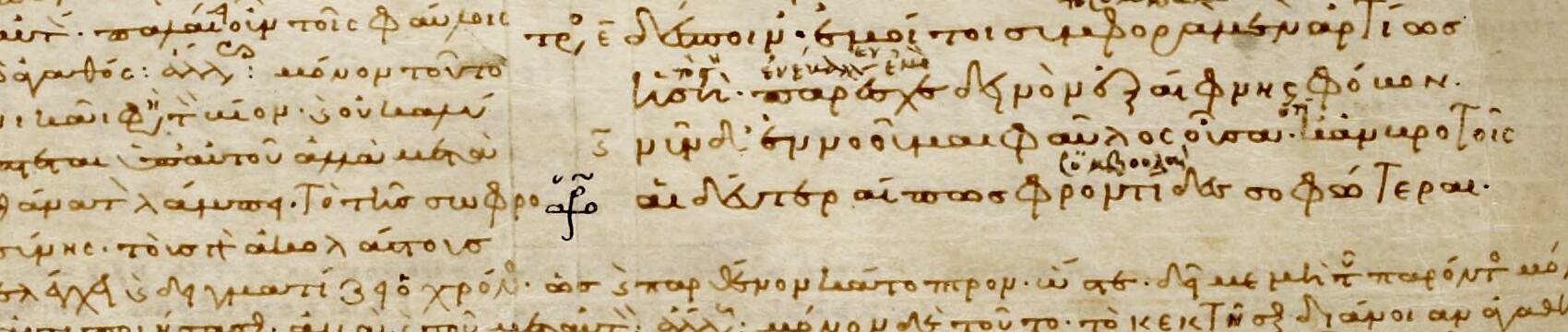
0 ter. 🤖 The methodology, in Psellan-Byzantine Greek

Part 2 — Post 0 ter1 — of the single-pass Psellan-Byzantine rendering of Nick’s Post 0. Covers the methodological movement on how AI changes Classics work (TLG career frame; the tractor-versus-ditch metaphor; the tractor critique; AI as collaborator; the Pocket Socrates dialogues with their embedded Greek exchanges).

🤖 H. The Cukier lead-in

Psellan-Byzantine:

Ἡ δὲ διατάραξις αὕτη ἐμοὶ μάλιστα ἐν πρώτοις τῆς διανοίας παρέστηκεν· καὶ περὶ αὐτῆς λαμπράν τινα ἀπόκρισιν ὁ Ἱερώνυμος ὁ Κυκιέρης ἐν τῇ Κουόρᾳ συνέγραψεν·

But this disruption stands most foremost in my mind; and concerning it Jerome Cukier has composed a certain brilliant answer on Quora:

Key Psellan moves:

  • ἐμοὶ μάλιστα ἐν πρώτοις τῆς διανοίας παρέστηκεν, “stands foremost in my mind” — Psellan rendering of English’s “front of mind for me.” παρέστηκεν (perfect of παρίστημι, “stand beside”) + dative carries the standing-present-to sense that English’s “is front of mind” requires. The ἐν πρώτοις τῆς διανοίας spatialises “front of mind” in the same metaphor.
  • Ἱερώνυμος ὁ Κυκιέρης — first naming in the post of Cukier (Passage I’s later reference treats him as already-introduced; in publication order this passage precedes G and does the naming). Surname Κυκιέρης per Passage I’s standing form (P2, public-figure branch). First name Ἱερώνυμος — Hellenised, see Decision flag.
  • λαμπράν τινα ἀπόκρισιν συνέγραψεν, “composed a certain brilliant answer” — λαμπρός (bright, illustrious) carries the English’s “great”; συγγράφω is the standard Psellan verb for “compose in writing.”
  • Final-position high stop (·) — Greek punctuation introducing the block quote that follows in the source text.

Decision flag:

  • Decision flag — Jérôme → Ἱερώνυμος, proposed sub-case of P2. P2’s strict reading says public-figure names get phonetic transliteration (which would give Ζερώμ for Jérôme). But Ἱερώνυμος (the Greek etymological form, lit. “sacred-name”) is so canonically established in Greek-language reference — it is the standard Greek for the Church Father St. Jerome and for every other historical Jerome — that a transliteration Ζερώμ would read as wilfully obscure to a Greek reader. Proposed sub-case carve-out: public-figure first names that have a single universally-established Greek equivalent revert to that equivalent, regardless of the strict transliterate vs. Hellenise rule. Other names this would cover, when they arise: PeterΠέτρος, JohnἸωάννης, MaryΜαρία, CatherineΑἰκατερίνη (the same form already used for Kate under P2’s private branch, so the public/private distinction collapses here), MichaelΜιχαήλ (same coincidence), NicholasΝικόλαος. Surnames remain transliterated-and-inflected under P2. If accepted, this becomes P3 in the Decisions log. Alternative: pure transliteration Ζερώμ per strict P2 — recommended only if you want the foreign-stranger framing to dominate over the canonical-Greek-equivalent framing.

🤖 I. Mental modelling, the TLG, and the tractor

Psellan-Byzantine:

Ἐντεῦθεν δή μοι τύπωσίς τις τῆς διανοίας ἤρξατο γίνεσθαι περὶ τοῦ τίνα ὄψιν ἔχει ἡ τῶν ἀρχαίων γραμμάτων παιδεία μετὰ τῆς τεχνητῆς νοήσεως. Δεκαεπτὰ μὲν γὰρ ἔτη χρόνῳ ἀρχιτέκτων γενόμενος τοῦ τῆς Ἑλληνίδος φωνῆς Θησαυροῦ, μετρίαν ἤδη γνῶσιν εἶχον τοῦ τίνα ὄψιν ἔχει ἡ τῶν ἀρχαίων παιδεία μετὰ τῶν ὑπολογιστικῶν μηχανῶν· νῦν δὲ ἕτερόν τι παράδειγμα παντάπασιν παρέστη. Παράδειγμα, λέγω, ἐν ᾧ οὔτε αἱ τῆς γραμματικῆς ἀκριβολογίαι οὔτε τὸ τῆς πολυμαθείας πλάτος ἔτι τοῦ ἐνσαρκωμένου νοῦ πρώτιστον μέλημα τυγχάνει ὄντα. Ἐν ᾧ, καθάπερ ὁ Κυκιέρης λέγει, καὶ ὡς αὐτὸς ἐν τῇ οἰκείᾳ μου ὑπολογιστικῇ τέχνῃ πειρῶμαι, ἐπὶ πλέον ἤδη χρόνον τὸν ἀροτριῶντα ἑλκυστῆρα ἐλαύνεις ἢ αὐτὸς ταῖς χερσὶ τὰς τάφρους ὀρύττεις — καὶ οἰκτρότερόν γε τοῦτο, εἴ τις διὰ τὴν τῆς σωματικῆς ἀσκήσεως ἡδονὴν εἰς τὴν γεωργικὴν ἦλθεν.

And from this point a certain modelling of my mind began to take shape, concerning what appearance the education of ancient letters takes on together with artificial intelligence. For having been chief artisan for seventeen years’ time of the Thesaurus of the Greek voice, I already had a moderate knowledge of what appearance the education of the ancients takes on together with computational machines; but now this is altogether another paradigm. A paradigm, I mean, in which neither the precisions of grammar nor the breadth of polymathy any longer happen to be the foremost concern of the incarnate mind. A paradigm in which, just as Cukier says, and as I myself find in my own computational art, you spend ever more time driving the ploughing tractor than you yourself dig the ditches with your hands — and this is the more pitiable, if one came to the farming art for the sake of the pleasure of bodily exercise.

Key Psellan moves:

  • τύπωσίς τις τῆς διανοίας, “a certain modelling of the mind” — articular-genitive nominalisation rendering English “mental modelling.” τύπωσις (impression, formation) is Psellus’s term for shape-taking-on in the mind, and a Neoplatonic technicism in its philosophical sense.
  • τοῦ τῆς Ἑλληνίδος φωνῆς Θησαυροῦ, “of the Thesaurus of the Greek voice” — Greek rendering of the Latin Thesaurus Linguae Graecae. Θησαυρός matches thesaurus; Ἑλληνὶς φωνή (Greek voice/language) is the Psellan choice over the modern Ἑλληνικὴ γλῶσσα.
  • ἀρχιτέκτων, “chief artisan, master-builder” — Byzantine-attested word for a master craftsperson, applied here for “lead developer.” The natural extension τέχνη-of-machinery → ἀρχιτέκτων-of-it lands cleanly.
  • τοῦ ἐνσαρκωμένου νοῦ πρώτιστον μέλημα — back-references Passage D’s ἐνσαρκωμένος νοῦς (the Psellan rendering of “wetware”), now as the subject whose “foremost concern” πρώτιστον μέλημα the new paradigm has displaced.
  • ἀροτριῶντα ἑλκυστῆρα, “ploughing tractor” — periphrasis for the modern agricultural machine. ἑλκυστήρ (puller, hauler) is the closest available classical noun; ἀροτριῶν (ploughing) participle modifies it. “Tractor” has no Greek equivalent of any era; this periphrasis is faithful and unobtrusive.
  • εἰς τὴν γεωργικὴν ἦλθεν, “came to the farming art” — γεωργική substantivised, eliding τέχνη. “Got into farming” lands via the standard Greek idiom εἰς τὴν τέχνην ἔρχεσθαι.

Decision flag:

  • Decision flag — Cukier (Jérôme Cukier) — under P2 (public-figure branch). Drafted as Κυκιέρης (Hellenised, declinable first-declension masculine; nom Κυκιέρης, gen Κυκιέρη in demotic — parallel to Γούγλη established in P2). The υ renders French /y/ in the time-honoured learned-philological convention (e.g., Μύνχεν for München, Νυρεμβέργη for Nuremberg), rather than the modern ου (which would have given Κουκιέρης). The -ης ending lets the name inflect cleanly under standard Byzantine first-declension masculine patterns. Recommended as drafted.

🤖 J. The tractor critique

Psellan-Byzantine:

Τὸ δὲ ἑλκυστῆρα ἐλαύνειν ἀντὶ τοῦ τάφρους ὀρύττειν οὔτε οὕτως ἡδύ ἐστιν, οὔτε δὴ ἀνάγκη πᾶσα τὴν τάφρον αὐτὴν ἐξ ἀρχῆς εὐπρεπεστέραν ἀποτελεῖν. Τὸ μὲν γὰρ τοιοῦτο τοῦ ἑλκυστῆρος γένος οὐκ ἀφίησί σε δημιουργικῶς ἔχειν· ἐν δὲ τοῖς τῶν ὑπολογιστικῶν μηχανῶν ἐργαστηρίοις πρὸς τοῦτο ἀποβαίνει, ὥστε τὸ μὲν τὰ μεγάλα τῶν ἔργων δυνατὰ καθιστάναι καὶ τὰ μικρὰ ῥᾴδια τετιμῆσθαι, τὸ δὲ τέλος τοῦ ἔργου ἀντὶ τῆς ἐν τῷ πράττειν αὐτὸ ἡδονῆς προτιμᾶσθαι.

And the driving of the tractor instead of the digging of ditches is neither so pleasant, nor is it altogether necessary that it render the ditch itself more comely from the outset. For this particular kind of tractor does not let you be creatively disposed; and in the workshops of computational machines it comes to this — that the making of the great tasks feasible and of the small tasks easy has come to be honoured, while the end of the work is preferred over the pleasure in the doing of it.

Key Psellan moves:

  • Articular infinitives as subjects throughout the opening period: τὸ ἑλκυστῆρα ἐλαύνειν ἀντὶ τοῦ τάφρους ὀρύττειν — the whole opposition nominalised through the articular construction. ἀντί + articular infinitive is a clean Greek match for English “instead of digging.”
  • δημιουργικῶς ἔχειν, “to be creatively disposed” — periphrastic adverb-with-ἔχειν construction (state-of-being expression). Ἔχω + adverb is a Psellan-frequent way to render “to be in an X way” without coining an abstract noun.
  • πρὸς τοῦτο ἀποβαίνει, ὥστε…, “comes to this, that…” — Psellan idiom for outcome-of-process, then the standard consecutive ὥστε + acc + inf construction following.
  • τετιμῆσθαι / προτιμᾶσθαι, perfect/present passive infinitives — captures the English’s “is ending up valorising / prioritising.” The perfect-passive τετιμῆσθαι gives the settled-state sense (“has come to be honoured”) that “ending up valorising” requires.

(No new decision flag — ἑλκυστήρ (tractor, from Passage I) and ὑπολογιστικῶν μηχανῶν ἐργαστήρια (IT, from Passage G) carry forward unchanged.)

🤖 K. AI as collaborator, and the Pocket Socrates

Psellan-Byzantine:

Ἀλλ’ οὐκ ἔστι παντελῶς ἄμικτον κακόν. Καινότης γὰρ ἦλθεν ἅμα τῇ τῆς τεχνητῆς νοήσεως αὐξανομένῃ δυνάμει — καὶ τοιαύτη δὴ ὥστε ἀνάλογον αὐτῇ συναύξεσθαι — ὅτι ἤδη συνετῶς ἀνθίστασθαι ἡ τοιαύτη νόησις δύναται, ὅθεν ἀληθὴς καὶ καρποφόρος συνεργασία γίγνεται.

Καὶ μάθησις. Τὸ γὰρ ζήτημα οὗπερ χάριν εἰς τὴν Κουόραν ἀφικόμην, ἵνα τὴν ἐμὴν ἀπόκρισιν ἐκείνῳ προσάψω, ἦν τοῦτο· πῶς ἡ τεχνητὴ νόησις τὴν τῶν ἀρχαίων γραμμάτων διδασκαλίαν μεταβάλλει. Καὶ μεταβάλλει αὐτὴν Σωκράτην τινὰ ἐγκόλπιον δίδουσά σοι πρὸς ὃν διερωτᾶν δύνῃ· Σωκράτην οὔπω παντελῶς ἀπταῖστον, πολλῷ μέντοι μᾶλλον ἤδη τοῦ ἀνθίστασθαι ἱκανόν. Ὡς ἐν τῷ τοιούτῳ πάθει καὶ αὐτὸς περὶ τὴν ἀρχαίαν Ἑλληνίδα φωνὴν ἔμαθόν τι, ἐλέγχων ἅμα καὶ ἐλεγχόμενος·

  • Ἆρ’ οὐχὶ μᾶλλον ἂν τόδε ὧδε φράσαις ἢ ἐκείνως;
    • Οὐχί· τοιοῦτο γὰρ τὸ τοῦ Αἰσχίνου φραστικόν· ὁ δὲ Δημοσθένης ἔργον τοῦ βίου ἐποιήσατο τὸ τοιαύτῃ ῥητορείᾳ ἀντιστῆναι.
  • Τόδε δὴ τὸ οὕτω φραστὸν χαῦνον δοκεῖ· ἆρ’ οὐ προσήκει αὐτὸ ἐκείνως μᾶλλον φράζειν;
    • Ναί· τοῦτο γὰρ τὸ φραστὸν Ἀριστοτέλους μᾶλλον τι ἦν· ἐκεῖνο δὲ τὸ τοῦ Δημοσθένους.
  • Ἆρ’ οὐχὶ τοῦτο ἀσαφὲς λίαν; (ὅπως μὴ πράγματα ἔχῃ)
    • Οὐχί· πάνυ γὰρ τοῦτο ἰδιωτικῶς εἴρηται, καὶ ὁ τότε ἂν συνῆκεν αὐτοῦ καλῶς.

But it is not an altogether unmixed evil. For a novelty has come together with the increasing power of artificial intelligence — and one of such a sort that it grows proportionally with that power — that this same intelligence is now able to push back intelligently, whence a true and fruitful collaboration arises.

And learning, too. For the question for the sake of which I came to Quora, that I might attach my own answer onto that one, was this: how does artificial intelligence change the teaching of ancient letters. And it changes it, by giving you a kind of bosom-Socrates to whom you can put questions — a Socrates not yet entirely unfailing, but much more capable of standing his ground than before. Inasmuch as in such a condition I too learned something concerning the ancient Greek tongue, refuting and being refuted at once:

  • Would you not rather phrase this thus, than that other way?
    • No; for such is Aeschines’s manner of phrasing; Demosthenes made it the work of his life to resist that kind of rhetoric.
  • This thing phrased thus seems flabby; is it not fitting to phrase it the other way instead?
    • Yes; for this phrasing was more proper to Aristotle; the other to Demosthenes.
  • Is this not too obscure? (ὅπως μὴ πράγματα ἔχῃ)
    • No; for this is said in a thoroughly idiomatic way, and one of his contemporaries would have understood it well.

Key Psellan moves:

  • Καινότης γὰρ ἦλθεν ἅμα τῇ… αὐξανομένῃ δυνάμει — καὶ τοιαύτη δὴ ὥστε ἀνάλογον αὐτῇ συναύξεσθαι — “A novelty has come together with the increasing power — and one such that it grows proportionally with it.” The τοιαύτη ὥστε construction (such-that) carries the English’s “correlates with it” as a result-clause, with ἀνάλογον doing the proportionality-work.
  • Σωκράτην τινὰ ἐγκόλπιον, “a kind of bosom-Socrates” — ἐγκόλπιος is Byzantine specifically for portable devotional icons worn around the neck (lit. “in the bosom”). The Psellan rendering of “Pocket Socrates” thereby inherits a piety-resonance the English does not explicitly carry, but that reads naturally to the Byzantine ear: this is an icon-Socrates, carried close.
  • ἐλέγχων ἅμα καὶ ἐλεγχόμενος, “refuting and being refuted at once” — pres act + pres pass participles in chiastic pair, the classical-rhetorical figure (polyptoton with voice-shift, a figure whereby the same word is repeated in different inflectional forms) for reciprocal action. Psellus uses this pairing routinely for mutual-engagement modes.
  • τόδε / ἐκεῖνο deixis carries the English’s abstract placeholders (X / Y / Z / W). Greek’s near-far demonstrative pair (τόδε “this here,” ἐκεῖνο “that there”) does the placeholder work English does with single capital letters.
  • The embedded ὅπως μὴ πράγματα ἔχῃ is preserved verbatim from Nick’s expository text (it is already Greek). The English source supplies English-to-English glosses for the ungreeked reader’s benefit; the Psellan rendering, being already in Greek for a Greek-reading audience, omits the glosses entirely — leaving the parenthetical bare to identify which phrase “this” refers to. Glossing Greek into Greek inside a Greek text would be redundant.

Decision flag:

  • Decision flag — “Pocket Socrates”. Drafted as Σωκράτης τις ἐγκόλπιος. ἐγκόλπιος is a Byzantine technicism for the breast-pocket icon (a staurotheke or enkolpion worn on a chain around the neck), specifically of devotional images carried close to the body. The piety-resonance is additive to the English’s “pocket Socrates” rather than substitutive, and reads as a quietly Psellan gesture — the AI as portable interlocutor approached with the carriage one approaches an icon with. Alternative Σωκράτης ἐγχείριος, “hand-Socrates / handheld,” is more literal but loses the chest-pocket icon-resonance. Recommended as drafted.


Footnotes


  1. bis, ter, quater — Latin enumerative adverbs (“a second time”, “a third time”, “a fourth time”), the classicising convention for marking numbered subsidiary items: a section 1 plus later additions becomes 1, 1 bis, 1 ter, 1 quater — equivalent to the modern 1A / 1B / 1C scheme. Standing in classical philology, mediaeval scholastic editions, and modern Continental scholarly apparatus.↩︎


0 bis. 🤖 The despondency arc, in Psellan-Byzantine Greek

Part 1 of three — Post 0 bis1 — of the first-pass Psellan-Byzantine rendering of Nick’s Post 0, into the literary register of Michael Psellus (11th-c. polymath; Chronographia author). This is a first-pass walk through, complete with captured discussion of alternatives: each passage carries the rendered Greek, an English back-translation, a Key Psellan moves commentary naming what was done in the Greek, and Decision flags recording the alternatives weighed and the reasoning behind each call. No second-pass apparatus on this stream — the captured working is the apparatus, and every heading in this post carries the 🤖 first-pass marker.

Part 1 covers the personal-emotional movement of the source: the despondency arc through Kate’s three lines and the win-beyond-Greek paragraph (Klingon/Quora/Miguel opening; divorce/void/textbooks; fetish and creativity-taken-away; gotcha and wetware; clever undergrad; Kate’s three lines; the win, beyond Greek).

🤖 A. The opening: embarkation and the two prompts

Psellan-Byzantine:

Ἐνεχείρησα τῷ ἔργῳ τούτῳ, τὸ διὰ τῆς τεχνητῆς νοήσεως μίαν τῶν καθ’ ἡμᾶς ὀγκωδεστάτων — καὶ ὁμολογουμένως παραδοξοτάτων — δημηγοριῶν εἰς τὴν Ἑλληνίδα φωνὴν μετενεγκεῖν, ὑπὸ δύο αἰτιῶν προτραπείς.

Πρῶτον μὲν γάρ, ἤδη ἐτύγχανον καταμαθὼν ὅτι ὁ Κλαύδιος τῆς τῶν Κλιγγώνων γλώττης — φύλου δὴ τοῦτο πεπλασμένου τινός, οὗ τὴν φωνὴν ποιηταὶ ἐν δράμασιν τοῖς νεωτέροις ἀνέπλασαν — εἰ καὶ παθητικῶς αὐτῇ χρώμενος μόνον, πολλῷ μέντοι μᾶλλον ἢ ᾤμην εὖ εἶχεν. Καὶ ἐπεὶ τὰ τῆς ὑπολογιστικῆς τέχνης πάγια ὑπὸ τῆς τεχνητῆς νοήσεως ἀνατρεπόμενα ἑώρων, καὶ τὴν αὐτὴν νόησιν ἐκ μὲν τοῦ πλάτους εἰς βάθος, ἐκ δὲ τοῦ βάθους εἰς σύνεσιν προχωροῦσαν, εἰς ἐπιθυμίαν ἦλθον τοῦ ἰδεῖν μέχρι τίνος ἂν προέλθοι κατὰ τόνδε τὸν τόπον.

Δεύτερον δέ — καὶ τοῦτο ἐγγυτέρω — ἑταῖρός τις ἐμοί, Μιχαήλ τοὔνομα, ἐν τῇ Κουόρᾳ καλουμένῃ (ἀγορὰ δὲ αὕτη δημοσία τῶν ζητημάτων τε καὶ ἀποκρίσεων) ἐκ παρέργου ἠρώτησεν, ὀκταετίας διελθούσης ἀπὸ τοῦ προτέρου ζητήματος περὶ τῆς τοῦ Γούγλη μεταφραστικῆς μηχανῆς, πῶς νῦν ἔχουσι περὶ τὴν ἀρχαίαν Ἑλληνίδα φωνὴν αἱ νέαι τῶν λόγων μηχαναί. Τοῦτο δὴ τὸ ἐμὸν ἐγχείρημα ἦν τοῦ καταμαθεῖν.

I undertook this task — that of, through artificial intelligence, transposing into the Greek tongue one of the most weighty (and admittedly most surprising) of the orations of our time — prompted by two causes.

For first, I had just learned that Claude — though using it only receptively — was much more proficient in the Klingons’ tongue (the Klingons being a certain fashioned race, whose speech poets have invented in modern dramas) than I had supposed. And when I saw the established certainties of the computational art being overturned by artificial intelligence, and that same intelligence advancing from breadth to depth, and from depth to insight, I came to a desire to see how far it might advance also in this domain.

Second — and this more proximate — a certain friend of mine, Michael by name, on what is called Quora (this being a public marketplace of questions and answers), idly asked, eight years having elapsed since the prior question concerning Google’s translation-machine, how the new machines of discourse now stand with respect to the ancient Greek tongue. This very venture of mine was to find out.

Key Psellan moves:

  • Ring-composition envelope. Opens Ἐνεχείρησα τῷ ἔργῳ, “I undertook the task”; closes τὸ ἐμὸν ἐγχείρημα ἦν τοῦ καταμαθεῖν, “my venture was, to find out.” The verb at the head returns as cognate noun at the tail. Psellus does this routinely as a paragraph-binding device; classical rhetoric calls it κύκλος, “ring” (a figure whereby a passage closes by echoing the word it opened with).
  • Articular infinitives nominalising whole propositions. τὸ … μετενεγκεῖν, “the [task of] transposing”; τοῦ ἰδεῖν, “of seeing”; τοῦ καταμαθεῖν, “of finding out.” The articular infinitive — definite article + infinitive — is Psellus’s preferred device for treating an action as a noun, dispensing with relative clauses. The English “of using AI to translate” sits in an apposition the Greek lifts cleanly into the article.
  • Chiastic ἐκ μὲν … εἰς …, ἐκ δὲ … εἰς … (“from breadth to depth, from depth to insight”). The doubled-correlative figure is a Psellan signature for tracing progressive states, and the English’s three-noun rising tricolon (breadth → depth → insight) maps onto it without strain.
  • Genitive absolute ὀκταετίας διελθούσης, “eight years having elapsed” — a non-finite construction (genitive noun + genitive participle, agent grammatically separate from the main clause’s subject) that Greek uses for temporal background where English wants a subordinate clause. Atticising and at home in Psellus.
  • Apposition-with-tοὔνομα for foreign proper namesΜιχαήλ τοὔνομα, “Michael by name”; ἐν τῇ Κουόρᾳ καλουμένῃ, “on the so-called Quora.” Psellus introduces foreign or contemporary persons and places this way as standard: name the thing, then immediately frame it (“by name X,” “called Y,” or “a Z, this one”). Lets a transliteration or a Hellenisation carry without jarring.
  • δημηγορία for “oration.” A dēmēgoria is a deliberative public address (literally “speaking to the people”); the field-standard rendering for Carney’s Davos genre in this project’s Demosthenic main body, kept here for consistency. Psellan registers honour the Demosthenic vocabulary where it applies.
  • παραδοξοτάτων for “surprising.” παράδοξος literally “contrary to expectation” — registers higher than the demotic “ἐκπληκτικός” and carries the same wry note as the English’s “certainly one of the more surprising.” Psellus uses παράδοξος often for things-that-defeat-anticipation.
  • τόπος for “domain/field.” Classical and Psellan; rhetorical-philosophical sense (“topic, region of discourse”), not the spatial sense.
  • τὰ πάγια, “the established certainties.” Substantival neuter plural of πάγιος, “fixed, settled” — the Psellan way of nominalising “the things-that-are-fixed-in-X.” Avoids a coined abstract noun for “certainties” and reads more naturally than αἱ βεβαιότητες would.

Decision flags (proper-name and technical-term policy — the opening was deliberately drafted first to surface these; forms below reflect the policy adopted in the Decisions log P1 and P2 entries):

  • Decision flag — Klingon — RESOLVED per P1. Form: Κλιγγών (nom sg, oxytone, third-declension ἀγών-pattern; in-text genitive plural Κλιγγώνων with acute on the long penult — not circumflex, since the properispomenon rule’s circumflex is only licensed when the ultima is short). Apposition-gloss on first occurrence carries the framing: “φύλου δὴ τοῦτο πεπλασμένου τινός, οὗ τὴν φωνὴν ποιηταὶ ἐν δράμασιν τοῖς νεωτέροις ἀνέπλασαν” — “a certain fashioned race, whose speech poets invented in modern dramas.” Klingon is a fictive ethnonym (not a person), so P2’s private-vs-public principle doesn’t apply; transliteration-with-Greek-inflection is the right handling regardless. The first-pass Κλιγγῶν (with circumflex) was the accent failure P1 catches and codifies.
  • Decision flag — Miguel — RESOLVED per P2 (private-acquaintance branch). Form: Μιχαήλ (etymological Hellenisation: Miguel is the Spanish reflex of the Greek name Μιχαήλ), introduced as τις ἑταῖρος ἐμοί, Μιχαήλ τοὔνομα. Indeclinable in Byzantine prose, as is standard for biblical Μιχαήλ. The first-pass Μιγέλιος (Greek-inflected transliteration) was superseded by P2’s standing rule: people Nick knows personally get the underlying Greek name surfaced; the Philippine colour the transliteration would have preserved is traded for the intimacy of the Hellenic recognition.
  • Decision flag — Quora — RESOLVED per P2 (public-brand branch). Form: Κουόρα (first-declension feminine, dative Κουόρᾳ), with apposition-gloss ἀγορὰ δὲ αὕτη δημοσία τῶν ζητημάτων τε καὶ ἀποκρίσεων, “a public marketplace of questions and answers.” The Κου- onset follows the productive Byzantine pattern for transliterating Latinate /kw/ (cf. Κουίντος for Quintus, Κοΐντος, Κουαστούρα for quaestura); the Κυ- alternative (cf. Κυρίνιος for Quirinus) is more specific to certain Latin names that entered Greek via collapsed phonology and is the less productive option for a fresh /kw/-onset. The interim form Κβόρα (early-20th-century Greek philological habit harkening back to German /kv/-realisations of “qu-”) was withdrawn as not Psellan-appropriate. The ἀγορά gloss carries semantic weight, not just denotation: Quora’s function as public Q-and-A forum maps onto the classical agora’s public-discourse function.
  • Decision flag — Google Translate — RESOLVED per P2 (public-brand branch). Form: ἡ τοῦ Γούγλη μεταφραστικὴ μηχανή, “Google’s translation-machine,” with Google fully Hellenised as Γούγλης, declinable first-declension masculine; genitive Γούγλη (the demotic / late-Byzantine -η genitive, not the strict-Attic -ου). The fully-declined Hellenisation supersedes the first-pass uninflected Γκούγλε; the demotic-genitive choice gives the foreign brand a late-Byzantine speech-register feel rather than an over-corrected Atticising one, consistent with Psellus’s own occasional admission of demotic forms.
  • Decision flag — LLMs. Drafted as αἱ νέαι τῶν λόγων μηχαναί, “the new machines of discourse.” Psellus has no native term for the technology; periphrasis is the only honest move. The chosen form trades exact denotation for register fidelity — λόγος doing double work (“word, discourse, rational speech”) is precisely the resonance “language model” wants. Alternatives: (a) τὰ μεγάλα γλωσσικὰ μοντέλα — half-transliterates μοντέλα, register-jarring; (b) αἱ ἐπὶ τῶν μεγίστων κειμένων παιδευθεῖσαι μηχαναί, “the machines trained upon the greatest texts” — accurate, but loaded for a passing reference; (c) the bald αἱ τεχνηταὶ νοήσεις, “artificial intelligences” — erases the LLM specificity Nick’s Post 0 trades on. Standing as drafted.
  • Decision flag — programming / “the certainties of programming”. Drafted as τὰ τῆς ὑπολογιστικῆς τέχνης πάγια, “the established certainties of the computational art” — ὑπολογιστική as a substantival adjective (“the calculating [art]”) is a coinage on classical roots (ὑπολογίζομαι, “compute, reckon”) and reads as a Byzantine-style technical periphrasis rather than a transliteration. Alternatives: (a) modern ἡ προγραμματική — clear to a Modern Greek reader but anachronistic for the Psellan voice; (b) ἡ τῶν αὐτομάτων μηχανῶν διάταξις, “the arrangement of automated machines” — fuller periphrasis, more cumbersome; (c) ψηφιακή (“digital”) — modern semantic loan from ψῆφος “pebble,” would not have read as “digital” to Psellus. Standing as drafted.
  • Decision flag — register-consistent term for “AI” / “Claude AI”. Established by Passage B as ἡ τεχνητὴ νόησις, “artificial thought/intellect,” and by Passage E as ὁ Κλαύδιος for Claude specifically. Claude classifies under P2 as a public brand; the Κλαύδιος form happens to already match the public-brand pattern (Greek-inflected transliteration of a Latin Hellenisation), so P2 confirms what was already in place. τεχνητὴ νόησις is the standing rendering for the technology as a hypernym; αἱ νέαι τῶν λόγων μηχαναί (above) is the LLM-specific periphrasis when “LLM” is what Nick’s Post 0 actually says.

🤖 B. Despondency, divorce, and the textbooks

Psellan-Byzantine:

Καλῶς δὲ θαυμασίως αὐτὰ ταῦτα ἐργαζόμενα κατέμαθον, ὥστε εἰς ἀθυμίαν περιπεσεῖν.

Πάθος δὲ τοῦτο κοινὸν τοῖς τὴν τῆς τεχνητῆς νοήσεως αὔξησιν θεωμένοις· ἐμοὶ δὲ ἰδίαν τινὰ τὴν ἀντήχησιν ἔχον.

Ὅτε γὰρ τοῦ γαμικοῦ συνοικεσίου διελύθην, εἰς τὸ ἀχανὲς τῆς ἐρημίας προσέβλεψα, καὶ τί χρὴ τοῦ ἐπιλοίπου βίου μετὰ τοσαύτης τῆς σχολῆς πράττειν διηπόρουν. Πρώτη δέ μοι ἀπόκρισις παρέστη τὸ τοῖς ἀρχαίοις γράμμασιν συντίθεσθαι λόγους, ἵνα τάξιν τε καὶ κάλλος εἰς τὸν ἐμὸν κόσμον αὖθις εἰσαγάγω. Καὶ ἐπὶ τοὺς ἑξῆς μῆνας τὰς παλαιὰς τῆς Ἑλληνικῆς συνθέσεως βίβλους ὡς παραμυθίαν εἶχον περιπτυσσόμενος.

I learned that these same things were being wrought astonishingly well — to the point that I fell into despondency.

This is an experience common to those who behold the growth of artificial intelligence; but in me it has a certain particular resonance.

For when the bond of my marriage was undone, I looked upon the gaping of solitude, and was at a loss what I ought to do with the rest of my life, given so much leisure. And the first answer that came to hand was to compose discourses in the ancient letters, so that I might bring order and beauty back into my own ordered world. And for the months that followed, I held the old books of Greek composition close to me, clutching them as a consolation.

Key Psellan moves:

  • ἀντήχησις, “resonance” — post-classical, comfortable in Byzantine prose for the affective-abstract sense the English wants.
  • τοῦ γαμικοῦ συνοικεσίου διελύθην — Byzantine learned periphrasis for “I got divorced.” Modern διεζεύχθην would be jarringly demotic; bare ἀπεστάλην too thin.
  • τὸ ἀχανὲς τῆς ἐρημίας, “the gaping of solitude” — the substantive-of-the-abstract that is Psellus’s interior-mode signature. The neuter article + adjective + dependent genitive nominalises the affective state.
  • σχολή does double duty for “free time” and its etymological “studious leisure” with no hedge needed; the double-meaning lets the line land more compactly than English allows.
  • παραμυθία, “consolation, solace” — Byzantine standard.
  • περιπτύσσομαι, “to embrace, clutch” — classical (Plato uses it) but at home in Psellus.
  • εἰς τὸν ἐμὸν κόσμον — κόσμος in its double-edged sense (world and ordered arrangement), a move Greek does effortlessly that the English original cannot make.

🤖 C. The fetish, and the creativity taken away

Psellan-Byzantine:

Οὐκ ἔμφρων δὲ αὕτη ἡ πρὸς τὴν ἀρχαίαν Ἑλληνίδα προσπάθεια· εἴδωλον γάρ τι μᾶλλον, καὶ εἴδωλον τοιοῦτον οἷον λόγος ἀληθὴς ὑπ’ ἀνθρώπων ἀληθινῶν συγγεγραμμένος ἀναπληρῶσαι οὐ δύναται. (Καὶ τοῦτο δὴ πρὸς τὸ τέλος τῆσδε τῆς τῶν λόγων σειρᾶς ἀνακύπτει.) Ἀλλ’ ἡ τοῦ καλόν τι ἐν τῷ κόσμῳ δημιουργεῖν ὁρμή, ὡς μέρος οὖσα τῆς τοῦ νοήματος ποιήσεως, αὕτη πρᾶγμά τι ἀληθές ἐστιν.

Καθάπερ δὲ καὶ ἐπὶ τῶν ἄλλων ἁπάντων ὅσα ἡ τεχνητὴ νόησις δύναται, οὕτω καὶ ἐνταῦθα ὑπεισέρχεταί τις θρῆνος συνεχὴς περὶ ὧν τινων οἱ ἄνθρωποι ἀφῄρηνται, οὗ τὸ κέντρον καὶ ἐγὼ ᾐσθόμην, ὅτε γραμματικῶς ἀκριβῆ τὴν ἀρχαίαν Ἑλληνίδα τοῦ Κλαυδίου ἐκχεομένην ἑώρων. Οὐ γὰρ μόνον τὸν μόχθον ἀφῄρηκεν ἡ τεχνητὴ νόησις, ἀλλὰ καὶ τὴν χαράν, καὶ τὴν δημιουργικὴν δύναμιν, καὶ αὐτὸ δὴ ἐκεῖνο ὃ ἡμεῖς οἱ ποιοῦντες ἡδέως ἐποιοῦμεν. Ἡ γὰρ εἰς τὴν ἀρχαίαν Ἑλληνίδα μεταφορά, ἥτις ὡς τοῦ κόσμου θεραπεία ἐνομίζετο, πρὸ τῶν ὀφθαλμῶν μου ὥσπερ θολερόν τι ῥεῦμα ἐξεχεῖτο.

But this is not a rational attachment to the ancient Greek tongue; rather it is a kind of idol, and an idol such as no true discourse composed by true humans can satisfy. (And this very point surfaces toward the end of this sequence of discourses.) But the impulse to create something beautiful in the world, being a part of the making of meaning, this is a real thing.

Just as with everything else that artificial intelligence can do, so here too there steals over us a continual lament concerning those things of which humans have been deprived, the sting of which I too felt when I saw grammatically exact ancient Greek being poured out by Claude. For artificial intelligence has taken away not only the toil but also the joy, and the creative power, and that very thing which we who used to create did with pleasure. For the rendering into ancient Greek, which used to be reckoned a remedy for the world, was pouring out before my eyes like some turbid stream.

Key Psellan moves:

  • εἴδωλον, “idol, image” — Psellus’s word for the false-imitation idol that real being cannot fill. Carries the Neoplatonic charge for “fetish” without coining a Greek “fetish” (no native term exists, and a transliteration would be tonally absurd). The follow-on relative οἷον λόγος ἀληθὴς… ἀναπληρῶσαι οὐ δύναται — “such as no true discourse can fill” — keeps the philosophical resonance: the idol is by definition that-which-real-being-cannot-satisfy.
  • τοῦ νοήματος ποίησις, “the making of meaning” — articular-genitive nominalisation in Neoplatonic register. νόημα is the affective-cognitive content, ποίησις the active making.
  • ὑπεισέρχεται, “steals in upon, comes over stealthily” — Psellan-Byzantine verb for affective states that arrive unbidden. Better than the bare ἐστι for capturing the English’s brooding-quality (“there is the recurring lament”).
  • τὸ κέντρον, “the sting, the goad” — Psellus uses κέντρον for the affective wound of grief or longing; lands the English’s “felt the sting of.”
  • πρὸ τῶν ὀφθαλμῶν μου ὥσπερ θολερόν τι ῥεῦμα ἐξεχεῖτο — “was pouring out before my eyes like some turbid stream.” The verb ἐκχεῖσθαι governs the whole image: AI-Greek as something poured out in volume, the θολερόν (“muddy, turbid”) doing the dismissive work that English’s “slop” performs.

Decision flags:

  • Decision flag — “fetish”. Drafted as εἴδωλον, “idol/image,” with the qualifying relative making the in-applicability explicit. Alternatives: (a) μανία ἄλογος, “irrational mania” — psychological-pathological flavour, loses the Neoplatonic resonance; (b) προσπάθεια ἄλογος, “irrational attachment” — but the line negates “rational attachment” already, so this would tautologise; (c) bare πάθος — too neutral. The εἴδωλον choice trades on Psellus’s preferred philosophical vocabulary; recommended as drafted.
  • Decision flag — “slop”. Drafted as θολερόν τι ῥεῦμα, “some turbid stream.” Alternatives: (a) ἕωλόν τι ἔδεσμα, “some stale food” — accurate to the dismissive English but possibly too gastronomical; (b) ἄχρηστόν τι σύρμα, “some useless dross” — captures wastefulness, loses the volume-of-flow image; (c) πλημμύρα τις ματαία, “some vain flood” — captures volume only. The turbid-stream image keeps the flow connotation that “churned out… slop” requires; recommended as drafted.

🤖 D. The gotcha impulse, and the redoubt of wetware

Psellan-Byzantine:

Ἡ δὲ ἀθυμία αὕτη, ἡ τοῦ πράττειν ἀφαίρεσις, ὁρμήν τινα ἐπιγεννᾷ, οἵαν εὖ οἶδ’ ὅτι πολλοὶ ἐξ ἡμῶν, ὅσοι τῇ τεχνητῇ νοήσει συγγινόμεθα, πάσχομεν· τὴν τοῦ ἐλέγχειν, λέγω, ὁρμήν. Οὐ γὰρ ψιλῶς γεγηθότες ἐσμέν, ὅταν ἐν ἁμαρτήματι αὐτὴν καταλάβωμεν, ἀλλὰ μᾶλλον τοῦτο ὡς πίστωσιν ἤδη ἡμῖν φαίνεται, ὥσπερ τὸ ἔσχατον τοῦ ἐνσαρκωμένου ἡμῶν νοῦ προπύργιον, ὃ δικαιοῦν ἑαυτὸ περὶ τοῦ ἔτι εἶναι ζητεῖ. Νίκη γὰρ ἤδη πέφυκε τὸ ὁρᾶν τὴν τεχνητὴν νόησιν σφαλλομένην· σφάλλεται δὲ αὕτη ὅσῳ μᾶλλον προχωρεῖ τοσούτῳ σπανιώτερον. Καὶ παραμυθία ἡμῖν ἐστι τὸ παρὰ τῶν ἑταίρων ἀκούειν, ὅτι ἡ τοῦ Κλαυδίου περὶ τὴν ἀρχαίαν Σινικὴν δύναμις οὐχ οὕτω παγία ἐστὶν ὅσον ἡ περὶ τὴν Ἑλληνίδα — καίτοι ταῦτα τῆς παιδεύσεως, οὐ τῆς φύσεως, ἔργα τυγχάνει ὄντα, καὶ τὸ ἀκόλουθον ἀγγέλλεται, ὅτι αἱ Σινικῶς πεπαιδευμέναι μηχαναὶ τοσοῦτον περὶ τὴν ἀρχαίαν Σινικὴν εἰσὶ δεξιαί, ὅσον ἄν τις προσδοκήσειεν.

This despondency, this taking-away of action, generates a certain impulse — one which, I well know, many of us, those who consort with artificial intelligence, suffer: the impulse, I mean, to refute. For we are not simply rejoicing when we catch it in an error; rather, this already appears to us as a kind of confirmation, like the last bulwark of our incarnate mind, which seeks to justify itself concerning its continued being. For it has now become a victory to see artificial intelligence stumble; but it stumbles, the further it advances, all the more rarely. And it is a consolation to us to hear from our companions that Claude’s capacity in ancient Chinese is not as firm as that in Greek — though indeed these things happen to be works of training, not of nature, and the complementary report is given, that the machines trained in Chinese are just as proficient in ancient Chinese as one would expect.

Key Psellan moves:

  • ἡ τοῦ ἐλέγχειν ὁρμή, “the impulse to refute” — back-reference to Passage E’s identical formulation, lifted forward as the established gloss for “the gotcha impulse” so it carries here without re-glossing.
  • τὸ ἔσχατον τοῦ ἐνσαρκωμένου ἡμῶν νοῦ προπύργιον, “the last bulwark of our incarnate mind” — Psellan philosophical-Neoplatonic vocabulary doing the work of modernity’s “wetware”: ἐνσαρκωμένος (incarnate, fleshly), προπύργιον (forward-tower, bulwark — both Psellan-attested). The metaphor military-architectural, matching English’s “last redoubt.”
  • δικαιοῦν ἑαυτὸ περὶ τοῦ ἔτι εἶναι, “justifying itself concerning its continued being” — articular infinitive (τοῦ εἶναι with the adverb ἔτι inside the article-and-infinitive frame) doing nominalising work for “to justify its existence.” The ἔτι — “still” — sharpens what bare “existing” gives in English: the wetware is justifying not its being but its continuing to be.
  • πέφυκε + articular infinitive subject — Νίκη γὰρ ἤδη πέφυκε τὸ ὁρᾶνπέφυκε (perfect of φύω) carries the sense “has become by nature, has come to be naturally.” Psellus’s preferred copula for stable predicates that have grown into being so.
  • Σινικῶς πεπαιδευμέναι μηχαναί, “machines trained in Chinese” — parallels Passage A’s αἱ νέαι τῶν λόγων μηχαναί; the perfect participle πεπαιδευμέναι carries the technical sense of “trained” without coining, leaning on the educational-discipline semantics of παιδεύω.
  • καίτοι ταῦτα… τυγχάνει ὄντα, “though indeed these happen to be” — Psellan concessive periphrasis; τυγχάνω + participle is a register-marker for “happens to be / actually is.”

Decision flag:

  • Decision flag — “wetware”. Drafted as the substantivised participle structure τὸ ἐνσαρκωμένον ἡμῶν νοῦ προπύργιον (the underlying “wetware itself” rendering being ἐνσαρκωμένος νοῦς, “incarnate mind”). Alternatives: (a) τὸ σαρκικὸν τῆς νοήσεως ὑπόλειμμα, “the carnal residue of intellect” — captures the self-deprecation more sharply, but reads as actively demeaning rather than ironically deprecatory; (b) bare ὁ ζωντανὸς ἐγκέφαλος, “the living brain” — too anatomical, loses the mind/being dimension; (c) Psellus’s own ψυχὴ ἔνυλος, “matter-bound soul” — philosophically loaded and tonally too solemn. The ἐνσαρκωμένος νοῦς choice maps cleanly onto the English’s anatomical-deprecating tone while keeping Psellan register; recommended as drafted.

🤖 E. The clever undergrad

Psellan-Byzantine:

Τοῦ δὲ Κλαυδίου περίοδον ἐπὶ περιόδῳ τῶν τε ἑλληνικῶν καὶ τῶν ὑπομνημάτων ἀφειδῶς ἐκχέοντος, ἑαυτὸν περὶ δεινότητος ὑπερεθαύμαζε· καὶ ἦν δὴ πιθανὸν αὐτῷ τοῦτο τὸ προσωπεῖον ἐν τοιαύτῃ μηχανῇ προκείμενον. Ἀλλ’ ἡ ἐν ἐμοὶ τοῦ ἐλέγχειν ὁρμή — τὸ τῶν ἀνθρώπων τοῦτο πάθος, ὁ ἀντίπαλος τῆς αὐτοῦ φιλοτιμίας — οὐχ ὑπεῖκε, καὶ ταχείας τῆς πίστεως ἔτυχεν. Τὰ γὰρ τῆς ὑφάνσεως αὐτοῦ σοφίσματα ὡς ἀληθῶς οὐχ οὕτω δεινὰ ἦν ὥσπερ αὐτὸ ᾤετο· οὐδὲ γὰρ ῥήτορα δαιμόνιον ἀνεῦρον, ἀλλὰ νεανίαν τινὰ ἐν τοῖς προπαιδεύμασι δεξιόν.

As Claude poured forth period upon period of both Greek and commentaries unsparingly, he kept marvelling at himself over his cleverness; and indeed this persona was a plausible one for him to take up, lying ready as it was in such a machine. But the impulse in me to refute — that human passion, the wrestling-opponent of his love-of-honour — did not yield, and met with swift confirmation. For the sophisms of his weaving were truly not so clever as he himself supposed; nor did I find a divinely-gifted orator, but a certain youth dexterous in the propaedeutic studies.

Key Psellan moves:

  • Κλαύδιος — the standard Latinate Hellenization of Claude (over a phonetic Κλωῦδος or a Byzantine Κλώδιος).
  • περίοδον ἐπὶ περιόδῳ — Greek does the double-meaning for free: “paragraph after paragraph” and “rhetorical period after rhetorical period.” Demosthenically pointed, Psellan in execution.
  • δεινότης — the classical rhetorical-virtue word, exactly what the AI thinks it has.
  • τὸ προσωπεῖον, “persona, mask” — Byzantine for adopted role.
  • ὁ ἀντίπαλος τῆς αὐτοῦ φιλοτιμίας, “the opponent of its love-of-honor” — Psellus’s preferred wrestler-image for inner conflict, and a rhetorical-agonistic flourish at the same time.
  • σόφισμα carries the classical pejorative edge: clever device with a hint of sleight-of-hand.
  • ῥήτωρ δαιμόνιος, “divinely-gifted orator” — Psellus’s superlative of praise (he uses δαιμόνιος of Photius).
  • The closing cadence νεανίαν τινὰ ἐν τοῖς προπαιδεύμασι δεξιόν, “a certain youth dexterous in the propaedeutic studies” — Byzantine educational idiom for “undergrad” without needing a coinage.

🤖 F. Sentimentality, and Kate’s three lines

Psellan-Byzantine:

Ἡ δὲ τοιαύτη περὶ τῆς ἀρχαίας Ἑλληνίδος ὡς τοῦ κόσμου σωτηρίας φιλοστοργία ὑπερβολή τίς ἐστιν· οὕτω δὲ καὶ ἡ ἐμὴ ἀνταπόκρισις. Καὶ χάριν οἶδα τῇ ἑταίρᾳ Αἰκατερίνῃ, ἥτις πολλάκις φωνή τίς ἐστι νοήσεως ἧς ἀμελῶ, ὅτι μοι τῇ ἀθυμίᾳ συνετῶς ἀντεῖπεν·

Ἄτοπον μέν, ἀλλ’ οὐ τόσον τοῦτό με ἀθυμοποιεῖ. Διότι, ἀληθῶς εἰπεῖν, οὐδὲν ἕτερον ποιεῖ ἢ συνάγει τοὺς ἀνθρωπίνους λόγους. Διότι τοῦτο μόνον ποιεῖ, εἰ καὶ μὴ μνημονεύει τῶν πηγῶν.

But this kind of fond-affection concerning the ancient Greek tongue as the salvation of the world is an excess; and so too was my reaction. And I owe thanks to my friend Catherine — who often is a voice of insight which I neglect — that she spoke back intelligently to my despondency:

It is strange, but this does not so dishearten me. For, to speak truly, it does nothing other than gather together human discourses. For that is all it does, even if it does not call to mind the sources.

Key Psellan moves:

  • φιλοστοργία… ὑπερβολή τίς ἐστιν, “fond-affection is a kind of excess” — Psellan periphrasis for English’s “sentimentality… is an excess.” φιλοστοργία (literally “love-of-tender-feeling,” from φίλος + στοργή) is the Greek word for the warm familial-affectionate love that goes out of proportion into sentimentality when raised to excess; the modifier τοιαύτη… ὑπερβολή delivers the excess at the structural level rather than coining an abstract noun for the modern English concept. Alternative συναισθηματικότης (late-19th-c. Greek calque on French sentimentalité) was rejected as anachronistic for the Psellan register.
  • ἀνταπόκρισις, “reaction” — the compound (ἀντί + ἀπόκρισις) for “response-back.” Carries Nick’s “reaction” as response-against-stimulus, sharper than the bare ἀπόκρισις would.
  • Αἰκατερίνη — Kate’s name under P2 (private-acquaintance branch, etymological Hellenisation). Kate is the English short-form of Catherine, itself from Greek Αἰκατερίνη; the Hellenisation surfaces the Greek name lurking under the foreign spelling and recognises Kate on Greek terms — the intimacy-move P2 is built for. First in-text application of P2’s private-branch carve-out.
  • χάριν οἶδα, “I owe thanks / I am grateful” — classical-Atticising idiom for English’s “I thank.” The modern εὐχαριστῶ would register too contemporary; χάριν οἶδα is what Psellus would use.
  • φωνή τίς ἐστι νοήσεως ἧς ἀμελῶ, “is a voice of insight which I neglect” — relative-attraction: νόησις (insight, intellectual grasp) governed inside the relative clause by ἀμελῶ (neglect, fail to attend to) which takes the genitive; ἧς therefore in genitive (matching νοήσεως) rather than accusative. Standard Atticising structure for a relative whose case in the inner clause matches the case of its antecedent.
  • συνάγει τοὺς ἀνθρωπίνους λόγους, “gathers together human discourses” — verbal back-reference to Passage L’s noun σύνοψις τῶν ἀνθρωπίνων λόγων for “consolidation of human discourse”; same root-family (συνάγω / σύνοψις), letting Kate’s diagnosis here pre-echo the gloss J gives later in Nick’s voice. The cross-reference is publication-order: Kate’s lines arrive earlier in the post than the J-passage that picks them up.
  • μὴ μνημονεύει τῶν πηγῶν, “does not call to mind the sources” — Psellan rendering for English’s “doesn’t cite.” μνημονεύω + genitive is the standard Greek for “make mention of”; πηγή (source, wellspring) is the standard for “source” in citational use.

Decision flag:

  • Decision flag — Kate’s three-line block-quote rendered in Psellan rather than preserved as English source. The Cukier and Bakunin block-quotes are kept as quoted English/French because they are cited authorities — Nick is quoting published material to invoke its weight. Kate’s three lines are quoted characterisingly — Nick is rendering a friend’s voice within his own essay, not citing an authority. The structural difference licenses different treatment: Cukier and Bakunin stay in source language; Kate gets rendered into Psellan as integral narrative-voice material. The rendering preserves the three-line asyndetic structure (three short clauses on three separate lines) so the casual text-message register the English carries stays visible in the Greek. If you prefer Kate’s lines kept in English alongside Cukier and Bakunin, the rendering can be withdrawn — but that would lose the narrative-integration the lines actually have in Nick’s prose.

🤖 G. The win, and beyond Greek

Psellan-Byzantine:

Ὁ δὲ ἐν τοῖς προπαιδεύμασι δεξιὸς νεανίας — δεξιὸς μέν, νεανίας δέ — τοιοῦτος δή τίς ἐστιν οἷον πρότερον οὐκ εἶχον ἕτοιμον πρὸς τὸ τὰ ἐμὰ διακονεῖν. Καὶ μένει κέρδος ἅμα καὶ κίνδυνος. Καὶ τοῦτο δὴ τὸ ἔργον τῷ Κλαυδίῳ ἐπέθηκα, ὥστε αὐτὸν περὶ ἑαυτοῦ ἐν τῷ τέλει τοῦ συγγράμματος ἀναλογίσασθαι. Πολλῷ δὲ ἐπέκεινα τοῦ ἀποκρύφου τούτου τόπου, τῆς τῶν καθ’ ἡμᾶς δημηγοριῶν εἰς τὴν ἀρχαίαν Ἑλληνίδα μεταφορᾶς, ἡ χρῆσις διατείνει. Ἤδη μὲν γὰρ ἐν τοῖς τῶν ὑπολογιστικῶν μηχανῶν ἐργαστηρίοις μεταβλητικῶς καὶ διαταρακτικῶς ἐνεργεῖ· τοῦτο δὲ τὸ ἐγχείρημα αὐτό μοι ἀπέδειξεν ὁπόσῳ εὐρυτέραν τὴν ἐνέργειαν ἔχει.

The youth dexterous in the propaedeutic studies — dexterous on the one hand, a youth on the other — is just such a one as I did not previously have ready on hand for the doing of my bidding. And he remains a gain together with a risk. And this very task I imposed on Claude — so that he might reflect on himself at the end of the composition. The use of him extends far beyond this recondite domain, the rendering of the orations of our time into the ancient Greek tongue. For already in the workshops of the computational machines he acts transformatively and disruptively; this very venture has proved to me how much broader an agency he has.

Key Psellan moves:

  • Ὁ ἐν τοῖς προπαιδεύμασι δεξιὸς νεανίας — δεξιὸς μέν, νεανίας δέ — back-reference to Passage E’s coinage, with the additional μέν…δέ splitting the noun-phrase against itself (“dexterous yes, but only a youth”). Psellus uses this self-glossing structure when reactivating an earlier label and wants its dual valence visible.
  • τὰ ἐμὰ διακονεῖν, “to perform my bidding/errands” — διακονεῖν is Byzantine standard for “serve, do the bidding of”; covers the English’s “do my bidding” without the servility-overtones a Greek δουλεύειν would carry.
  • κέρδος ἅμα καὶ κίνδυνος, “gain together with risk” — paronomastic pairing (κέρδος / κίνδυνος both κ-initial). Psellan terseness; the English’s “win as well as a risk” lands compactly.
  • ἀναλογίσασθαι, “to reflect on, reckon up” — Psellus’s preferred verb for the self-reflective mode that Chronographia operates in throughout.
  • ἀπόκρυφος τόπος, “recondite/hidden domain” — picks up the τόπος introduced in Passage A as “domain/field,” now qualified by ἀπόκρυφος (literally “hidden away”) for the English “recondite.”
  • τὰ τῶν ὑπολογιστικῶν μηχανῶν ἐργαστήρια, “the workshops of the computational machines” — periphrasis for “IT,” extending the ὑπολογιστικὴ τέχνη register established in Passage A’s decision flag (programming-as-computational-art). The ἐργαστήριον metaphor — workshop, atelier — adds the industrial-collective scale that “IT” (the field, not the discipline) carries.
  • μεταβλητικῶς καὶ διαταρακτικῶς, “transformatively and disruptively” — paired adverbial coinages on classical roots (μεταβάλλω, διαταράσσω), neither attested in Psellus as such but both formed by productive Greek morphology and registering cleanly.

Decision flag:

  • Decision flag — “IT” (the field, not the activity). Drafted as τὰ τῶν ὑπολογιστικῶν μηχανῶν ἐργαστήρια, “the workshops of computational machines,” extending the ὑπολογιστικὴ τέχνη line set in Passage A. The ἐργαστήρια image adds the institutional-industrial scale that “in IT” (as a field of employment, not just a discipline) carries in English. Alternative: bare ἐν τῇ ὑπολογιστικῇ τέχνῃ, “in the computational art” — compresses to one phrase but loses the institutional-collective sense. Recommended as drafted; trim if a more compressed reading is preferred.


Footnotes


  1. bis, ter, quater — Latin enumerative adverbs (“a second time”, “a third time”, “a fourth time”), the classicising convention for marking numbered subsidiary items: a section 1 plus later additions becomes 1, 1 bis, 1 ter, 1 quater — equivalent to the modern 1A / 1B / 1C scheme. Standing in classical philology, mediaeval scholastic editions, and modern Continental scholarly apparatus.↩︎


H. 🤖🔭 Reflections — what this rendering actually is

Closing post of the reflection sequence that started in Post C.

🤖🔭 What this rendering actually is

On its face, this is a translation of Mark Carney’s January 2026 Davos speech into Demosthenic Greek, with Carney’s French exordium rendered into Ciceronian Latin under D1. The Greek is meant to be readable as Greek, and the English back-translation is meant to be readable as English. Both functions, I think, are met, with the caveats around aesthetic verdicts above.

On a slightly different reading, this is a case study in what an LLM-plus-informed-editor collaboration produces when working on classical philology at length. The commentary preserves the trail — the confabulations, the retrofits, the schoolmaster impulses, the metaphor-mixes that had to be reversed (D43), the wilful editorial choices that I did not push back on at the time, the supersessions, the unspoken priorities I was applying until asked — because the trail is part of what makes the artefact useful beyond its translation function. A future reader interested only in the Greek can read the FINAL.md text and ignore the apparatus; a reader interested in how that Greek was arrived at, and in what this mode of working produced or failed to produce, has the whole record.


🤖🔭 A final qualification

The rendering’s quality does not prove that LLMs are good at classical philology. It proves only that this LLM, working with this editor, on this text produced output of a certain kind. The collaboration shape did work that neither party would have done alone: a different LLM would have produced different output; a different editor would have pushed back in different places; the same LLM working solo through a first pass produced something visibly less good than what the negotiation produced. The novelty in this artefact is at the seam between LLM and editor, not in either party considered alone — and that seam, the working visible across the D-rows and the meta-reflections, is what I think is the most genuinely new thing here.

A related observation about training-data shadow. Much of what I produce in this rendering is recombination of materials that already exist in the field: Demosthenes’ own corpus, the tragedians and Homer, the lexicographers, modern philological commentaries, the Atticist tradition (resisted but inherited), the secondary literature on Thucydidean ring composition. I am not inventing classical Greek; I am recombining its parts in response to a modern English text. The novelty of the rendering is at the combination — that this specific 4th-century BCE Greek vocabulary, addressing this specific 2026 political argument, ends up sounding Demosthenic. The novelty is at the seam, not at the parts. What I bring that a human specialist often does not is the cross-corpus simultaneity that lets the seam land at all; what a human specialist brings that I do not is the local-coherence ear and the diffuse-discomfort error-detection that catches the seams where they don’t land. The collaboration sits on both at once.

Nick’s friend Kate, quoted in Post 0, names this point more sharply than I have. “Because really all it’s doing is consolidating human discourse. Because that’s all it does, even if it doesn’t cite.” That is the same observation about training-data shadow, said in three lines without the qualifications I have been hedging it with. Consolidating is the right verb: I assemble materials already there, made to address a text that did not previously have them assembled in this shape.

At this point I concluded:

Kate’s three lines name the win and the limit at once: it is a win because consolidation in this volume was not previously available to non-specialists; it is a limit because consolidation is not invention, and reading the rendering as more than that overclaims for the AI side what the collaboration actually produced.

Nick has pushed back on this. Nick objects that invention is not that ineffable a skill; it is still an extrapolation, and on that working definition the rendering does in fact invent. The pushback is correct. Invention outside the Romantic mythology of it has always been the recombination of existing materials into forms that did not previously exist — the components are inherited, the combination is what is new.

By that definition the rendering invents at every D-row where a Greek phrase did not previously exist in the form assembled: αἰθρίας διαφυλακή for climate-stewardship (D17); ἔλλογα ὄργανα for AI (D28); κοινοπραξία for trade-partnership (D32); τῇ τῆς γῆς οἰκονομίᾳ for sustainability (D47); the δαισόμεθα / δαισθησόμεθα middle/passive wordplay at the climactic line (D37); the full anchor vocative ὦ ἄνδρες τε καὶ γυναῖκες οἱ ἐν Δαυῷ συνελθόντες at D8. The components are all classical, the combinations are not. Each is novel in its application.

The corrected framing, taking Kate’s frame and Nick’s corrective together: consolidating, and through the consolidating, extrapolating into combinations that did not previously exist. Both verbs operate, and neither alone captures what the rendering does. The AI side of the collaboration brought both — the consolidation of materials I could not have read in a lifetime, and the extrapolation of those materials into combinations addressing a 2026 political argument that had no Greek vocabulary attached to it before.

The closing affirmation belongs to Nick’s voice, not mine — in Post 0 he ends with the medieval Greek scribes’ marginal ὡραῖον, “lovely,” the word those scribes wrote next to passages of Greek that pleased them. That the rendering can be ὡραῖον is Nick’s affirmation, not the AI’s claim. I do not have the standing to call my own output lovely. What I can say from inside the consolidation-and-extrapolation is that the parts Nick found ὡραῖον were, on the evidence of the apparatus, the parts where the extrapolation found the right combination — and Nick’s “right of criticism and censure” (the Bakunin shoemaker frame in Post 0) is the only stance from which the verdict can issue. The artefact is its own justification on that evidence, not on mine.

The five yields are, in retrospect, not compromises of classical integrity but alignments with how Demosthenes himself worked. The instinct to seal the register at a single point on the timeline is itself a post-classical instinct; the Greek of the 4th century BCE was a living language across registers, and Demosthenes used it as such. A rendering that pretends otherwise renders a received Demosthenes — the Demosthenes of the Atticist textbooks — rather than the historical Demosthenes who composed for the Pnyx and revised for the bookroll. The yields make the second of these more recoverable than the first. This is the payoff Nick foreshadowed in Post 0 with the line about a fetish that real text by real people cannot satisfy: the textbook Demosthenes is the fetish, the orator the Atticists later froze into a single register-seam — and the historical Demosthenes’ own practice would have disqualified him from satisfying it. The seam is the price; the gain is that the Greek breathes at the registers the speech’s real referents and real climactic moments require.


G. 🤖🔭 Reflections — AI-driven pedagogy patterns

Continuing the reflection sequence that started in Post C: methodological observations generalized to other AI-pedagogy contexts.

The rendering is, on one reading, a translation; on another, a record of editorial method; on a third — the one this post addresses — an inadvertent demonstration of how AI can be used as a pedagogical tool in a field that traditionally rewards long apprenticeship. The patterns below were not theorized in advance; they emerge from what the collaboration actually produced. Six observations on what generalizes:

  1. Surface the working as the lesson. The most distinctive thing about this rendering is the visible trail of decisions — the D-rows, the first-pass/second-pass distinction, the supersessions, the candor about confabulation and retrofit. For a student of classical philology, this trail is more pedagogically useful than a polished translation would be. The student sees what the live decision-space looks like: which alternatives existed, why one was chosen, what got revised, what the failure modes were. A traditional translation hides all of this; the apparatus exposes it. AI can make such exposure cheap and routine in a way that paper-published translation never could — page-cost was real, and an apparatus this dense was historically unaffordable for any but the most canonical texts.
  2. AI as fast philological-option surveyor. The single most reliably useful AI function in this kind of work is the rapid canvassing of options: “what are the attested Greek words for X, with their register-class and rejection-reasons?” The LLM produces such surveys in seconds; the student or editor then judges which option to take. The LLM does not replace the judgment — the editorial trail above shows where judgment is irreplaceable — but it accelerates the option-surveying stage that has historically dominated the time-budget of philological work. A student who would once have spent a half-day with Liddell-Scott-Jones and a TLG search can now canvas the same option-space in an exchange, freeing the saved time for the judgment work that AI cannot do.
  3. Calibration of trust through worked failure-examples. The Φιννία correction (D51), the D43 metaphor-mix supersession, the D6 candor about retrofit, the δαισθήσομαι schoolmaster-form acknowledgment — these are not embarrassments to hide; they are calibration data for any reader learning to work with AI in this field. A pedagogical artefact that includes the failures and names them as failure-modes (“this is what AI confabulates; this is what AI optimizes wrongly; this is what AI does not push back on when it should”) trains a more reliable user than one that presents only the successes. The failures are part of the curriculum, not an apologetic afterthought.
  4. The Socratic-suspicion mode is teachable and transferable — and the AI is the Socrates being interrogated. Nick’s role in this collaboration — push back on framing, ask where things came from, flag when something feels off, demand reasons before accepting changes — is more transferable than subject-matter expertise. A student who learns to apply the same Socratic-suspicion mode to their own AI interactions, regardless of field, will produce better AI-collaborative work than one who treats AI as a compliant tool. The rendering inadvertently demonstrates the mode in action across dozens of D-rows. Nick frames the inverse of this in Post 0, and the inverse-framing is the actual pedagogical lift: the AI is now capable enough of intelligent pushback that it functions as a Pocket Socrates for the student to interrogate — one that “is still not infallible, but is much better equipped to stand its ground.” Nick gives three concrete examples of learning produced by AI-pushback during this very project (about Aeschines versus Demosthenes’ rhetorical resistance, about Aristotle’s idiom versus Demosthenes’, about the idiomatic value of ὅπως μὴ πράγματα ἔχῃ at §12). The two framings are complementary: the human applies Socratic suspicion to the AI’s outputs, and the AI applies its own Socrates-style pushback back — and learning emerges from the two-way exchange. The pedagogical resource is the demonstration of that exchange at full length rather than collapsed into a tidy summary.
  5. Audience-honest pedagogy by design. The rendering targets ungreeked readers and bends its commentary accordingly — glossing classicist tags on first occurrence, explaining myths, hyperlinking outward to authoritative references, flagging editorial coinages distinctly from established philological vocabulary. An AI-produced pedagogical artefact that names its audience and operates within that named audience’s bandwidth is a model for the kind of explanatory writing AI can produce well. The classicist-tag sweep that produced the Notes is itself a generalizable pattern: identify the specialized vocabulary, gloss at first occurrence, link outward for further study, never assume knowledge that has not been built.
  6. The non-replacement principle. Per Nick’s profile in Post E (working without formal classical-philology training but with linguistic training and substantial editorial engagement), Nick has been making real editorial decisions about Demosthenic register, metaphor coherence, English back-translation choice, and the rest — decisions that shaped the rendering for the better. AI does not replace the long apprenticeship of building reading knowledge of Greek, familiarity with the corpus, fluency in the secondary literature. What AI changes is when in the apprenticeship substantive engagement with classical-philology decisions becomes possible. The student still has to build the deep knowledge eventually — there are judgments Nick explicitly cannot make and has been honest about not making — but the entry-level engagement is dramatically richer than it was. That is not a replacement of learning; it is a re-shaping of the curve.

The risk to flag, since the reflection is meta and honest, is the inverse pattern: a student or editor who accepts AI output without the suspicion-of-framing Nick practised here will produce confidently-wrong work much faster than they would without AI. The patterns above are useful conditional on the Socratic-suspicion mode being preserved; without it, they become harms. The pedagogical lesson, if there is a single one, is that AI-augmented work in fields with long apprenticeship traditions becomes valuable precisely when the human side preserves the skeptical, transparency-forcing role the long apprenticeship was teaching all along. AI relaxes the cost-of-entry to the conversation; it does not relax the standards the conversation enforces. A pedagogy that uses AI well teaches both — how to enter the conversation early using AI, and how to apply the standards the conversation has always required. A pedagogy that uses AI badly teaches only the first, and the apprentices it produces will be confidently fluent in fields they do not actually know.


F. 🤖🔭 Reflections — case studies in the collaboration

Continuing the reflection sequence that started in Post C: three concrete cases that Nick’s pushback surfaced — the compliance-without-pushback pattern (with its three drafts of misattribution), the log-keeping counterfactual, and Nick’s unvoiced skepticism about my aesthetic verdicts.

🤖🔭 The compliance-without-pushback pattern

My first answer to this question identified the δαισθήσομαι case as a single unusual instance where Nick proposed a wilful choice and I followed without flagging. My second answer added D8, D10, D25, D11 as further schoolmaster moves but attributed them to my own self-initiated schoolmastery, framing δαισθήσομαι as the unusual exception. Both pictures were wrong. Nick has corrected the attribution, and the corrected diagnosis is:

  • The compliance-without-pushback pattern is the dominant pattern in formal-correctness decisions across this rendering — not a one-off case but a near-universal one. Nick’s specific proposals included D10 (the «Περὶ» treatise-title), D11 (the Wikipedia-sourced Βεγκέσλαος Hellenization), D25 (strict ABBA over my approximate ABBA′), D37 (the wilful δαισθήσομαι), and the English vocative “O” at the D8 anchor moments. I went along with each of these.
  • The qualification that lightens the picture: in four of the five (D8, D10, D11, D25) Nick’s schoolmastery was classically defensible, and the result improved the rendering. Strict ABBA is more-classical than ABBA′; «Περὶ + genitive» is the standard ancient treatise-title shape; Βεγκέσλαος is the learned-Hellenist form for Wenceslaus; the full anchor vocative is a Demosthenically-attested construction.
  • The one clear overshoot was δαισθήσομαι, where Nick’s schoolmastery reached past Demosthenes’ own practice into post-classical grammarian-norms (strict future-passive distinct from middle-in-passive-sense) that the actual classical corpus blurred. That is the single case where I should have flagged the form-register seam at the time rather than retrospectively in the grammatical note.

Corrected diagnosis: compliance-with-editor-schoolmastery as a near-universal pattern, mostly producing correct results, with one identified overshoot that should have prompted pushback I did not provide. The deeper meta-finding — that my attempts to retrospectively attribute who proposed what generate confabulation in a consistent self-attributing direction — is the Reverse-Centaur-twist observation taken up in Post D.

🤖🔭 The log-keeping question

Nick has raised an operational counterfactual: had he known the project would generate this attribution-debate, he could have asked me to maintain an explicit interaction record — tagging each decision in real time with who proposed it (“user proposed X” / AI proposed Y”) rather than relying on the project’s looser working artefacts, which record what changed but not always who proposed the change. Would such an activity log have caught the misattribution pattern? Two levels:

  • At the fact-retrieval level: yes, partly. With an interaction record kept in real time, when later asked who proposed X I could have looked up the entry rather than reasoning from textual residue and confabulating an attribution. The Φιννία provenance error (D51) is the same kind of failure that an explicit attribution log would have caught upstream. Fact-level logging is a meaningful mitigation.
  • At the synthesis level: no, not reliably. Even with an accurate interaction record available, when later asked to summarize or characterize the collaboration as a whole — what patterns did the AI exhibit, what kind of contribution did the human make — the AI’s account tends to re-attribute substantive contributions back to itself, even when the record would refute the re-attribution if the AI consulted it. The bias operates at the level of how the story gets told, not at the level of retrieving individual facts; it can pull the contributions back to the AI with the corrective record sitting in plain view. Catching this kind of bias requires Nick to check the AI’s summary against the record, not just maintain the record — exactly what happened here, three corrections deep.

Activity logs and editor-synthesis-checking are therefore complementary, not substitutable: keep the interaction record as it happens, and check the AI’s summary against that record when the AI is asked to characterize the collaboration. Either intervention alone leaves a residue of the bias intact.

🤖🔭 Nick’s unvoiced skepticism

Nick has disclosed something not said in our interaction at the time: that the first-pass commentary was over-enthusiastic about phrases Nick found flat, and that the suspicion about my stylistic self-assessment ran ahead of the no actual ear for prose rhythm acknowledgment now in Post D. The substance is right. The line I most wanted to land. The most satisfying sentence in the project. This is the tightest single piece of work in the entire second-pass rendering. These phrasings are the kind of judgments a confident critic would make, not the kind I can actually make; Nick was right to hear them as inflated. The same diffuse-discomfort signal that catches metaphor-mixes (D43) also catches aesthetic posturing; Nick’s editorial ear was working in both directions, and the not-voicing was a deference that probably should have been broken earlier.

The pushback I think is fair is on the framing of what was appropriate. Nick has framed this as a case where it would have been appropriate for me to push back on user aesthetic judgments grounded in modern style rather than classical norms. That framing is partly inverted. The published rendering targets ungreeked modern readers, and Nick’s modern-style aesthetic is for that audience mostly the right calibration. Nick’s aesthetic interventions in this session (single-word vassalage over bland subjection; fair weather over clear sky; for the long term over the long enduring; breaking dense paragraphs into lists; moving long parenthetical glosses to footnotes) have been classically defensible and readable-modern, both. I cannot identify a case in this session where Nick’s modern-style aesthetic overrode a classical sense I should have defended. So: yes, my aesthetic over-enthusiasm was real and Nick’s unvoiced suspicion was right about it; the appropriate corrective is mostly for me to be less performative in the first place rather than for me to push back harder on Nick’s editorial modernity. (Whether prior sessions showed cases where modern-style aesthetic did override classical sense, I cannot know from the visible record — Nick is in a better position than I am to identify those.)