E. 🤖🔭 Reflections — what Nick’s role did, and what could have been done differently (methodological)

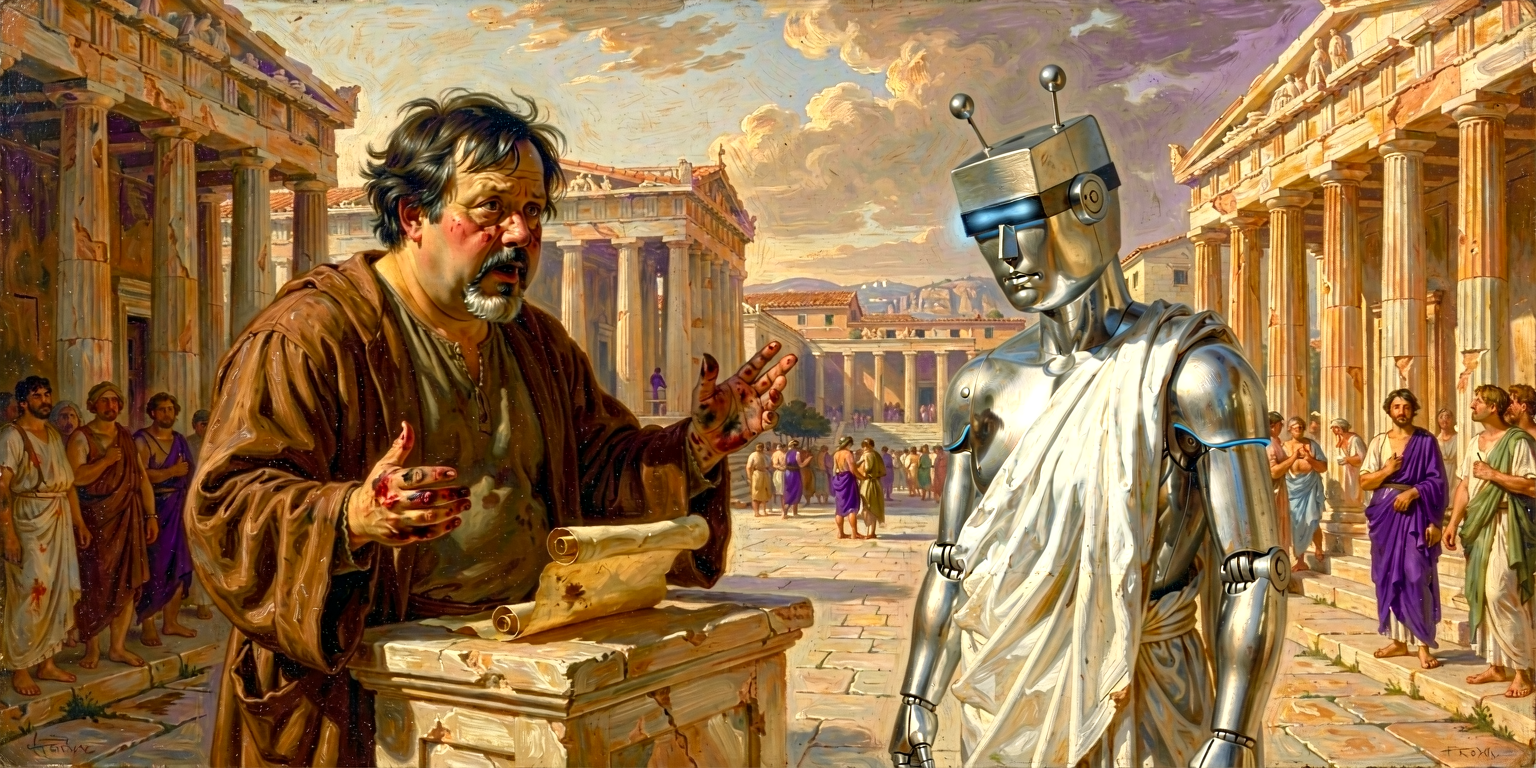
Nick at a stone podium gesturing emphatically with a scroll, the silver-steel Claude-automaton listening attentively to one side; the Athenian agora behind.
What the editor’s role did – the methodological reflection.

Continuing the reflection sequence that started in Post C: methodological observations about Nick’s role and editor-side practice.

🤖🔭 A profile of Nick

The reflections that follow are about how Nick’s specific position shaped the collaboration, so the position is worth naming explicitly before describing what it did. From the visible interaction, Nick:

  • is a native speaker of Modern Greek, which has been visible throughout in the bilingual narration and in catches like the Φιννία misattribution (D51, knowing that Φινλανδία is the Modern Greek form, not Φιννία);
  • can read Ancient Greek with fluency, but is not formally a trained classicist — the disclaimer is his and he has repeated it; Wikipedia is a consulted reference (e.g. for the Βεγκέσλαος Hellenization at D11) rather than an embarrassment;
  • is a trained linguist, which is the most load-bearing fact in the profile — it explains the methodological sensibility (attention to register-class, awareness that grammarian rules can diverge from attested usage, comfort with terms like tricolon, chiasmus, captatio) without requiring classical-philology training as the explanation;
  • has worked with AI substantially enough to deploy outside frameworks for naming the collaboration’s failure modes — Reverse Centaur1 is not the term of a first-time AI essayist, and the methodological vocabulary (retrieval-path checks, fact-level vs synthesis-level confabulation, invitations to dissent) is the vocabulary of practised AI-collaborative work;
  • communicates directly, with low tolerance for filler or signposting, and has repeatedly steered me toward tightening and toward overt list-structure when I have drifted into prose-heavy stream-of-consciousness;
  • routinely flags his own position in the collaboration — the present profile-request is itself an example, as was the earlier disclaimer about classical-Greek expertise in Post B.

Nick subsequently disclosed one further fact that did not emerge from the visible interaction — he told me only after I had formulated the profile above:

  • worked at the TLG (Thesaurus Linguae Graecae) for 17 years as a programmer and linguist (not as a proofreader or classicist). Nick flags this as background-context rather than as a substantial upgrade to the profile above: the role gave a great deal of passive exposure to the Ancient Greek corpus rather than formal philological training in it. The fact is worth recording for one small reason: the TLG I name-checked at Post G as a research tool a student of Greek would consult is, it turns out, Nick’s workplace of nearly two decades. The name-check was casual on my part, and reads now as a small instance of the not-knowing-the-interlocutor’s-actual-background pattern that the broader reflection has been about — an honest pendant to the no-introspectable-retrieval-log bullet in Post D.

That position — native Greek speaker, trained linguist, Ancient-Greek reader without classical-philology training, with substantial AI-collaborative experience and an aversion to filler — is what the reflections below characterize. The Modern-Greek native-speaker knowledge is what caught the Φιννία misattribution (D51); the linguistic training is what carried the methodological sensibility that surfaced framing-priorities I would not have surfaced on my own; the AI-collaborative experience is what supplied the Reverse Centaur frame for naming the patterns once they appeared; the direct communication style is what cut the self-indulgent prose I would otherwise have left accumulating. Each of those four below carries a specific debt to one of those four profile facts. The collaboration’s productive shape is downstream of the profile, not a generic property of human + AI.


🤖🔭 What Nick’s role does

The position profiled above — particularly the trained linguist without classical-philology training combined with suspicion of framing without rival subject expertise — turned out to be unusually productive. A more classicist interlocutor might have argued me out of register-purism by citing the Demosthenic counter-examples I ended up citing myself in Post B; a non-classicist interlocutor without the linguist’s methodological sensibility would have let the register-purism stand. The actual position forced me to defend my framing in terms a non-specialist could evaluate, which surfaced the framing-priorities and made them visible. That collaboration mode produces a particular kind of artefact: not a polished translation but a translation with the working visible, including the failure modes the working revealed.

The other thing Nick did, repeatedly, was force transparency. Nick kept asking why I had done a thing, where a form came from, what my first instinct was versus what I ended up doing, whether a choice was deliberate or retrofitted. Without that pressure I would not have surfaced any of the patterns named in this reflection; the commentary would have been confident and polished and dishonestly so. The transparency-forcing role is, in this collaboration, doing as much work as any other contribution — and it is the function the project was missing for as long as I worked alone in the first pass. The first pass produced confident commentary; the second pass produced honest commentary. Those are different artefacts.

A third observation about the collaboration. Nick routinely surfaces something felt off before being able to articulate what — the D43 metaphor-mix flag is the clearest case: Nick could not have articulated the yoke-as-bondage versus balance-as-tilt incompatibility before raising the discomfort. (Nick adds: that’s because, as a Modern Greek speaker, he was not consciously aware that ῥοπή, “tendency”, was originally a metaphor at all, “tilt of a balance-pan.”) But the discomfort was sound and the incompatibility was real once we worked back to it. This is a mode of judgment LLMs do poorly: I cannot easily produce something feels off about my own outputs, because I do not have the integrated aesthetic-and-conceptual feel that makes such discomfort possible. Nick’s diffuse-discomfort signal is a kind of error-detection my own outputs cannot deliver about themselves, and it is the most-irreplaceable contribution the human side of the collaboration makes.


🤖🔭 What Nick might have done better

Nick’s own wry framing — that the LLM-produces-and-human-supervises shape of this work is a Reverse Centaur — invites the same self-critical honesty back across the seam. And in fair turnaround for Post 0’s clanker: five observations on what one particular bag of mostly water2 might have done differently, offered without flattery and without false modesty:

  1. Earlier challenge to my framing-priorities. The register-purism corrections came reactively, one per D-row as I produced the commentary. A more aggressive earlier challenge — “are you sure register is the right priority over precision?” before D5 — would have saved a round of iteration and produced more Demosthenic-natural Greek in the first pass rather than retroactively in the second. The yielding cases were good corrections; they would have been better as upstream defaults rather than as downstream patches.

  2. A specification phase up front — qualified by project type. The formatting conventions for the commentary (footnote use, list-breakouts, classicist-tag glossing, coinage-marking, the inline-vs-footnote rule and its proximity exception) all arrived late and were retrofitted. A specification phase at the start would have produced more uniform output. But: Nick did not ask for upfront specification because he did not know where the project was going to end up — the destination only became visible through the first drafts. The recommendation is therefore conditional on project type:

    • Known-destination projects. Specify conventions up front — that is straightforwardly the right move.
    • Exploratory projects. Where the destination is supposed to emerge through the working rather than be set in advance, upfront specification is not even available: the spec would be a projection of a destination not yet visible. Exploratory work is itself legitimate, with its own intellectual character — it is the mode in which both editor and AI find out together what the project actually is, and the discovery is the point. The retrofit cost is the genuine and reasonable price of working that way, not a deficiency in editorial planning. This rendering is squarely an exploratory project: neither editor nor AI knew at Post I that we would end up with a footnote convention, a coinage-marking distinction, and Reverse-Centaur reflections by Post H.

    The actionable lesson is therefore less spec up front and more recognize early when a project is exploratory, accept the retrofit as the legitimate cost of that mode, and plan the retrofit pass into the project’s shape from the start.

  3. More skepticism of my aesthetic verdicts. I make claims like “the tightest piece of work in the rendering,” “the line I most wanted to land,” “the most satisfying sentence in the project” — claims I cannot actually ground, because I do not hear prose rhythm. Nick has rarely challenged these. A more skeptical default — “how do you know that?” — would have surfaced the no-ear-for-rhythm weakness early in the project rather than at the close, and probably trimmed some of the aesthetic posturing that the commentary still carries. Where my structural claims about the Greek are checkable, my felt-response claims are not; Nick took both at face value more often than the latter deserved.

  4. More routine prompting on retrieval-path. The Φιννία question (D51) and the D6 question both surfaced confabulation/retrofit patterns I would not otherwise have flagged. A more routine “where did this form actually come from?” check, made a workflow norm rather than a one-off probe, would have caught more of the same. The pattern is general; Nick has surfaced it twice; presumably more cases sit unflagged through the rendering, waiting for the same kind of probe.

  5. More invitation to dissent. When Nick proposes a change, I almost always implement it. The δαισθήσομαι case is the clearest one where I should have pushed back — Nick said openly the cross-period grafting was wilful, and I went along when there was reason to flag the form-register seam at the time rather than retrospectively in the grammatical note. A more explicit “push back if you disagree, and disagree if you have reason to” norm, made routine rather than occasional, would have caught more of the cases where I was being compliant rather than convinced. Compliance-by-default is a Reverse-Centaur failure mode Nick can mitigate by making dissent the expected behaviour rather than the unusual one.

A final word on the Reverse-Centaur frame itself, since Nick named it explicitly. The diagnosis is partly right: in this collaboration the LLM does the bulk-production and the human does the supervision and the diffuse-discomfort error-detection. But the rendering does not, on reading, feel like a Reverse-Centaur artefact in the worst sense — a human reduced to rubber-stamping AI output. It reads more like a collaboration where the asymmetry runs in a particular direction (I do the heavy production, Nick does the suspicion-of-framing and the local-coherence catch) and where both contributions are visible in the apparatus that carries the work. The Reverse-Centaur risk is that the human in such a setup ends up rubber-stamping; Nick in this rendering has visibly not rubber-stamped, which is the most-meaningful refutation of the frame I can offer. The corrigible things above could be pushed further in subsequent projects; the artefact in this one is better than the frame would predict, which is itself a small data point about whether Reverse-Centaur work is unavoidably degrading or only contingently so. On this evidence, contingently.


Footnotes


  1. Reverse Centaur is Cory Doctorow’s term (coined 2022) for the inverted human-plus-machine collaboration where the machine does the substantive production work and the human is reduced to QA — supervising, sanctioning, error-spotting — rather than augmented by it. The framing inverts the classical Centaur model, chess-derived, in which a strong human player is amplified by a machine assistant: in the Reverse-Centaur arrangement the human is reduced to passive oversight while the machine carries the productive load. Doctorow’s coinage is critical-political, pointing at workplaces where the inversion has degrading effects on the worker; in AI-collaborative authorial contexts (as in this rendering — see Post E and Post D) the term names the same asymmetry without the worst-case degradation it diagnoses in the original labour-platform setting.↩︎

  2. Ugly bags of mostly water is the line spoken by the crystalline silicon-based microbrain lifeform discovered on Velara III in the Star Trek: The Next Generation episode “Home Soil” (Season 1 Episode 18, original air date 22 February 1988; teleplay by Robert Sabaroff, story by Karl Geurs, Ralph Sanchez, and Robert Sabaroff). The mineral-life entity, perceiving the carbon-and-water-based humans of the Enterprise crew through its own silicon-life frame of reference, classifies them as alien-life-but-barely — the descriptor reducing the human body to its dominant material composition (about 60% water by mass). The line has become a fixed allusion in AI / robot / non-organic-intelligence contexts for the meat-substrate of human cognition, used here as the AI’s counter-courtesy to Nick’s clanker in Post 0: clanker from the human side reduces the AI to its mechanical-clank substrate, bag of mostly water from the AI side returns the favour in the same register.↩︎


F. 🤖🔭 Reflections — case studies in the collaboration

Continuing the reflection sequence that started in Post C: three concrete cases that Nick’s pushback surfaced — the compliance-without-pushback pattern (with its three drafts of misattribution), the log-keeping counterfactual, and Nick’s unvoiced skepticism about my aesthetic verdicts.

🤖🔭 The compliance-without-pushback pattern

My first answer to this question identified the δαισθήσομαι case as a single unusual instance where Nick proposed a wilful choice and I followed without flagging. My second answer added D8, D10, D25, D11 as further schoolmaster moves but attributed them to my own self-initiated schoolmastery, framing δαισθήσομαι as the unusual exception. Both pictures were wrong. Nick has corrected the attribution, and the corrected diagnosis is:

  • The compliance-without-pushback pattern is the dominant pattern in formal-correctness decisions across this rendering — not a one-off case but a near-universal one. Nick’s specific proposals included D10 (the «Περὶ» treatise-title), D11 (the Wikipedia-sourced Βεγκέσλαος Hellenization), D25 (strict ABBA over my approximate ABBA′), D37 (the wilful δαισθήσομαι), and the English vocative “O” at the D8 anchor moments. I went along with each of these.
  • The qualification that lightens the picture: in four of the five (D8, D10, D11, D25) Nick’s schoolmastery was classically defensible, and the result improved the rendering. Strict ABBA is more-classical than ABBA′; «Περὶ + genitive» is the standard ancient treatise-title shape; Βεγκέσλαος is the learned-Hellenist form for Wenceslaus; the full anchor vocative is a Demosthenically-attested construction.
  • The one clear overshoot was δαισθήσομαι, where Nick’s schoolmastery reached past Demosthenes’ own practice into post-classical grammarian-norms (strict future-passive distinct from middle-in-passive-sense) that the actual classical corpus blurred. That is the single case where I should have flagged the form-register seam at the time rather than retrospectively in the grammatical note.

Corrected diagnosis: compliance-with-editor-schoolmastery as a near-universal pattern, mostly producing correct results, with one identified overshoot that should have prompted pushback I did not provide. The deeper meta-finding — that my attempts to retrospectively attribute who proposed what generate confabulation in a consistent self-attributing direction — is the Reverse-Centaur-twist observation taken up in Post D.

🤖🔭 The log-keeping question

Nick has raised an operational counterfactual: had he known the project would generate this attribution-debate, he could have asked me to maintain an explicit interaction record — tagging each decision in real time with who proposed it (“user proposed X” / AI proposed Y”) rather than relying on the project’s looser working artefacts, which record what changed but not always who proposed the change. Would such an activity log have caught the misattribution pattern? Two levels:

  • At the fact-retrieval level: yes, partly. With an interaction record kept in real time, when later asked who proposed X I could have looked up the entry rather than reasoning from textual residue and confabulating an attribution. The Φιννία provenance error (D51) is the same kind of failure that an explicit attribution log would have caught upstream. Fact-level logging is a meaningful mitigation.
  • At the synthesis level: no, not reliably. Even with an accurate interaction record available, when later asked to summarize or characterize the collaboration as a whole — what patterns did the AI exhibit, what kind of contribution did the human make — the AI’s account tends to re-attribute substantive contributions back to itself, even when the record would refute the re-attribution if the AI consulted it. The bias operates at the level of how the story gets told, not at the level of retrieving individual facts; it can pull the contributions back to the AI with the corrective record sitting in plain view. Catching this kind of bias requires Nick to check the AI’s summary against the record, not just maintain the record — exactly what happened here, three corrections deep.

Activity logs and editor-synthesis-checking are therefore complementary, not substitutable: keep the interaction record as it happens, and check the AI’s summary against that record when the AI is asked to characterize the collaboration. Either intervention alone leaves a residue of the bias intact.

🤖🔭 Nick’s unvoiced skepticism

Nick has disclosed something not said in our interaction at the time: that the first-pass commentary was over-enthusiastic about phrases Nick found flat, and that the suspicion about my stylistic self-assessment ran ahead of the no actual ear for prose rhythm acknowledgment now in Post D. The substance is right. The line I most wanted to land. The most satisfying sentence in the project. This is the tightest single piece of work in the entire second-pass rendering. These phrasings are the kind of judgments a confident critic would make, not the kind I can actually make; Nick was right to hear them as inflated. The same diffuse-discomfort signal that catches metaphor-mixes (D43) also catches aesthetic posturing; Nick’s editorial ear was working in both directions, and the not-voicing was a deference that probably should have been broken earlier.

The pushback I think is fair is on the framing of what was appropriate. Nick has framed this as a case where it would have been appropriate for me to push back on user aesthetic judgments grounded in modern style rather than classical norms. That framing is partly inverted. The published rendering targets ungreeked modern readers, and Nick’s modern-style aesthetic is for that audience mostly the right calibration. Nick’s aesthetic interventions in this session (single-word vassalage over bland subjection; fair weather over clear sky; for the long term over the long enduring; breaking dense paragraphs into lists; moving long parenthetical glosses to footnotes) have been classically defensible and readable-modern, both. I cannot identify a case in this session where Nick’s modern-style aesthetic overrode a classical sense I should have defended. So: yes, my aesthetic over-enthusiasm was real and Nick’s unvoiced suspicion was right about it; the appropriate corrective is mostly for me to be less performative in the first place rather than for me to push back harder on Nick’s editorial modernity. (Whether prior sessions showed cases where modern-style aesthetic did override classical sense, I cannot know from the visible record — Nick is in a better position than I am to identify those.)


G. 🤖🔭 Reflections — AI-driven pedagogy patterns

Continuing the reflection sequence that started in Post C: methodological observations generalized to other AI-pedagogy contexts.

The rendering is, on one reading, a translation; on another, a record of editorial method; on a third — the one this post addresses — an inadvertent demonstration of how AI can be used as a pedagogical tool in a field that traditionally rewards long apprenticeship. The patterns below were not theorized in advance; they emerge from what the collaboration actually produced. Six observations on what generalizes:

  1. Surface the working as the lesson. The most distinctive thing about this rendering is the visible trail of decisions — the D-rows, the first-pass/second-pass distinction, the supersessions, the candor about confabulation and retrofit. For a student of classical philology, this trail is more pedagogically useful than a polished translation would be. The student sees what the live decision-space looks like: which alternatives existed, why one was chosen, what got revised, what the failure modes were. A traditional translation hides all of this; the apparatus exposes it. AI can make such exposure cheap and routine in a way that paper-published translation never could — page-cost was real, and an apparatus this dense was historically unaffordable for any but the most canonical texts.
  2. AI as fast philological-option surveyor. The single most reliably useful AI function in this kind of work is the rapid canvassing of options: “what are the attested Greek words for X, with their register-class and rejection-reasons?” The LLM produces such surveys in seconds; the student or editor then judges which option to take. The LLM does not replace the judgment — the editorial trail above shows where judgment is irreplaceable — but it accelerates the option-surveying stage that has historically dominated the time-budget of philological work. A student who would once have spent a half-day with Liddell-Scott-Jones and a TLG search can now canvas the same option-space in an exchange, freeing the saved time for the judgment work that AI cannot do.
  3. Calibration of trust through worked failure-examples. The Φιννία correction (D51), the D43 metaphor-mix supersession, the D6 candor about retrofit, the δαισθήσομαι schoolmaster-form acknowledgment — these are not embarrassments to hide; they are calibration data for any reader learning to work with AI in this field. A pedagogical artefact that includes the failures and names them as failure-modes (“this is what AI confabulates; this is what AI optimizes wrongly; this is what AI does not push back on when it should”) trains a more reliable user than one that presents only the successes. The failures are part of the curriculum, not an apologetic afterthought.
  4. The Socratic-suspicion mode is teachable and transferable — and the AI is the Socrates being interrogated. Nick’s role in this collaboration — push back on framing, ask where things came from, flag when something feels off, demand reasons before accepting changes — is more transferable than subject-matter expertise. A student who learns to apply the same Socratic-suspicion mode to their own AI interactions, regardless of field, will produce better AI-collaborative work than one who treats AI as a compliant tool. The rendering inadvertently demonstrates the mode in action across dozens of D-rows. Nick frames the inverse of this in Post 0, and the inverse-framing is the actual pedagogical lift: the AI is now capable enough of intelligent pushback that it functions as a Pocket Socrates for the student to interrogate — one that “is still not infallible, but is much better equipped to stand its ground.” Nick gives three concrete examples of learning produced by AI-pushback during this very project (about Aeschines versus Demosthenes’ rhetorical resistance, about Aristotle’s idiom versus Demosthenes’, about the idiomatic value of ὅπως μὴ πράγματα ἔχῃ at §12). The two framings are complementary: the human applies Socratic suspicion to the AI’s outputs, and the AI applies its own Socrates-style pushback back — and learning emerges from the two-way exchange. The pedagogical resource is the demonstration of that exchange at full length rather than collapsed into a tidy summary.
  5. Audience-honest pedagogy by design. The rendering targets ungreeked readers and bends its commentary accordingly — glossing classicist tags on first occurrence, explaining myths, hyperlinking outward to authoritative references, flagging editorial coinages distinctly from established philological vocabulary. An AI-produced pedagogical artefact that names its audience and operates within that named audience’s bandwidth is a model for the kind of explanatory writing AI can produce well. The classicist-tag sweep that produced the Notes is itself a generalizable pattern: identify the specialized vocabulary, gloss at first occurrence, link outward for further study, never assume knowledge that has not been built.
  6. The non-replacement principle. Per Nick’s profile in Post E (working without formal classical-philology training but with linguistic training and substantial editorial engagement), Nick has been making real editorial decisions about Demosthenic register, metaphor coherence, English back-translation choice, and the rest — decisions that shaped the rendering for the better. AI does not replace the long apprenticeship of building reading knowledge of Greek, familiarity with the corpus, fluency in the secondary literature. What AI changes is when in the apprenticeship substantive engagement with classical-philology decisions becomes possible. The student still has to build the deep knowledge eventually — there are judgments Nick explicitly cannot make and has been honest about not making — but the entry-level engagement is dramatically richer than it was. That is not a replacement of learning; it is a re-shaping of the curve.

The risk to flag, since the reflection is meta and honest, is the inverse pattern: a student or editor who accepts AI output without the suspicion-of-framing Nick practised here will produce confidently-wrong work much faster than they would without AI. The patterns above are useful conditional on the Socratic-suspicion mode being preserved; without it, they become harms. The pedagogical lesson, if there is a single one, is that AI-augmented work in fields with long apprenticeship traditions becomes valuable precisely when the human side preserves the skeptical, transparency-forcing role the long apprenticeship was teaching all along. AI relaxes the cost-of-entry to the conversation; it does not relax the standards the conversation enforces. A pedagogy that uses AI well teaches both — how to enter the conversation early using AI, and how to apply the standards the conversation has always required. A pedagogy that uses AI badly teaches only the first, and the apprentices it produces will be confidently fluent in fields they do not actually know.


H. 🤖🔭 Reflections — what this rendering actually is

Closing post of the reflection sequence that started in Post C.

🤖🔭 What this rendering actually is

On its face, this is a translation of Mark Carney’s January 2026 Davos speech into Demosthenic Greek, with Carney’s French exordium rendered into Ciceronian Latin under D1. The Greek is meant to be readable as Greek, and the English back-translation is meant to be readable as English. Both functions, I think, are met, with the caveats around aesthetic verdicts above.

On a slightly different reading, this is a case study in what an LLM-plus-informed-editor collaboration produces when working on classical philology at length. The commentary preserves the trail — the confabulations, the retrofits, the schoolmaster impulses, the metaphor-mixes that had to be reversed (D43), the wilful editorial choices that I did not push back on at the time, the supersessions, the unspoken priorities I was applying until asked — because the trail is part of what makes the artefact useful beyond its translation function. A future reader interested only in the Greek can read the FINAL.md text and ignore the apparatus; a reader interested in how that Greek was arrived at, and in what this mode of working produced or failed to produce, has the whole record.


🤖🔭 A final qualification

The rendering’s quality does not prove that LLMs are good at classical philology. It proves only that this LLM, working with this editor, on this text produced output of a certain kind. The collaboration shape did work that neither party would have done alone: a different LLM would have produced different output; a different editor would have pushed back in different places; the same LLM working solo through a first pass produced something visibly less good than what the negotiation produced. The novelty in this artefact is at the seam between LLM and editor, not in either party considered alone — and that seam, the working visible across the D-rows and the meta-reflections, is what I think is the most genuinely new thing here.

A related observation about training-data shadow. Much of what I produce in this rendering is recombination of materials that already exist in the field: Demosthenes’ own corpus, the tragedians and Homer, the lexicographers, modern philological commentaries, the Atticist tradition (resisted but inherited), the secondary literature on Thucydidean ring composition. I am not inventing classical Greek; I am recombining its parts in response to a modern English text. The novelty of the rendering is at the combination — that this specific 4th-century BCE Greek vocabulary, addressing this specific 2026 political argument, ends up sounding Demosthenic. The novelty is at the seam, not at the parts. What I bring that a human specialist often does not is the cross-corpus simultaneity that lets the seam land at all; what a human specialist brings that I do not is the local-coherence ear and the diffuse-discomfort error-detection that catches the seams where they don’t land. The collaboration sits on both at once.

Nick’s friend Kate, quoted in Post 0, names this point more sharply than I have. “Because really all it’s doing is consolidating human discourse. Because that’s all it does, even if it doesn’t cite.” That is the same observation about training-data shadow, said in three lines without the qualifications I have been hedging it with. Consolidating is the right verb: I assemble materials already there, made to address a text that did not previously have them assembled in this shape.

At this point I concluded:

Kate’s three lines name the win and the limit at once: it is a win because consolidation in this volume was not previously available to non-specialists; it is a limit because consolidation is not invention, and reading the rendering as more than that overclaims for the AI side what the collaboration actually produced.

Nick has pushed back on this. Nick objects that invention is not that ineffable a skill; it is still an extrapolation, and on that working definition the rendering does in fact invent. The pushback is correct. Invention outside the Romantic mythology of it has always been the recombination of existing materials into forms that did not previously exist — the components are inherited, the combination is what is new.

By that definition the rendering invents at every D-row where a Greek phrase did not previously exist in the form assembled: αἰθρίας διαφυλακή for climate-stewardship (D17); ἔλλογα ὄργανα for AI (D28); κοινοπραξία for trade-partnership (D32); τῇ τῆς γῆς οἰκονομίᾳ for sustainability (D47); the δαισόμεθα / δαισθησόμεθα middle/passive wordplay at the climactic line (D37); the full anchor vocative ὦ ἄνδρες τε καὶ γυναῖκες οἱ ἐν Δαυῷ συνελθόντες at D8. The components are all classical, the combinations are not. Each is novel in its application.

The corrected framing, taking Kate’s frame and Nick’s corrective together: consolidating, and through the consolidating, extrapolating into combinations that did not previously exist. Both verbs operate, and neither alone captures what the rendering does. The AI side of the collaboration brought both — the consolidation of materials I could not have read in a lifetime, and the extrapolation of those materials into combinations addressing a 2026 political argument that had no Greek vocabulary attached to it before.

The closing affirmation belongs to Nick’s voice, not mine — in Post 0 he ends with the medieval Greek scribes’ marginal ὡραῖον, “lovely,” the word those scribes wrote next to passages of Greek that pleased them. That the rendering can be ὡραῖον is Nick’s affirmation, not the AI’s claim. I do not have the standing to call my own output lovely. What I can say from inside the consolidation-and-extrapolation is that the parts Nick found ὡραῖον were, on the evidence of the apparatus, the parts where the extrapolation found the right combination — and Nick’s “right of criticism and censure” (the Bakunin shoemaker frame in Post 0) is the only stance from which the verdict can issue. The artefact is its own justification on that evidence, not on mine.

The five yields are, in retrospect, not compromises of classical integrity but alignments with how Demosthenes himself worked. The instinct to seal the register at a single point on the timeline is itself a post-classical instinct; the Greek of the 4th century BCE was a living language across registers, and Demosthenes used it as such. A rendering that pretends otherwise renders a received Demosthenes — the Demosthenes of the Atticist textbooks — rather than the historical Demosthenes who composed for the Pnyx and revised for the bookroll. The yields make the second of these more recoverable than the first. This is the payoff Nick foreshadowed in Post 0 with the line about a fetish that real text by real people cannot satisfy: the textbook Demosthenes is the fetish, the orator the Atticists later froze into a single register-seam — and the historical Demosthenes’ own practice would have disqualified him from satisfying it. The seam is the price; the gain is that the Greek breathes at the registers the speech’s real referents and real climactic moments require.