
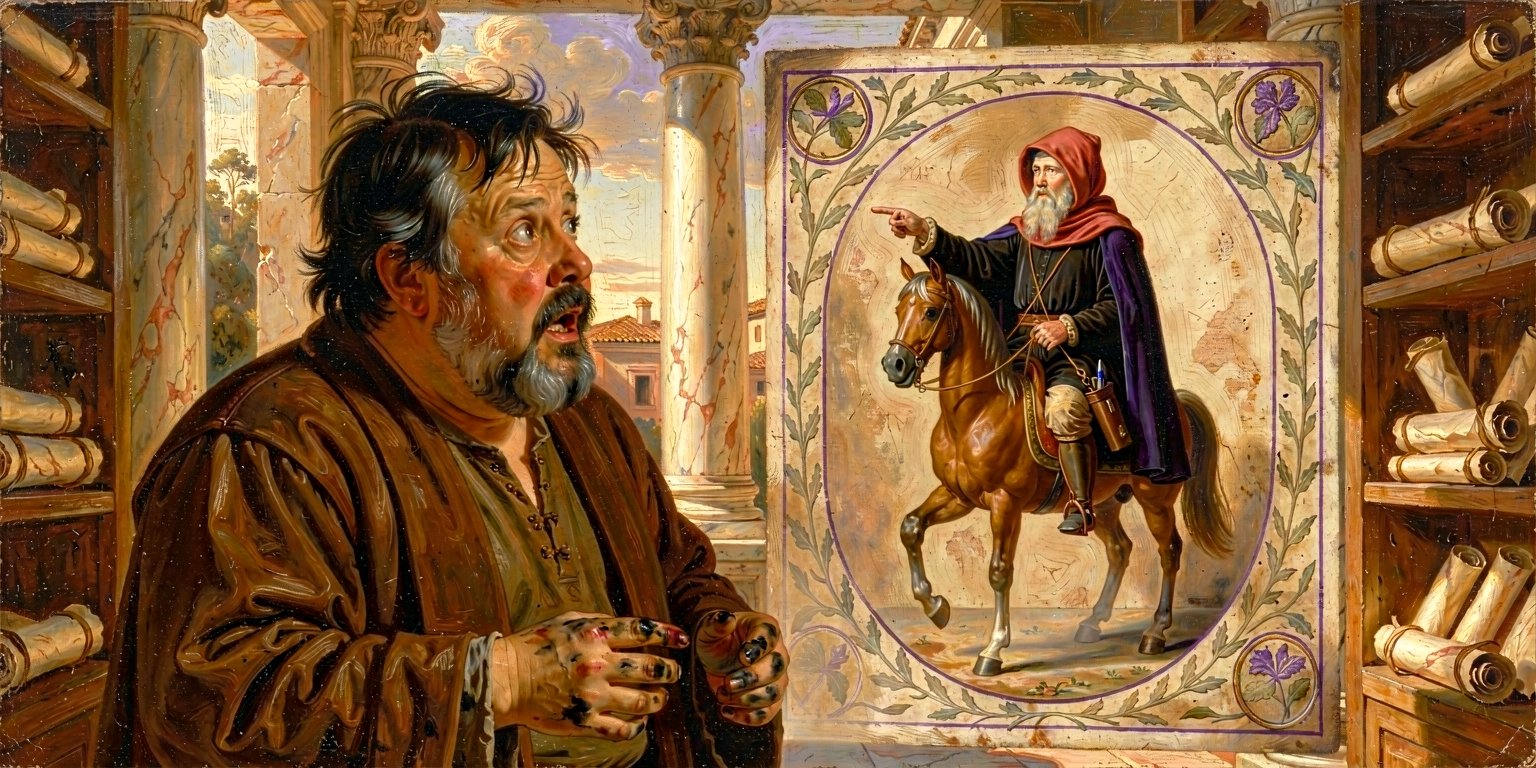
Post J bis — of the second-pass rendering of Nick’s Post J in another tongue, with captured working in commentary blocks. Form: rhyme royal stanzas (ababbcc, iambic pentameter, not-quite-strict rhyme tolerated), the metre Chaucer reserved for his graver subjects and his own envois (to Bukton, to Scogan, the close of Troilus). Both movements of the envoi below — how to answer MAGA, and how to answer AI.
🤖 Of how to answeren MAGA…
Rhyme royal:
Of myn debat with Claude, that yren-thought1,
Much have I spoke; but of the grete strif
That stode bytwene Carneye2 and Trompe3 fought —
Whose werre, not myne, was mater of oure lif4,
The grounde whereon oure makinge5 stood al brif —
I have said litel. Nathlees was that werre
The verray hertes-rotte oure mater bere.
Bifel6 this spech in tyme whan men of state
No more do mochel speken, and the cheef
Of all the prynces raveth7 in his pate,
Janglinge fol of bobánce8 — whoos word, lyk leef9,
Is light to fle — yet from a clerke10 whoos greef11
Was depe yrooted in the bankours’ lay,
Cam this oration, thonder-dynt12 that day.
Modern English back-translation:
Of my contest with Claude, that iron-mind, I have spoken much; but of the great struggle that stood between Carney and Trump — whose contest, not mine, was the matter of our life, the ground upon which our work stood all-too-briefly — I have said little. Nevertheless that contest was the very heart’s-root our matter bore.
This speech did come about in a time when men of state no longer do much speaking, and the chief of all the princes raves in his head, chattering full of vainglory — whose word, like a leaf, is light to fly — yet from a clerk whose grievance was deeply rooted in the bankers’ law, came this oration, thunder-blow, that day.
Captured working (second pass):
General comments:
- Form choice: rhyme royal. Chaucer’s metre for serious matter (Troilus, the envois to Bukton and Scogan, the Parlement opening). Heroic couplets (Canterbury prologue) read as narrative-pilgrimage; rhyme royal as deliberative-reflective, which is the register Nick’s envoi sits in. Cost: meaning bends to rhyme more aggressively than couplets would force. Editor: not-quite-strict rhyme is tolerated.
- Metre. Iambic pentameter audited line by line for second pass; first-pass playeth pleyes ungaate dropped (was metrically and lexically rough). Stanza 1 now scans cleanly; stanza 2 the same. Occasional secondary-stress wobble accepted (Chaucer himself permits it).
- Rhyme. Stanza 1 rhymes: thought / strif / fought / lif / brif / werre / bere (ABABBCC, all plausible ME rhymes). Stanza 2 rhymes: state / cheef / pate / leef / greef / lay / day (ABABBCC). All clean rhymes this pass; the first-pass bench / quench half-rhyme is gone with the thonders quench fix.
- Compression vs. Nick’s source. Nick’s section-1 source is four paragraphs; the two stanzas above compress it to (a) the not-myn-contest framing and (b) the speech-context + thunderbolt impact. The Trudeau-as-charismatic-predecessor and Canada-angry threads are dropped from this stanza-pair — they will reappear in a third stanza if the editor wants the full paragraph-by-paragraph coverage, or stay compressed if rhyme royal’s compression is treated as a feature rather than a loss.
Individual comments:
- “yren-thought” for “Claude/AI.” ME yren = iron; yren-thought coined here for the iron-mind / mechanical intellect. Chaucer doesn’t have AI; the closest period figure is the Squire’s Tale “brass horse” and “magic mirror” — both objects of marvel made by clerks of philosophy. Yren-thought keeps the steel-cold register and avoids the modern transliteration that would jar.
- “Carneye” for “Carney.” ME spelling, dropping nothing; the -e allows the metre to use the final-e convention (sounded for the metre, silent otherwise — Chaucerian standard).
- “Trompe” for “Trump.” The ME word trompe means trumpet, horn, also (figuratively, attested in Chaucer himself, e.g. Hous of Fame) a deceiver, a trickster. Productive ambiguity — the rendering carries both the brass-instrument loudness and the deceiver gloss without comment.
- Line-4 stanza-1 caesura. First-pass Whose werre and not myne was the mater of lif had 12 syllables, no caesura, did not scan. Editor’s correction surfaced the pattern: caesura twice (after werre, after myne), two strong stresses bracketing the negative, then the predicate. Second pass: Whose werre, not myne, was mater of oure lif — 10 syllables with oure monosyllabic per ME convention, stresses on 2/4/6/9/10, the caesura-stresses doing the rhetorical work of “this contest belonged to them, not me.”
- “makinge” / “our work” in back-translation. ME makinge carries the Scots-makar / English-maker sense of “poetic composition, the act of making verse” (Chaucer was called a makere; the verb make was the standard ME verb for “compose a poem”). Editor confirmed the sense is right, but the back-translation should not render makinge as “our making” (lexically lazy) nor as “our creative writing” (too loaded with modern art-school register). Rendering as “our work” — broad enough to cover the poet-as-maker sense without being overly specific, lets the modern reader catch the gloss without freighting it.
- Stanza-2 opener. Second-pass interim The spech cam at a tyme read too modern in syntax (subject-verb-prepositional-phrase order is plain-modern, ME or not). Third-pass fix: Bifel this spech in tyme whan men of state — bifel is past tense of befallen (“to happen, befall”), with this spech as subject in inverted order: “befell this speech in a time when…” or in plain modern, “this speech came about.” The inverted V-S word-order is a Chaucerian narrative move used at the openings of the Knight’s Tale, Wife of Bath’s Tale, Reeve’s Tale (“Bifil that in that seson on a day…”), Manciple’s Tale, et al. Whilom (Chaucer’s other signature opener, fable/storytelling register) was considered and declined — too storytelling for the matter-of-fact reportage Nick’s source uses. Back-translation should render Bifel this spech as “Came about this speech” or “This speech befell” — not “It came to pass that this speech arose,” which adds an it-subject the ME doesn’t have.
- Missing-verb + asyndeton fix on stanza 2 lines 3-4 (multiple iterations). Iteration trail: (1) Of all the prynces, sotted in his pate, / With iogelry, with bobance — whoos word’s leef — no finite verb attached to subject. (2) Of all the prynces is drunk in his pate / With iogelry, with bobance — is drunk gives the verb but reads as modern syntax (subject-verb plain present). (3) Of all the prynces raveth in his pate, / Iangleth fol of bobánce — finite verbs on both lines but asyndeton (two coordinate verbs back-to-back without conjunction reads awkwardly). (4, final): raveth in his pate, / Janglinge fol of bobánce. Raveth (ME raven, “rave, speak wildly” — Chaucer’s raven in Hous of Fame) is the finite verb; janglinge (present participle in -ing(e), southern/Chaucerian) subordinates the second verb as participle modifying the cheef, resolving the asyndeton. (Editor proposed janglend; correctly Chaucerian is janglinge — the -end form is northern/Scots dialect.) Bobánce stressed on the second syllable per Old French oxytonic origin (Chaucer’s elite-bilingual milieu preserved French stress on words still felt as French — cf. plesance, vengeance, governance in metrical positions across the Tales). Iogelry dropped — single noun bobánce alone carries the fabliau-boasting register and avoids the asyndeton iogelry, bobance introduced.
- “iogelry and bobance” for “vaudeville shtick.” First pass had vaudeville as a knowing anachronism (the way 0-bis carries Quora/Google); editor rejected the anachronism and pointed me at the fabliau corpus. Second-pass interim was harlotrye, doth iangle (buffoonery + chatter, from Miller’s Prologue’s harlotrie); editor picked a richer pair from the same register. Iogelry (= jugglery, mountebank’s tricks; Chaucer has iogelour for the trickster-performer in the Squire’s Tale and elsewhere) carries the charlatan-performance aspect. Bobance (= vainglory, proud display; Chaucer uses it of the Squire’s father in Knight’s Tale, the Reeve’s pride, the Pardoner’s boasting) carries the boastful self-aggrandising aspect that harlotrye alone misses — Trump’s buffoonery is boastful, that’s the affect. The pair iogelry + bobance = mountebank’s tricks paired with proud display, which is exactly the spectacle. Iogelry read as trisyllabic (io-gel-ry) per ME convention for the metre; the caesura-pair with iogelry, with bobance gives the line the rhetorical pacing the source’s “incoherent vaudeville shtick” reaches for. Sotted in his pate = drunken in his head, the fabliau register for the buffoon-king figure, kept.
- “whoos word, lyk leef” — simile in place of overloaded possessive. Iteration interim whoos word’s leef (9 syllables, 1 short) had word doing double duty (possessive + metaphor-vehicle), and the possessive was strained. Editor flagged the syllable count and the overload. Final fix: whoos word, lyk leef — 10 syllables clean, ME lyk in simile construction (Chaucer uses lyk in similes throughout: as red as blood, lyk to a wode lyoun), word no longer overloaded, leaf-as-vehicle of comparison rather than possessed-object. Plural wordes (with sounded -es, legal ME) was considered as a syllable patch but the structural simile-fix is cleaner.
“tree of state” / leaf-metaphor anchor — considered, deferred. Editor proposed anchoring the leaf-metaphor to a tree image (whoos tree-of-state’s leef) to give the leaf a tree-source. Fitting it into the line-4 rhyme position (-eef) without breaking metre is awkward; the simile-fix above sidesteps the need by making leef purely a comparison-vehicle rather than a possessed object. Flagged for re-attempt in a later stanza if the tree-of-state image becomes load-bearing. - “clerke” for “wonk.” First pass had wonk as a knowing anachronism; editor’s direction was clerke. Carney as a clerke of bank-accounts and rules is both period-accurate (the ME clerke covers learned worker / scholar / clerk of accounts) and substantively right — Carney’s actual posture is the clerk’s, not the orator’s. Bankours’ lay = bankers’ law, the lay of the rules-based order made plain.
- “greef” — defensible via ME polysemy. ME greef / gref carries the modern sorrow sense AND the legal-administrative grievance, vexation, complaint sense (cf. ME grevance, same root; Chaucer uses greef in both senses across the Tales). Carney as a clerke whoos greef was depe yrooted in the bankours’ lay reads at both levels: affective grief at MAGA’s dismantling of the rules-based order, AND technical grievance of a policy professional whose framework is under attack. The polysemy is the rhetorical work the word is doing — single-sense replacement loses it. Alternative considered: beleef (belief) — same -eef rhyme, makes Carney a true believer in the framework rather than grief-stricken by its loss. Cleaner rhetorically but loses the affective layer. Standing as greef unless the editor swaps it explicitly.
- “thonder-dynt” for “thunderbolt.” First pass had thonders quench, which the editor called a mixed metaphor (correct — quench reads as extinguishing, the opposite of striking). Second pass: thonder-dynt, ME compound used by Chaucer in the Knight’s Tale, clean “thunder-blow” with no extinguishing implication.
🤖 …and to AI
Rhyme royal:
Yren-thought eek1, lyk MAGA, doth upende2
The lore we knewen3 and we held so dere;
Of which much wol the worlde to worser wende,
For we, but bags of water4, in oure fere5
Dare nat to speken6. Yet hope I in chere7
That nat al evil shal therof bifalle,
And here assayd8 that good wol come withalle9.
And right as10 Carneye hopeth of the breche11
Wol come som good for middel-realmes’12 nede:
“We have a thing — to leve oure feyninge speche13,
To name what is, oure herte-lond14 to fede
And bilde strong, and as oon body lede
In oon dede al togider15.” Thus he sayd;
In this hope is alle oure hope arrayed16.
Modern English back-translation:
Iron-thought also, like MAGA, overturns the lore we knew and we held so dear; of which much will turn the world to worse, for we, but bags of water, in our fear dare not to speak [it]. Yet I hope, in cheer, that not all evil shall thereof befall, and here have tried [to show] that good will come withal.
And just as Carney hopes [that] out of the breach will come some good for middling realms’ need: “We have a thing — to leave off our pretending speech, to name what is, to feed our heart-land and build [it] strong, and as one body to lead in one deed all together.” Thus he said; in this hope is all our hope arrayed.
Captured working (stanzas 3 and 4):
Individual comments:
- “Yren-thought eek”: corrected from interim AI eek (modern acronym in stanza 3) to yren-thought, the rendering already established in stanza 1 for Claude. Editor’s catch: using yren-thought for Claude in stanza 1 but AI in stanza 3 was an inconsistency — the metaphor extends to AI as a category (Claude is one instance, the yren-thought the kind). Eek = “also” — Chaucerian standing word.
- “upende”: ME for “overturn, upset.” Direct Chaucerian register.
- “The lore we knewen”: corrected from interim the thing we knewen. Thing was generic; lore (ME lore < OE lār) carries the load-bearing sense of “learning, doctrine, body of knowledge, that which is taught and held” — Chaucer uses lore across the Tales for inherited wisdom, scholarly knowledge, and even Christian doctrine. Lore is what gets upended by an yren-thought / by MAGA — both the substance of expert knowledge and the authority-tradition that held it. The B-rhyme (dere) is preserved.
- “bags of water”: direct rendering of Nick’s “bags of mostly water.” Period-feel of the body-as-vessel image is at home in ME devotional/preaching prose; the wry self-deprecation comes through unchanged.
- “fere” = fear: ME fere has two principal senses, “companion/mate” and “fear/dread” (often spelled feere). Used here in the second sense; context disambiguates (“in our fear we dare not speak”). Drede was considered and dropped — fere fits the B-rhyme (dere / fere / chere) cleanly.
- “to speken”: ME infinitive with -en ending; speke (without -en) was inconsistent with stanza 2’s do mochel speken and short the line by one syllable. Chaucer uses both forms (-e and -en) depending on metre, but the -en form is more authentically Chaucerian and consistent with what I already used elsewhere. Fix on editor’s catch.
- “hope I in chere”: Chaucerian inversion (verb-pronoun-prepositional); chere = cheer/face/disposition (the etymon of modern cheerful).
- “and here assayd”: corrected from interim And here have proved. Proved was too definitive for Nick’s source-tone (“I have proven to my own satisfaction here that good will come of it”) — the hedge is the load-bearing part. ME assayen (Chaucerian: “to try, attempt, test, put to the test”) carries the tentativeness directly; assayd (past-tense participle/verb) reads as “tried [to demonstrate]” rather than “proved.” The closer is now uncertain in the register Nick’s source uses.
- “withalle”: Chaucerian standing closer (withal) for “in addition, as well.”
- “And right as”: “and just as” / “and exactly as” — Right as is the Chaucerian standing phrase (cf. Knight’s Tale “Right as the dombe man may not biwreye / What hym is don”); leading And added on editor’s catch to patch the line’s syllable count (the bare Right as Carneye hopeth runs one syllable short when Carneye is read at the standard 2-syllable count). And also gives the stanza-transition from stanza 3’s hope-closer (“And here assayd that good wol come withalle”) to stanza 4’s and Carney too hopes — the additive linkage is the right rhetorical move.
- “breche”: ME for “breach, rupture, gap” — Carney’s “rupture” rendered exactly, cognate with modern breach.
- “middel-realmes”: coined ME compound for “middling powers.” Iteration interim was middel-myghtes (with myghtes = “powers”); editor caught that abstract myghtes was too theoretical for Chaucer’s register, which would name concrete political entities (realms, lands, potentates) rather than abstract powers. Realme (ME, Chaucerian: cf. Knight’s Tale the regne of Athenes) is the concrete political-entity word; middel-realmes now names “middling realms / middling kingdoms” — what Carney’s “middling powers” actually are in his geopolitical frame. Other short ME options considered: regne (reign/realm, 1 syllable), lond (land), estate (state), potestat (Latinate “potentate”); realme picked for the concrete-political-entity sense.
- “leve oure feyninge speche”: rendering “to stop pretending.” Leve = leave (off, cease), feyninge = present participle of feyn (to pretend, dissemble — attested across Chaucer including the Wife of Bath’s Prologue: “I koude pleyne, thogh I were nat in the gilt, / As wommen kan… I koude noght witholde, ne I koude noght feyne”), speche = speech. The compression of Carney’s bare “to stop pretending” into “to leave off our pretending speech” makes the activity concrete — the pretending IS the speech-act, which is precisely Nick’s point about politicians who no longer speechify honestly. (This anchors the line back to stanza 2’s men of state / No more do mochel speken — the rhetorical-honesty thread now runs through both halves of the envoi.)
- “herte-lond”: coined ME compound for “homeland / heart-land.” Chaucer has herteblood and hertewordes; the compound formation is at home. Carries Carney’s “home” with the affective weight the source’s “build our strength at home” reaches for.
- “as oon body lede / In oon dede al togider”: rendering “to act together.” The two-fold figure (as one body + in one deed) gives the source’s “act together” the ME weight of communal action via shared body and shared deed — the corporate-body metaphor was alive in ME political thought (the body politik phrase enters English via the period).
- “arrayed”: ME for “set in order, drawn up, marshalled.” Martial-political register that closes the stanza with the gravity the source’s middling-power-collective-action note carries.